
The Domestication of the Horse: A Historical Introduction for Beginners
- Horse Education Online

- Jan 7
- 5 min read
Updated: Feb 23
The domestication of the horse was not a single moment in time, but a gradual process that unfolded over thousands of years and across multiple civilizations. By tracing when, where, and how horses transitioned from wild prey animals to domesticated partners, we gain critical insight into both human history and the biological and behavioral foundations of the modern horse.
Horses Before Domestication: Deep Prehistory
The evolutionary ancestors of the modern horse (genus Equus) emerged approximately 55 million years ago in what is now North America. Over millions of years, horses evolved from small, forest-dwelling animals into large, single-toed grazers adapted to open grasslands.
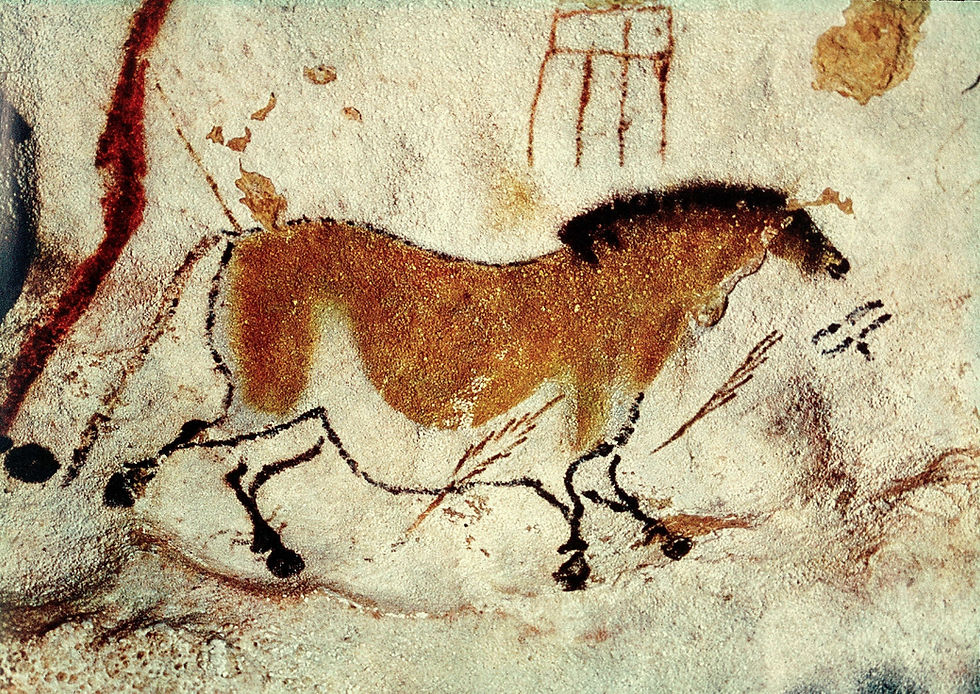
By roughly 10,000–8,000 BCE, near the end of the last Ice Age, wild horses had spread widely across Eurasia, particularly throughout the Pontic–Caspian steppe and Central Asia. During this period, humans encountered horses primarily as hunted animals. Archaeological sites from Paleolithic cultures show horse bones bearing butchery marks, indicating that horses were valued for meat, hides, and bone tools.
At this stage, there is no evidence of domestication: horses were entirely wild.
The First Evidence of Domestication (ca. 3500–3000 BCE)
The earliest widely accepted evidence of horse domestication dates to around 3500 BCE, associated with the Botai culture in what is now northern Kazakhstan. Archaeological findings at Botai sites include:
Horse bones making up the majority of animal remains
Evidence of corrals or enclosed spaces
Chemical traces of mare’s milk on pottery, suggesting early dairying
Evidence of early bit use on equine teeth
These findings indicate that horses were no longer simply hunted, but managed and bred by humans.
Early domestication likely focused on meat and milk, with riding and traction developing later.

The Emergence of Riding and Mobility (ca. 3000–2000 BCE)
Clear evidence for horseback riding appears between 3000 and 2000 BCE. During this period, steppe cultures such as the Yamnaya and related pastoral societies began using horses for mobility rather than solely for food.
Although early riders did not use saddles or stirrups, they likely rode bareback or with simple pads. This innovation dramatically changed human movement, enabling:
Faster migration across vast landscapes
Improved herd management
Expanded trade and cultural exchange
Mounted travel gave steppe societies a major strategic advantage and contributed to their rapid geographic expansion across Europe and Asia.
Horses and Early Civilizations (ca. 2000–1000 BCE)
As domesticated horses spread, they were adopted by major early civilizations, each using horses in distinct ways.
Mesopotamia and Anatolia
By 2000 BCE, horses were present in Mesopotamia, though early use was limited. Horses became more prominent with the rise of chariot warfare.
Ancient Egypt
Horses were introduced to Egypt around 1600 BCE, likely by the Hyksos. The New Kingdom period (ca. 1550–1070 BCE) saw widespread use of horses for chariots, particularly in military and ceremonial roles.

The Indus Valley and China
In South Asia, horses appeared during the late Indus Valley Civilization (after 2000 BCE), though their role remains debated. In China, horses became increasingly important during the Shang Dynasty (ca. 1600–1046 BCE), especially for chariot warfare and elite transport.

Classical Antiquity: Horses as Instruments of Power (ca. 1000 BCE–500 CE)
During classical antiquity, horses became central to warfare, agriculture, and communication.
Assyrian Empire (ca. 1400–600 BCE): Developed advanced cavalry units
Persian Empire (ca. 550–330 BCE): Established mounted couriers and cavalry forces
Ancient Greece: Used horses primarily for warfare and sport, including chariot racing
Roman Empire: Relied on horses for transportation, military logistics, and agriculture
Selective breeding became more deliberate during this period, favoring strength, endurance, and trainability.

The Medieval World and Beyond (ca. 500–1500 CE)
During the Middle Ages, horse domestication reached new levels of specialization:
Warhorses were bred for strength and temperament
Agricultural horses increased food production through plowing
Trade and communication networks expanded
Technological developments such as the stirrup (introduced to Europe by ca. 700–800 CE) significantly improved rider stability and control, further deepening the human–horse partnership.

How Domestication Shaped the Modern Horse
Across thousands of years, domestication altered horses physically and behaviorally:
Increased size variation and specialized body types
Greater tolerance of human proximity
Retention of prey-animal instincts such as flight response and herd reliance
Despite domestication, horses remain biologically adapted to open spaces, social living, and movement—facts that continue to influence modern horse care and training.
Why This History Matters for Today’s Horse Owners
For beginners, understanding the historical timeline of horse domestication explains why:
Horses are highly sensitive to their environment
Social structure and leadership matter deeply to them
Ethical care requires balancing domestication with natural instincts
The human–horse relationship, forged between 3500 BCE and the present, is one of cooperation shaped by necessity, innovation, and adaptation. That long history still defines how horses learn, behave, and thrive today. To learn more about equine behavior, read our article The Study of Equine Behavior: why does my horse do that?
Continue Learning About the History of Domestication
Read the next article in this series: The Domestication of the Horse: An Intermediate Historical Examination
FAQ - Domestication of the Horse: A Historical Introduction for Beginners
What does horse domestication mean in simple terms?
Horse domestication means humans gradually changed how horses lived and behaved over many generations, shifting them from wild animals to animals people could manage, breed, and use for work, travel, and partnership.
When were horses first domesticated?
The article explains that the earliest widely accepted evidence of horse domestication is linked to the Botai culture, around 3500 to 3000 BCE, in what is now northern Kazakhstan.
How do we know horses were domesticated at Botai?
The article points to multiple clues, including large numbers of horse remains, evidence of corrals or enclosed spaces, chemical traces of mare’s milk on pottery, and signs consistent with early bit use on horse teeth.
Were horses used for riding right away?
No. The article explains early domestication likely focused on practical resources like meat and milk, with clearer evidence of riding appearing later, roughly between 3000 and 2000 BCE.
How did early people ride without saddles and stirrups?
The article describes early riding as likely bareback or using simple pads, relying on balance, training, and the horse’s tolerance of close contact. More advanced equipment developed much later.
When did the stirrup arrive in Europe, and why did it matter?
The article notes the stirrup reached Europe by about 700 to 800 CE. It improved rider stability and control, which changed how horses were used in travel and warfare.
Did domestication remove a horse’s prey instincts?
No. The article explains domestication increased tolerance of people and handling, but horses still keep strong prey instincts, social needs, and a flight response. This is why humane training and safe management still matter.


Comments