
Thrush: A Science and Evidence Based Deep Dive

Updated: Feb 23
What “thrush” is (and what tissue it affects)
Thrush is an infectious/inflammatory condition of the frog: the V-shaped, rubbery structure on the underside of the hoof, and especially the sulci (grooves) that border it:
Central sulcus: the groove down the middle of the frog
Collateral sulci: the grooves on either side

Clinically, thrush is often described as a degenerative/keratolytic process: microbes contribute to the breakdown of keratinized horn (the tough, outer hoof tissue), leading to softened, crumbly, necrotic material and sometimes deeper invasion. (The term keratolytic means “able to break down keratin.”)
How common is thrush?
A large, cross-sectional field study in the Netherlands examined 942 horses assessed during routine trimming by 21 certified farriers. In that population:
Thrush was the most frequently diagnosed hoof disorder: 45.0% of horses.
85% had at least one hoof disorder (most lesions were mild).
This is one of the better epidemiologic data points we have because it uses a large sample and consistent scoring during trimming—though it still reflects that management context and country.
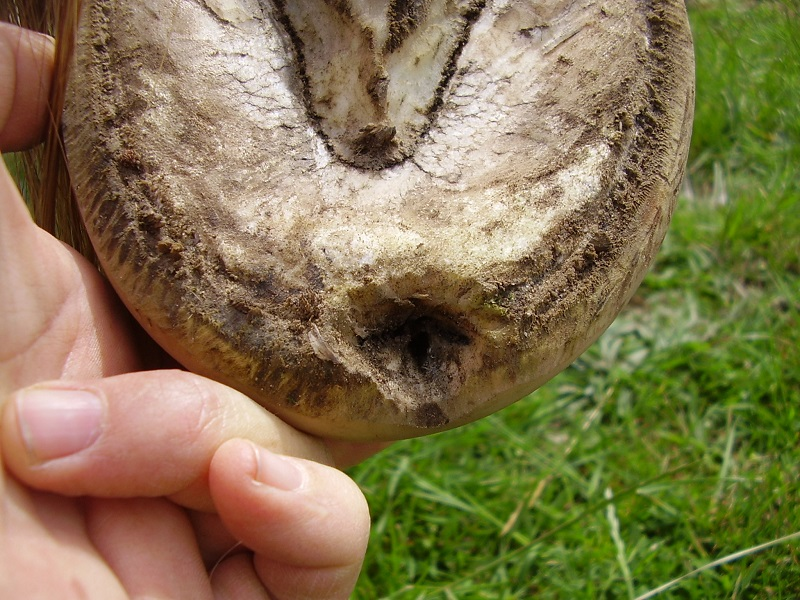
Mild thrush infection Severe thrush infection, bleeding Severe thrush infection where the frog has been completely eaten away
Causes: which microbes are implicated?
The best direct evidence: Fusobacterium necrophorum
A targeted microbiology study tested hoof material from horses with thrush versus healthy hooves and found an association with Fusobacterium necrophorum (an anaerobic bacterium), while Dichelobacter nodosus (a classic ovine (sheep) foo-trot pathogen) was not the primary association in this equine thrush dataset.
Strengths of the evidence
Uses direct sampling and microbial detection from affected vs. healthy feet.
Limits
Sample size is small (thrush studies are often small).
Thrush likely isn’t a single-bug disease; it may be a polymicrobial infection and/or a dysbiosis (microbial imbalance) with environmental/hoof-structure drivers. So, this study supports association, not “the only cause.”
Why anaerobes “make sense” biologically
Anaerobes prefer low-oxygen environments. Deep, narrow sulci packed with manure/mud create exactly that kind of niche. The most implicated organism above (F. necrophorum) is a well-described animal pathogen capable of contributing to necrotic infections in other species and body sites.
Pathogenesis: what’s happening in the hoof?
A practical, evidence-consistent way to think about thrush is a three-factor model:
Environment that favors anaerobes
Moisture + organic debris (manure/soil) + low oxygen in deep grooves.
A susceptible frog/sulcus
Softened horn, micro-cracks, or “trapped” debris.
Conformation or trimming/shoeing patterns that reduce frog contact/airing can contribute in some horses (mechanistic plausibility; strong clinical consensus, but limited controlled trials).
Microbial overgrowth + tissue breakdown
Keratin breakdown → black/gray necrotic exudate and odor.
In more severe cases, invasion can extend deeper toward sensitive tissues, producing pain/lameness.
Risk factors: what the best field study found
In the 942-horse Netherlands study, factors significantly associated with thrush included:
Wet stable floor (vs dry):
“Somewhat wet” - OR 1.6
“Wet” - OR 2.9
Straw bedding (vs flax): OR 1.5
Housing strategy: permanent housing vs permanent pasturing: OR 1.7
Poor horn quality: OR 3.4
How to interpret odds ratios (OR): An OR > 1 means higher odds of thrush in horses exposed to that factor (in that study). ORs do not prove causation, but they strengthen the case for management changes when paired with biological plausibility (wet/low-oxygen conditions).
Signs and severity spectrum
Typical early/mild thrush
Foul odor
Black, gray, or dark exudate in the sulci
Soft, ragged frog tissue
Usually minimal pain

Mild thrush infection of the collateral sulci
Moderate to severe
Deeper central sulcus fissure, bleeding with cleaning, obvious tenderness
Heel pain/avoidance, shortened stride, or lameness
Swelling/heat can occur if secondary infections develop (these cases warrant veterinary evaluation promptly)

Moderately severe thrush infection bleeding following regular hoof cleaning with hoof pick
Diagnosis
Thrush is primarily a clinical diagnosis:
Visual inspection and hoof pick/probe of sulci
Odor + characteristic necrotic material
Determine depth and pain response
Microbial testing is rarely necessary in routine cases, but is reasonable when:
Disease is recurrent despite good management
There is significant pain, abnormal discharge, or concern for deeper involvement
You’re trying to avoid unnecessary antimicrobials and want culture/sensitivity guidance
Treatment: what is supported, what is uncertain
What has the strongest evidence base (because it targets known risk factors)
(A) Environmental control
Keep feet out of persistently wet, manure-contaminated footing.
Improve stall drainage; remove urine/manure frequently; keep bedding dry.
These steps directly address the high-impact risk factors identified epidemiologically (wet floor, housing strategy).
(B) Mechanical cleaning + opening the sulci
Pick/clean daily (or more often in wet seasons).
A farrier/vet may remove undermined, necrotic frog horn to expose healthier tissue and increase oxygen access.
Key principle: remove only clearly diseased/loose horn and avoid aggressive trimming into sensitive tissue.
Topical therapy: common, biologically plausible, but limited direct clinical trials
Many topical products are used (iodine, chlorhexidine, copper salts, etc.). The challenge is that controlled clinical efficacy trials for specific thrush products in horses are scarce (a frequent conclusion in the veterinary literature and reviews).
What we can say scientifically:
Thrush involves anaerobic bacteria and degraded horn; topical antisepsis plus drying/oxygenation is mechanistically reasonable.
But product-to-product superiority is largely not established by robust equine clinical trials.
A practical, evidence-aligned approach:
After cleaning/debridement, apply a topical antiseptic in a way that reaches the depth of the affected sulcus and then keeps it dry.
Reassess frequently; if it isn’t clearly improving within ~7–14 days, escalate evaluation (management review, farrier/vet exam, consider differentials).
When systemic antibiotics are (and are not) appropriate
For typical superficial thrush, systemic antibiotics are usually not justified: the infection is localized to keratinized tissues and responds to local management.
Consider veterinary-directed systemic therapy when there is evidence of:
Deep tissue involvement, cellulitis, significant swelling/heat
Marked lameness, fever, or ascending infection
Concurrent lesions (e.g., deeper frog/heel pathology)
This aligns with antimicrobial stewardship principles: reserve systemic antibiotics for cases where they are likely to improve outcomes and where deeper infection is present.
Prevention: turning evidence into a stable “maintenance plan”
If you want prevention that maps directly onto the strongest available data:
Control moisture
Wet floors were strongly associated with thrush (OR up to 2.9).
Improve drainage, remove wet spots, ensure turnout areas aren’t perpetually muddy.
Bedding choices and management
Straw bedding was associated with higher odds than flax in that study.
Whatever bedding you use: the key is dryness and cleanliness.
Maximize healthy frog function
Regular trims that avoid long intervals and help keep sulci from becoming deep debris traps.
Encourage appropriate movement/turnout when feasible (supports hoof self-cleaning and frog stimulation).
Routine hoof inspection
Catch early odor/black exudate before deep sulcus disease develops.
Key uncertainties (what science still can’t say confidently)
Even with good studies, there are real gaps:
Thrush is likely multifactorial; one bacterium may be common but not exclusive.
We have limited randomized, controlled trials comparing topical agents and protocols in horses.
Management associations (wet floors, bedding, housing) are strong but are still observational, meaning confounding factors may contribute.
FAQ: thrush
What is thrush in horses, and what part of the hoof does it affect?
Thrush is an infection and tissue breakdown problem that primarily affects the frog, especially the central and collateral sulci (the grooves around the frog). It is typically associated with foul odor and dark discharge in those grooves.
What causes thrush in horses (and why do anaerobic bacteria matter)?
Thrush develops when the frog sulci become a low oxygen “pocket” packed with manure or mud, which favors anaerobic bacteria. Those conditions support microbial overgrowth and keratin breakdown in frog tissue.
What are the most proven risk factors for thrush?
The article highlights field-study associations including wet stable floors, straw bedding compared with flax, permanent housing compared with permanent pasturing, and poor horn quality. These are practical “start here” levers because they’re modifiable.
How can you tell thrush from normal frog shedding or mild “funk”?
Typical thrush is more than a smell. Look for deep, narrow sulci, black or gray discharge, a ragged or softened frog, and tenderness when the sulcus is gently probed. If the sulcus is deep enough to “hide” a hoof pick tip, treat it as a higher risk case.
What is the best evidence-based treatment approach for thrush?
The strongest evidence-supported foundation is environmental control plus mechanical cleaning: reduce moisture and manure exposure, clean and open the sulci (conservatively), and keep the hoof as dry as practical. The article notes that strong head-to-head evidence for a single “best” topical is limited compared with management changes.
When is thrush serious enough to call the vet or farrier urgently?
Escalate if there is marked lameness, significant swelling or heat, deep sulcus pain, bleeding or severe tissue loss, or if the problem isn’t clearly improving with correct management. Deep infections and concurrent hoof pathology are not DIY situations.
How can you prevent thrush from coming back?
Prevention is mostly routine: keep living areas as dry and clean as possible, maintain regular hoof care, pick out feet consistently, and address deep sulci before they become a low-oxygen, debris-packed environment. If thrush keeps recurring, reassess the housing and hygiene factors first.



Comments