
What the Peer-Reviewed Literature Does (And Doesn’t) Say About Donkey Conformation And Hoof Care

Updated: May 15
When people discuss donkey conformation and hoofcare, the conversation often drifts toward opinions, breed-show ideals, or comparisons to horses. However, peer-reviewed research paints a much more practical picture. Scientific literature does not support one universal, evidence-based “ideal donkey” template. Instead, researchers focus primarily on measurable body structure, hoof and limb health, movement, and how conformation relates to welfare and soundness.
This distinction matters.
In horses, conformation discussions frequently revolve around discipline-specific ideals or breed standards. In donkeys, the strongest evidence base is far more functional. Researchers examine whether body structure supports sound movement, healthy feet, and long-term comfort under real-world conditions.
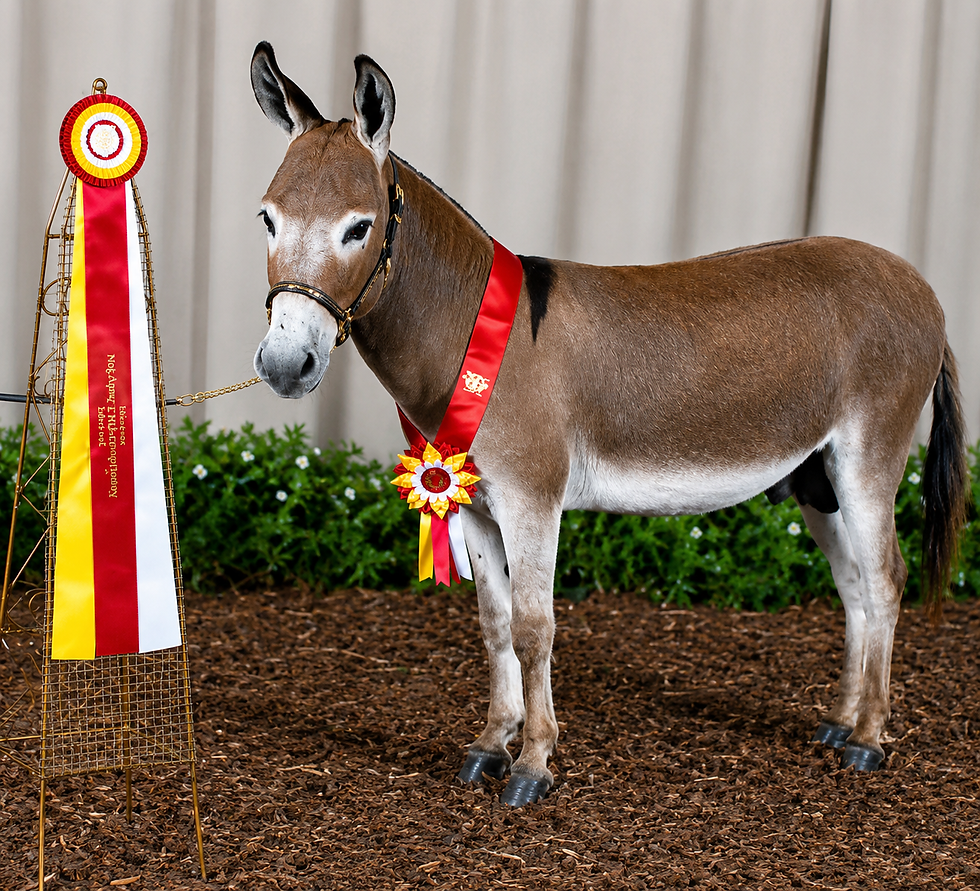
The most important takeaway from current peer-reviewed literature is simple: good donkey conformation is best defined as species-appropriate structure that supports soundness, efficient movement, and healthy hoof-limb mechanics.
The evidence is strongest in two areas:
Limb alignment and its relationship to lameness
Hoof conformation and the need for donkey-specific trimming standards
This article explores what peer-reviewed research currently tells us about donkey conformation, hoof structure, and trimming practices, while separating evidence-based findings from assumptions borrowed from horses. For an overview on the major differences between horses, donkeys, and mules, read "Donkeys, Mules, and Hinnies: An Introductory Guide"
Understanding Donkey Conformation
In scientific studies, donkey conformation is generally evaluated through objective morphometrics. This means researchers measure physical characteristics such as:
Height at the withers
Heart girth
Body length
Cannon bone length and circumference
Neck length
Head and ear length
Rump width and height
Limb proportions
Researchers then use these measurements to calculate proportional indexes. These may include body index, compactness index, or profile index, which help describe whether a donkey is more compact, heavier-built, or long-lined.
The purpose of these studies is not to declare one perfect body shape. Instead, they establish reference ranges that allow veterinarians, breeders, and researchers to objectively describe donkey build.

This is an important distinction because many traditional conformation opinions are subjective. Scientific morphometric studies provide measurable, repeatable data.
At the same time, these studies do not necessarily prove that one body type is superior for long-term performance or soundness. Current evidence is far stronger when examining specific limb deviations and hoof health than when evaluating overall body shape.
If you want a broader foundation for evaluating body structure, review The Beginner’s Guide to Equine Conformation, then apply those ideas carefully through a donkey-specific lens.
Whole-Body Proportions and Functional Balance
Although there is no single “ideal” donkey structure supported by research, studies do emphasize proportionality and symmetry.
A balanced donkey typically demonstrates:
A proportionate body length relative to height
Even muscling
Symmetrical limb placement
Appropriate body condition
Efficient movement without strain
The American Donkey Association’s conformation checklist aligns closely with these functional principles. Key features include:
A strong topline
Moderate shoulder slope
Deep heart girth
Straight, balanced legs
Upright, healthy hooves
Smooth, free movement
Importantly, these characteristics are practical rather than cosmetic. They relate directly to movement efficiency, workload tolerance, and overall welfare.
A donkey with balanced proportions is more likely to move efficiently and comfortably, especially when carrying weight or performing work over long periods.

Limb Alignment and Lameness
One of the clearest welfare-related findings in donkey conformation research involves limb alignment.
A significant peer-reviewed field study examining working draught donkeys in Pakistan found extremely high rates of gait abnormalities and lameness. Researchers reported that lameness severity was significantly associated with:
Older age
Lower body condition score
Forward-at-the-knee conformation
This study is especially valuable because it examined donkeys under real working conditions rather than idealized environments.
Forward-at-the-knee conformation places abnormal stress on the limb structures and may alter movement mechanics over time. The research suggests that this particular deviation has meaningful welfare implications.
For owners, handlers, and rescue organizations, this reinforces the importance of evaluating limb alignment carefully.
When assessing a donkey, attention should be paid to:
Limb straightness from the front and rear
Joint alignment
Symmetry between limbs
Movement quality
Evidence of uneven loading or stiffness
Even subtle alignment issues can become more significant when combined with poor hoof care, excessive workload, obesity, malnutrition, or advancing age.
Because conformation only matters when it affects comfort and movement, pair visual assessment with a practical equine lameness evaluation when a donkey appears uneven, stiff, or reluctant to move.
Why Horse Standards Cannot Always Be Applied to Donkeys
One of the most important lessons from donkey research is that donkeys cannot simply be evaluated using horse standards.
This is particularly true when assessing hind limb conformation.
The “Cow Hock” Question
In horses, cow hocks are generally considered a conformational fault. However, peer-reviewed research in donkeys tells a more nuanced story.
A study published in Equine Veterinary Education examined cow-hocked conformation in Egyptian "baladi" donkeys using objective grading methods. Researchers concluded that cow hock alignment may actually be common and non-pathological in the population studied. This finding is important because it challenges the assumption that horse standards should automatically apply to donkeys.
A limb alignment that appears undesirable by horse standards may be perfectly normal in certain donkey populations.
That does not mean all cow-hocked donkeys are sound or free from issues. Instead, it means conformation should always be interpreted in context.

The following factors matter more than appearance alone:
Whether the donkey moves soundly
Whether the alignment is symmetrical
Presence or absence of pain
Workload demands
Hoof balance
Muscle development
Overall function
Function should always take priority over cosmetic comparison to horse ideals.
Donkey Hooves Are Not Horse Hooves
Perhaps the strongest and most consistent finding in modern donkey research involves hoof structure.
Scientific evidence clearly demonstrates that donkey hooves differ significantly from horse hooves.
This has major implications for trimming, hoof care, and farrier practices.
Distinct Hoof Geometry
A 2024 peer-reviewed radiographic study examining generally sound European donkeys established reference values for physiological hoof conformation.
Researchers emphasized that donkey hoof parameters differ substantially from horses.
Donkey hooves are typically described as:
More upright
Smaller relative to body size
Boxier in shape
Associated with a more upright hoof-pastern axis
Featuring a more U-shaped sole

These differences are not abnormalities. They are species-specific anatomical characteristics.
Unfortunately, many hoof-care approaches still rely heavily on horse standards. Applying horse trimming targets to donkeys can create problems when natural donkey hoof geometry is ignored.
Research strongly supports the use of donkey-specific reference values rather than transferring horse measurements directly.
Radiographic Reference Values and Modern Hoof Assessment
Recent research has expanded the availability of radiographic morphometric databases for donkeys.
Studies published in peer-reviewed journals now provide measurable reference values for:
Hoof wall angles
Sole thickness
Hoof wall length
Distal limb dimensions
Hoof-pastern alignment
Internal hoof structures
These references are extremely valuable for veterinarians and farriers.
Radiographs allow practitioners to evaluate not only the external hoof capsule but also the internal structures hidden beneath the surface.
This becomes especially important in cases involving:
Chronic overgrowth
Laminitis
Distorted hooves
Asymmetrical wear
Suspected bone displacement
Long-term neglect
Rather than trimming based solely on appearance, practitioners can compare radiographs to species-specific morphometric norms.
This creates a far more objective and evidence-based approach to donkey hoof care.
For owners trying to understand how hoof shape connects to deeper limb structures, the interactive horse anatomy tool can help explain the relationship between external structure and internal support.
Evidence-Based Principles of Donkey Hoof Trimming
Although formal controlled trials examining specific trimming techniques in donkeys remain limited, existing anatomical research and welfare studies strongly support several practical trimming goals.
1. Maintain a Balanced Hoof-Pastern Axis
Research demonstrates that donkey hoof conformation can be measured radiographically to evaluate whether trimming preserves functional alignment.
A balanced hoof-pastern axis helps support natural biomechanics and efficient movement.
In equine podiatry research, abnormal hoof capsule alignment is associated with altered stress distribution and increased strain on joints and soft tissues.
While not all biomechanical research is donkey-specific, the principles are highly relevant.
The goal is not to force the foot into a horse-like shape. Instead, trimming should preserve normal donkey morphology while supporting balanced loading.
2. Prevent Overgrowth and Distortion
Overgrown hooves are a major welfare concern in donkey populations worldwide.
Scientific welfare assessments consistently associate poor hoof care with:
Hoof pathology
Lameness
Soft tissue injury
Altered gait
Reduced mobility
Chronic pain

Because donkeys are naturally stoic animals, significant hoof problems may go unnoticed until disease is advanced.
Routine trimming plays a critical role in preventing severe distortion and maintaining functional movement.
3. Preserve Sole Concavity and Frog Function
Direct controlled studies in donkeys are limited, but broader equine research supports maintaining healthy sole concavity and functional frog contact.
These structures help:
Distribute forces
Absorb concussion
Support circulation within the foot
Reduce pressure on sensitive tissues
Excessive trimming that weakens these structures may compromise hoof function.
Trimming Frequency and Practical Management
Current welfare recommendations generally support trimming intervals of approximately every 6 to 10 weeks for most donkeys.
This schedule aligns with observed hoof growth patterns and the need to prevent excessive overgrowth.
However, trimming frequency should always be individualized.
Factors influencing hoof growth and wear include:
Environment
Terrain
Nutrition
Exercise level
Age
Existing hoof pathology
Workload
Some donkeys living on abrasive terrain may naturally wear their feet more effectively, while others may require more frequent professional attention.
Regular observation remains essential.
Owners should monitor for:
Cracks
Distortion
Uneven wear
Long toes
Flaring
Changes in gait
Heat or swelling
Reluctance to move
Early intervention is far preferable to corrective trimming after severe overgrowth develops.
When Radiographs Become Especially Important
Severely distorted or neglected hooves should ideally be evaluated radiographically before major corrective trimming is attempted.
This is particularly important in cases involving:
Chronic laminitis
Severe overgrowth
Rotation or displacement concerns
Long-standing neglect
Significant asymmetry

Aggressive trimming without understanding internal structures can weaken support mechanisms and potentially worsen the situation.
Radiographs provide objective guidance that helps practitioners determine:
How much hoof can safely be removed
Whether internal pathology exists
The relationship between the hoof capsule and bone structures
Appropriate trimming goals
Moderate, carefully planned correction is generally safer than attempting rapid transformation.
Donkey-Specific Hoof Characteristics
Research consistently reinforces that normal donkey hoof structure differs from horse norms.
Key donkey-specific characteristics include:
More upright hoof-pastern axis
Boxier hoof shape
U-shaped sole
Different radiographic measurements
Species-specific wall angles
These features should be respected during trimming.
Attempting to reshape donkey feet into horse-like forms may create unnecessary stress and imbalance.
This point cannot be emphasized enough.
The goal of donkey hoof trimming is not cosmetic uniformity. The goal is functional soundness within normal donkey anatomy.
Integrating Conformation and Hoof Care
Conformation and hoof health cannot be separated.
Poor hoof balance alters movement mechanics, while limb alignment influences hoof wear patterns.
An evidence-informed approach to donkey assessment should therefore combine:
Whole-body evaluation
Limb alignment assessment
Hoof conformation analysis
Movement observation
Radiographic assessment when needed
This integrated approach provides a much more accurate picture of soundness and welfare than visual appearance alone.
A Practical, Evidence-Based Evaluation Framework
Based on current peer-reviewed literature, a practical approach to donkey conformation assessment includes the following steps.
Start with Objective Measurements
Use morphometric methods to evaluate:
Height
Body length
Heart girth
Limb proportions
Symmetry
Objective measurements reduce subjectivity and create consistent records over time.
Prioritize Soundness and Welfare
Pay close attention to:
Limb alignment
Gait quality
Hoof balance
Body condition
Signs of pain or stiffness
Research supports strong connections between soundness outcomes and certain conformational deviations.
Use Donkey-Specific Hoof Standards
Avoid applying horse hoof angles or trimming goals directly to donkeys.
Use donkey-specific reference values whenever possible.
Interpret “Faults” Carefully
Traits considered faults in horses may be normal in donkeys.
Always evaluate conformation within the context of:
Function
Comfort
Symmetry
Workload
Population norms
Combine Trimming with Good Management
Regular hoof care works best alongside:
Proper nutrition
Appropriate workload
Clean environments
Routine observation
Veterinary support when needed
Use Horse Tracker to record hoof photos, trim dates, radiograph notes, body condition changes, lameness observations, and long-term progress.
Final Thoughts
Peer-reviewed research on donkey conformation continues to grow, but the current evidence already supports several important conclusions.
There is no single scientifically proven “ideal donkey” template.
Instead, the strongest evidence focuses on:
Functional soundness
Healthy hoof-limb mechanics
Species-appropriate hoof structure
Limb alignment associated with welfare outcomes
Modern research clearly shows that donkey feet differ significantly from horse feet, and donkey-specific trimming standards are essential.
It also reminds us that not all apparent conformational “faults” are truly pathological in donkeys.
Ultimately, good donkey conformation should be judged less by cosmetic ideals and more by practical outcomes:
Is the donkey comfortable?
Does it move freely?
Are the feet healthy and balanced?
Is the structure supporting long-term soundness?
Those questions are far more meaningful than attempting to fit donkeys into horse-based templates.
For owners, farriers, veterinarians, and rescue organizations, the growing body of donkey-specific research offers an increasingly evidence-based foundation for improving welfare and hoof care.
You can explore additional equine anatomy, hoof care, and welfare education resources at www.horseeducationonline.com.
Q&A
1. Is there a scientifically proven “ideal” donkey conformation?
No. Peer-reviewed research does not support one universal ideal donkey template. Most scientific studies focus on measurable body structure, hoof conformation, movement, and welfare outcomes rather than cosmetic breed-show standards.
2. What conformational issue has been linked most clearly to lameness?
Research in working donkeys found that forward-at-the-knee conformation was significantly associated with increased lameness severity. Older age and poor body condition were also linked to worse outcomes.
3. Are cow hocks always considered a fault in donkeys?
Not necessarily. Research in Egyptian baladi donkeys found that cow-hocked alignment may be common and non-pathological in some populations. Function, comfort, and soundness are more important than appearance alone.
4. How are donkey hooves different from horse hooves?
Donkey hooves are generally more upright, boxier, and associated with a more upright hoof-pastern axis. They also tend to have a more U-shaped sole. These are normal species-specific differences.
5. Why shouldn’t horse trimming standards be used directly on donkeys?
Research shows donkey hoof anatomy differs significantly from horses. Applying horse hoof angles or trimming goals to donkeys may create imbalance or unnecessary stress because normal donkey hoof geometry is different.
6. How often should donkeys typically have their hooves trimmed?
Most donkeys benefit from trimming every 6 to 10 weeks, although the ideal interval depends on factors such as environment, workload, hoof growth, and natural wear.
7. When should radiographs be used before trimming?
Radiographs are especially valuable in cases involving severe overgrowth, chronic laminitis, hoof distortion, asymmetry, or suspected internal pathology. Imaging helps guide safe and evidence-based corrective trimming.
This article is for educational purposes only and does not replace professional veterinary or farrier advice.
Key Peer-Reviewed Citations
Reix et al., 2014 (Equine Veterinary Journal) conformation factors associated with lameness severity in working donkeys (forward-at-the-knee association).
Frontiers in Veterinary Science, 2024 Radiographic measurements of the hoof in generally sound donkeys with emphasis on the front limbs, radiographic hoof reference values in generally sound donkeys; donkey–horse differences emphasized.
Wacker Juliana , Schaus Kyra , Jandowsky Anabell , Büttner Kathrin , Röcken Michael , Bartmann Claus Peter
Equine Veterinary Education “Cow hock: A normal tarsal conformation in donkeys” (objective grading; prevalence; may be non-pathological). A. I. Abdelgalil, E. A. Hassan, F. A. Torad First published: 29 October 2018
Animals (MDPI), 2025 distal hind limb radiographic morphometrics in generally sound donkeys (reference database for trimming/assessment).
Folia Veterinaria, 2020 whole-body morphometrics and conformation indexes in domestic donkeys.
Wacker et al., Frontiers in Veterinary Science (2024): Radiographic hoof morphometrics for healthy donkeys provide species-specific reference values for practitioners.
Field welfare assessments: Poor hoof care and overgrowth are associated with hooves pathology in donkey populations studied.
Equine podiatry principles: Biomechanical evidence in equine podiatry emphasizes balanced trimming to promote function and prevent lameness.


Comments