The History of Dressage

Updated: Jul 28
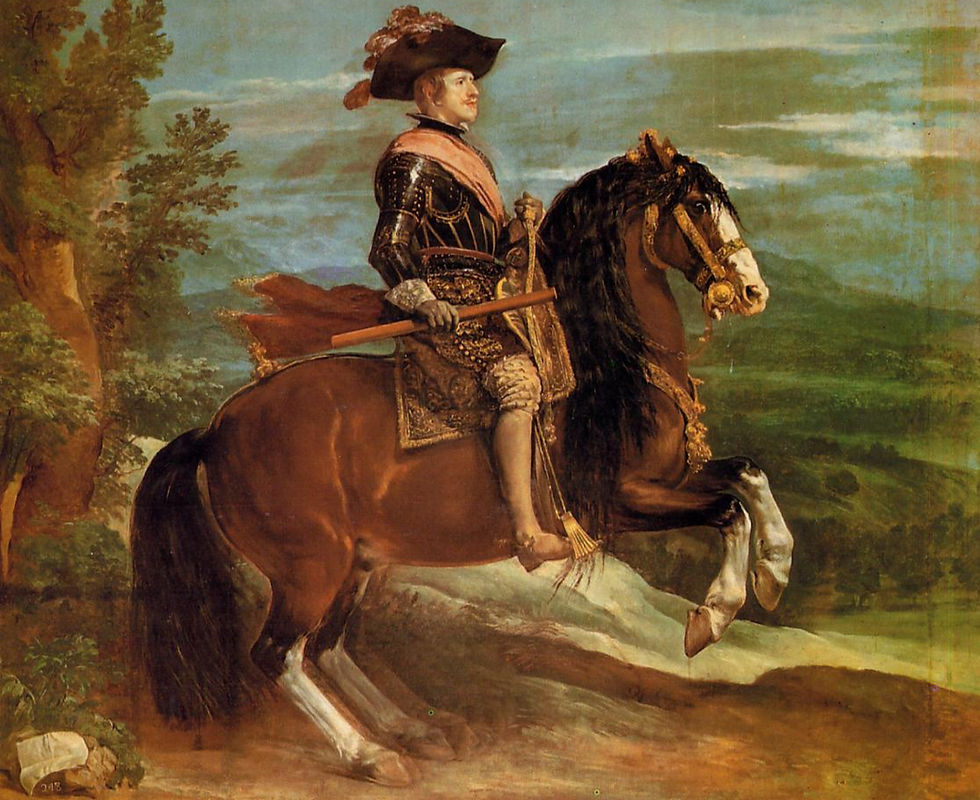
Dressage has evolved over thousands of years, shaped by ancient horsemanship, Renaissance riding academies, royal courts, military cavalry schools, and modern international competition. Its history reveals how practical training methods once used to prepare horses for warfare and demanding work gradually developed into a highly disciplined equestrian art and Olympic sport. Understanding this journey offers valuable insight into the movements, principles, traditions, and welfare debates that continue to influence dressage today.
From Military Horsemanship to International Sport
Dressage is the systematic training of a horse to perform controlled movements in response to increasingly subtle signals from the rider. The word comes from the French dressage, meaning training or education. Earlier horsemen more commonly used terms such as equitation, manège, horsemanship, or simply the art of riding.
Today, dressage has two closely related meanings. It describes a method of developing a horse’s balance, strength, suppleness, coordination, and responsiveness. It is also an international competitive discipline in which horse-and-rider combinations perform prescribed movements before a panel of judges.

The history behind modern dressage is complex. It did not develop through a single, uninterrupted line from one ancient riding master. Its methods were shaped by warfare, hunting, royal courts, scholarly riding academies, cavalry schools, national traditions, breeding programs, public performances, and eventually organized competition.
Every period contributed something different. Ancient writers preserved early ideas about thoughtful horse training. Renaissance riding masters transformed riding into an academic discipline. Royal schools refined advanced movements and displayed them as symbols of political authority. Military institutions introduced greater structure and standardization. The
Olympic movement and the Fédération Equestre Internationale, or FEI, turned parts of these traditions into a regulated international sport.
Understanding this history helps explain why dressage contains elements of both practical horsemanship and formal art. The exercises performed in a modern arena may appear highly specialized, but many began as ways to make horses safer, stronger, more maneuverable, and easier to control.
Horse Training Before Dressage
Humans were training horses thousands of years before anything resembling modern dressage existed. Early horses were prepared for transportation, agriculture, warfare, hunting, racing, ceremonial processions, and chariot competition.
One of the oldest surviving written horse-training programs is the Kikkuli text, produced in the Hittite world during the second millennium BCE. It describes a detailed conditioning program for chariot horses, including feeding, watering, exercise, rest, and carefully managed workloads.
The Kikkuli text is important because it shows that ancient horsemen understood the value of progressive conditioning. They did not simply harness a horse and expect it to perform. Horses were prepared over time so they could develop the endurance and physical capacity needed for demanding work.
Read our introductory article to the Kikkuli text: The Oldest Training Manual in the World: The Kikkuli Text, or read the full manuscript available in our library by clicking here.
However, the Kikkuli text should not be described as an early dressage manual. It concerns the conditioning of chariot horses rather than the ridden development of balance, collection, lateral movement, and responsiveness associated with later European equitation.
Ancient military horses still needed qualities that dressage riders would recognize today.
They had to remain manageable around noise, weapons, unfamiliar terrain, other horses, and sudden movement. A horse that could accelerate, stop, turn, and respond promptly gave its rider or driver an obvious advantage.
These requirements encouraged humans to select and train horses for:
Obedience and responsiveness
Balance during sudden changes of direction
Physical endurance
Courage in confusing environments
Control at different speeds
Acceptance of equipment
Cooperation with a rider or driver
The methods varied widely among cultures, and relatively little written evidence survives. Much of the knowledge was probably passed directly from one horseman to another.
Did You Know? The Kikkuli text is often casually identified as the first dressage manual. It is more accurately described as an ancient conditioning program for chariot horses. Its importance lies in its detailed approach to preparing equine athletes, not in teaching modern dressage movements.
Xenophon and Classical Greek Horsemanship
The Greek soldier, historian, and philosopher Xenophon lived during the fourth century BCE. His treatise commonly translated as On Horsemanship or The Art of Horsemanship is one of the earliest surviving Western works devoted specifically to riding, handling, and horse training.

Xenophon discussed selecting a horse, examining conformation, caring for the feet, mounting safely, developing obedience, improving the rider’s position, and preparing a horse for military use. He also wrote about the horse’s behavior and the effect of the rider’s actions on the animal’s willingness to cooperate.
Several of his ideas still sound familiar to modern riders. He warned against approaching training in anger, encouraged riders to reward correct responses, and preferred movements that appeared willing and proud. He recognized that fear and punishment could interfere with learning.

Xenophon did not describe modern dressage tests, competition levels, judging systems, or a formal training scale. He also lived in a very different military and social world. Calling him the inventor of dressage oversimplifies both his work and the long history that followed it.
His importance is better understood as intellectual influence. He preserved ideas about observation, fairness, preparation, and the development of willing performance. Later European riders read, translated, and discussed his writings, particularly during periods of renewed interest in classical Greek and Roman scholarship.
There is no clearly documented, uninterrupted institution that carried Xenophon’s training system directly into the modern dressage arena. His work survived, disappeared from common use in some areas, was rediscovered, translated, and interpreted according to the needs of later horsemen.
Did You Know? Xenophon advised riders to avoid making the horse associate work with pain or fear. Although his writing is more than two thousand years old, his attention to the horse’s willingness remains one of the reasons he is frequently discussed by classical riders today.
Horsemanship During the Medieval Period
Written evidence about systematic riding instruction becomes less complete in medieval Europe. This does not mean medieval horsemanship was crude or unorganized. Horses were essential to warfare, transportation, hunting, agriculture, communication, tournaments, and aristocratic life.
A mounted warrior needed a horse that could carry substantial weight, remain balanced during contact, respond while the rider handled weapons, and stay manageable in crowded or frightening conditions. Horses also had to negotiate uneven ground rather than the carefully prepared surfaces used in modern competitions.

Training differed according to the horse’s purpose. A heavily equipped warhorse required different physical qualities from a fast messenger horse, hunting horse, pack animal, or ceremonial mount. Regional breeds, local terrain, military tactics, and available equipment also influenced training.
The medieval tournament contributed to the development of specialized riding skills. Jousting demanded straightness, acceleration, balance, and the ability to maintain a line while the rider carried a lance. Mounted combat required rapid turns, stops, and changes of pace.
Much of this knowledge was probably transmitted orally through:
Royal and noble households
Military units
Family traditions
Stable workers and grooms
Professional horse trainers
Riding masters
Breeding establishments
Hunting communities
The shortage of surviving instructional books makes it difficult to reconstruct exactly how horses were trained. Historical artwork and written descriptions provide evidence, but they cannot always tell us how an exercise was taught or how consistently a method was used.

Renaissance Italy and the Rise of Academic Equitation
The Renaissance brought a major change to European horsemanship. Italian courts became centers of political power, military education, art, literature, fencing, dance, and classical scholarship. Riding became part of the formal education expected of young noblemen.
A skilled courtier was supposed to display control over his body, weapons, emotions, and horse. Refined riding demonstrated discipline and social status. It could also advertise a ruler’s wealth, military strength, and access to carefully bred horses and expert instructors.
Riding was increasingly treated as an academic subject. Exercises were studied, organized, named, demonstrated, and eventually recorded in printed books. This helped move specialized equestrian knowledge beyond direct oral instruction.
Federico Grisone’s Gli ordini di cavalcare, published in Naples in 1550, became one of the most influential Renaissance works on riding. It was reprinted and translated, allowing Italian ideas to spread through European courts.
Grisone helped establish riding as a subject worthy of formal study, but some methods described in Renaissance literature were severe. Harsh bits, strong restraints, punishment, and forceful corrective techniques were accepted by some trainers. Historical influence should never be treated as proof that every method was humane or effective.

Cesare Fiaschi was another important Italian riding master and author. His work addressed riding, training, bits, and horseshoeing. Giovanni Battista Pignatelli also became highly influential, particularly through the riders who reportedly studied with him and carried Italian ideas into France and other European countries.
The Italian schools did not create every movement from nothing. Many exercises probably had practical or oral precedents. Their great contribution was bringing riding into a structured academic environment and distributing its principles through printed literature.
Did You Know?The spread of printing helped transform European horsemanship. Riding knowledge that had once been limited to individual courts, military households, and personal instruction could now travel through books, translations, illustrations, and revised editions.
Antoine de Pluvinel and French Court Riding
Antoine de Pluvinel became one of the most important figures in the development of French academic equitation. After studying in Italy, he returned to France, established an academy in Paris, and became involved in the equestrian education of the French monarchy.
His teachings were published after his death in Le Maneige Royal in 1623 and in the more complete L’Instruction du Roy en l’exercice de monter à cheval in 1625.
These works used conversations between an instructor and the king to explain riding. Elaborate engravings showed horses, riders, equipment, training pillars, and courtly settings. The books were practical instructional works, but they also communicated the political and social importance of refined horsemanship.

Pluvinel placed considerable value on understanding the horse’s temperament. He described the horse as intelligent and capable of learning through carefully presented instruction. Praise, timing, appropriate aids, and the development of confidence were important parts of his approach.
Pillars were used in some exercises to help organize the horse’s position and teach advanced movements. The practice later became strongly associated with classical schools, although its use and purpose differed among instructors.
Pluvinel’s methods should still be understood within the seventeenth century. Strong equipment and highly demanding exercises remained part of court riding. Nevertheless, his emphasis on intelligence, cooperation, and individual temperament represented an important development in written European horsemanship.
Shoulder-In: François Robichon de La Guérinière
François Robichon de La Guérinière became one of the most influential riding masters of the eighteenth century. His École de cavalerie, published in complete form in 1733, discussed conformation, training, stable management, equipment, preservation of the horse, and veterinary concerns.
La Guérinière organized existing knowledge into a clearer and more progressive educational system. He described how one exercise could prepare the horse for another and how training should gradually improve balance, suppleness, obedience, and collection.
He is closely associated with the shoulder-in. In this exercise, the horse moves forward while its shoulders are displaced slightly inward from the original line of travel. When correctly performed, the horse bends through its body and steps across with the limbs.
Shoulder-in can help develop:
Lateral suppleness
Coordination
Engagement of the hind limbs
Responsiveness to the rider’s leg
Control of the shoulders
Straightness
Balance
Preparation for more collected work
La Guérinière famously treated shoulder-in as a particularly valuable gymnastic exercise. It remains part of dressage training and competition, although its benefits depend on correct execution. Too much angle, loss of rhythm, forced bend, or incorrect positioning can reduce its value.
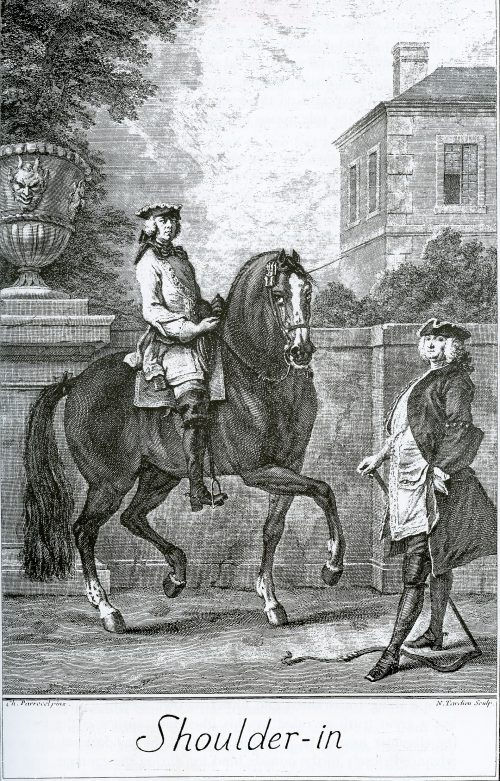
It is difficult to prove that any one person invented a movement. Exercises may exist in practical use long before someone names or publishes them. La Guérinière’s importance lies in the way he explained, organized, and promoted shoulder-in within a broader training system.
Did You Know? Shoulder-in has remained in use for centuries because it can address several qualities at once. Correctly ridden, it helps the rider influence the shoulders while encouraging bend, engagement, and coordination.
Royal Riding Schools and the Haute École
European royal courts established riding schools where advanced horsemanship could be taught and displayed. These institutions combined military preparation, aristocratic education, breeding, ceremony, entertainment, and artistic performance.
The term haute école translates as “high school” and refers to advanced classical riding. It may include highly collected movements such as piaffe, passage, pirouettes, and specialized school movements performed on or above the ground.
Collection is central to many advanced exercises. In collection, the horse carries more weight toward the hindquarters, shortens and elevates the steps without simply becoming slower, and maintains energy, balance, and responsiveness. Collection requires considerable strength and should be developed gradually.
The airs above the ground include movements such as the levade, courbette, and capriole.
These exercises are preserved by certain classical institutions.
In the levade, the horse raises the forehand and remains balanced on deeply flexed hind limbs at a relatively low angle. In the courbette, the horse raises the forehand and makes a series of forward jumps on the hind limbs. In the capriole, the horse leaps into the air and kicks out with the hind legs.

Popular accounts sometimes claim that every air above the ground was invented as a battlefield maneuver. Some advanced movements may reflect qualities valued in warhorses, but direct claims about their battlefield use are often difficult to prove. By the time these exercises were formally documented and displayed, they were strongly connected with academic schooling and court performance.
These movements are not required in modern FEI Grand Prix dressage. A Grand Prix horse performs piaffe, passage, one-tempi flying changes, pirouettes, half-pass, extended gaits, and other advanced exercises, but it does not perform the levade, courbette, or capriole as part of the test.
The Spanish Riding School
The Spanish Riding School in Vienna is one of the best-known surviving institutions of classical European horsemanship. Its history is traced to a riding and tournament ground documented in 1565. Construction of the present Winter Riding School began in 1729, and the building was completed in 1735 under Emperor Charles VI.
The word “Spanish” refers to the Spanish horses that contributed to the development of the Lipizzaner. The breed developed through several lines and influences associated with the Habsburg monarchy and its stud farms.
The Spanish Riding School preserved a Central European tradition of Renaissance and Baroque horsemanship while many other court institutions disappeared. Political revolutions, warfare, changes in government, and the decline of European monarchies ended or transformed numerous royal riding establishments.

Training at the school includes progressive ridden work, exercises in hand, work on long reins, quadrille riding, collected movements, and selected schools above the ground. Not every stallion performs every advanced air. Horses are trained according to their physical ability, temperament, and suitability.
Young stallions begin with basic work before advancing to greater collection. The process takes years. The finished public performance represents the upper level of a much longer system of development.
The Spanish Riding School’s main purpose is the preservation and demonstration of a historical form of classical horsemanship. Its training should not be viewed as identical to preparation for international competitive dressage, although the two share many principles and movements.
Did You Know? Lipizzaners are often associated with their mature white appearance, but most are born dark. Their coats generally become progressively lighter as they age, although some individuals remain darker.
Dressage and the Military
Military requirements remained central to the development of dressage through the nineteenth and early twentieth centuries. Cavalry horses had to work individually and in groups, remain obedient in stressful conditions, and respond quickly to the rider.
A useful military horse needed more than impressive arena movement. It had to travel over varied terrain, conserve energy, maneuver around other horses, tolerate noise and weapons, and remain controllable when frightened or fatigued.

Military riding schools helped standardize training. A royal riding master might tailor an individual system to a small number of elite riders and carefully selected horses. An army needed to train large numbers of officers, soldiers, instructors, remounts, and operational horses.
Standardization made it possible to teach common procedures for:
Mounting and dismounting
Rider position
Use of the aids
Transitions between gaits
Riding in formation
Jumping obstacles
Negotiating difficult ground
Care of the horse
Progressive physical conditioning
Evaluating riders and mounts
Dressage, jumping, and cross-country riding were not originally treated as completely separate worlds. A well-trained military horse was expected to perform a wide range of tasks. The specialization seen in modern equestrian sport developed later.
Cavalry Riding School: The Cadre Noir of Saumur
France established a cavalry school at Saumur in 1815 following the Napoleonic Wars. Its purpose included improving and standardizing military equitation. The instructional group that became known as the Cadre Noir dates from 1825.
The name refers to the black uniforms worn by its instructors. The Cadre Noir drew from French civilian riding traditions as well as military experience. Its instructors developed and preserved methods of training that valued balance, mobility, lightness, and effective use of the aids.
As mounted cavalry lost its battlefield role during the twentieth century, Saumur’s purpose changed. The institution increasingly focused on preserving French equitation, educating professional instructors, performing publicly, and contributing to competitive and recreational equestrian sport.
French equitation was later recognized by UNESCO as an element of intangible cultural heritage. The tradition emphasizes harmony between horse and rider, knowledge of the individual horse, reduced reliance on force, and respect for physical and mental condition.
Such recognition does not mean that every French rider uses identical methods. French equitation has always contained individual interpretations and internal debate. Its history includes military, courtly, sporting, and academic influences.
Baucher and Steinbrecht
The nineteenth century produced several influential riding systems. Two names frequently discussed are François Baucher and Gustav Steinbrecht.
Baucher developed methods centered on balance, lightness, flexions, mobility of the jaw and neck, and control of the horse’s forces. His ideas changed during his lifetime, especially after a serious accident. This is why historians and trainers often distinguish between his first and second methods.
His principal work, Méthode d’équitation basée sur de nouveaux principes, first appeared during the 1840s and went through multiple revisions. Discussions of Baucher can be difficult because different editions do not always present exactly the same system.
Some riders valued his ability to produce lightness and mobility. Critics argued that certain interpretations could reduce forward energy or separate the horse’s posture from genuine movement through the body. Much depended on which period of his work was being discussed and how later riders applied his ideas.
German riding master Gustav Steinbrecht emphasized progressive gymnastic development, forward movement, straightness, engagement, and the orderly preparation of advanced exercises. His Das Gymnasium des Pferdes was assembled and published posthumously in 1886 under the editorship of Paul Plinzner.
Steinbrecht is commonly associated with the principle of riding the horse forward and straight. In this context, straightness does not simply mean traveling along a straight line. It refers to developing more equal use of both sides of the body and aligning the hindquarters with the forehand according to the line being ridden.
French and German traditions are often presented as opposites, with French riding associated with lightness and German riding associated with forward gymnastic development. The historical reality is less tidy. Ideas moved between countries, individual instructors disagreed within their own traditions, and modern dressage contains influences from both.
Did You Know? Many famous riding books were revised, edited, translated, or published after an author’s death. Two riders can believe they are following the same historical master while relying on different editions or interpretations of that person’s work.
The Creation of Competitive Dressage
For most of its history, advanced riding was evaluated by instructors, military superiors, court audiences, and other horsemen. International competition required a different structure.
Organized dressage needed:
Written rules
Standard arena dimensions
Prescribed movements
Defined competition levels
Formal judging
Comparable scoring
Eligibility requirements
Recognized officials
Procedures for resolving penalties and disputes
Dressage entered the modern Olympic Games at Stockholm in 1912, alongside jumping and eventing. The first Olympic dressage test looked considerably different from modern Grand Prix competition. It included five jumps with obstacles reaching approximately 1.10 meters and did not include piaffe or passage.

That early test reflected the dressage horse’s close relationship with the military. The ideal mount was still expected to be versatile rather than specialized exclusively for movements performed in a rectangular arena.
The Fédération Equestre Internationale was established in 1921. The FEI created internationally accepted rules and qualification systems for Olympic equestrian disciplines.
Early Olympic equestrian competition was dominated by military organizations and commissioned officers. Horses, riders, and training systems were closely connected with cavalry schools. As the sport developed, dressage tests became more specialized.
Jumping elements eventually disappeared from dressage. Tests placed increasing emphasis on:
Purity and regularity of the gaits
Accurate transitions
Lateral movements
Collection
Impulsion
Straightness
Precision
Submission and responsiveness
Harmony between horse and rider
Judges award marks for individual movements and broader qualities. Modern scoring attempts to convert a complex performance into a numerical result. This allows combinations to be ranked, but it also creates continuing debate about judging consistency and the relative importance of technical accuracy, movement quality, expression, and harmony.

Women and Civilians Enter Olympic Dressage
Early Olympic equestrian competition was highly restrictive. Participation was largely limited to male military officers and a small group of socially privileged riders.
The rules changed before the 1952 Helsinki Olympic Games. Civilians, noncommissioned riders, and women were allowed to enter Olympic dressage. Four women competed.
Danish rider Lis Hartel won the individual silver medal. Her achievement was especially significant because she had contracted polio and lived with paralysis below the knees. She required assistance to mount and dismount but developed an effective way to communicate with her horse.

Hartel won another individual Olympic silver medal in 1956. Her success became one of the most important stories in equestrian history and later held particular significance for therapeutic riding and para equestrian sport.
Equestrian sport is unusual within the Olympic program because men and women compete directly against one another under the same rules and scoring system. Success depends upon the performance of the horse-and-rider combination rather than a separate men’s or women’s division.
Did You Know? Women first competed in Olympic dressage in 1952. Lis Hartel earned the individual silver medal that same year, making the change in eligibility immediately visible on the Olympic podium.
World Championships and International Expansion
International dressage grew rapidly after the Second World War. FEI dressage championships had been held during the 1930s, but the first official FEI World Dressage
Championship was held in Bern, Switzerland, in 1966. Twenty-four combinations representing six nations participated.
The sport later expanded through:
Continental championships
World Cup competition
Youth divisions
Young-horse championships
National federations
Regional associations
International competitions at several levels
Professional training and breeding programs
Breeding also became increasingly specialized. Warmblood registries developed performance-testing systems and selected horses for movement, temperament, rideability, conformation, and athletic ability. Improvements in transportation and reproductive technology allowed bloodlines to spread more widely between countries.
This specialization changed the appearance and athletic capacity of many dressage horses.
Modern competitors are often bred specifically for expressive gaits and advanced collection. This differs from early military competition, in which the horse also needed to jump, travel over difficult terrain, and meet broader service requirements.
Dressage is now practiced at many levels. Introductory tests assess basic steering, rhythm, transitions, and geometry. Advanced tests require collection, rapid changes of balance, lateral work, flying changes, pirouettes, piaffe, and passage.
The lower levels are not merely preparation for elite competition. They provide an organized way to evaluate basic training and help riders identify weaknesses in rhythm, straightness, connection, accuracy, and responsiveness.
The Freestyle to Music
The freestyle to music introduced a more openly artistic form of dressage competition. In a standard test, every combination performs the same movements in the same prescribed order. In a freestyle, the rider creates an individual program within established technical requirements.
The choreography must include required movements for the level, but the rider decides where and when to perform them. Music is selected and arranged to complement the horse’s gaits, tempo, character, and changes in movement.
A successful freestyle requires careful planning. The program must be technically difficult enough to score well without asking the horse to perform movements in an order that causes loss of balance, tension, or fatigue. Riders must also consider arena geometry, musical phrasing, transitions, and the placement of movements where judges can see them clearly.
Musical interpretation adds another scoring element. Music should support the performance rather than distract from it. Changes in tempo or mood can highlight transitions between collected, extended, and lateral work.
Did You Know? Freestyle music is often edited to match the tempo of an individual horse’s walk, trot, and canter. A selection that works beautifully for one horse may feel noticeably out of time with another.
The Development of Para Dressage
Para dressage developed as an international discipline for riders with eligible physical and visual impairments. Athletes are classified according to functional ability so they compete against riders with comparable levels of impairment.
The classification process considers how an impairment affects riding rather than relying only on the person’s medical diagnosis. Riders may use approved compensating aids, adaptive equipment, or alternative methods of giving signals.
Para dressage became part of the Paralympic Games in Atlanta in 1996. Sixty-one athletes from 16 countries competed in four grades using borrowed horses. It remains the only equestrian discipline included in the Paralympic Games.
The sport demonstrates the adaptability of communication between horse and rider. A rider who cannot use a conventional leg aid may use another approved signal. The objective remains the production of an accurate, balanced, and harmonious test.

Para dressage also reminds us that effective horsemanship cannot be reduced to physical strength. Timing, feel, consistency, preparation, trust, and the horse’s understanding of the aids are essential.
Classical Dressage and Competitive Dressage
Classical and competitive dressage overlap, but the terms are not interchangeable.
Classical dressage generally refers to the systematic gymnastic education of the horse according to principles associated with European schools of equitation. Its stated aim is to develop the horse’s natural abilities while improving balance, strength, suppleness, responsiveness, and longevity.
Competitive dressage is a regulated sport. Horse-and-rider combinations perform standardized or freestyle tests and receive scores from judges according to written rules.
A rider can study classical principles without ever entering a competition. A competitive rider may also base an entire training program on classical principles. The difference is found mainly in the environment and immediate goals.
Classical institutions may concentrate on:
Preserving historical methods
Maintaining particular breeds
Demonstrating traditional equipment
Performing historical exercises
Educating professional riders
Protecting an institutional style
Competitive riders must also consider:
Test requirements
Qualification procedures
Competition schedules
Scoring priorities
Arena accuracy
Rules concerning equipment
Fitness for travel and repeated performance
Problems arise when competition results take priority over the horse’s progressive development. A movement may appear expressive while still containing tension, loss of rhythm, instability, or conflict behavior. Conversely, an accurate but dull performance may technically complete the test without showing the energy and balance expected at the level.
Good dressage should make the horse more capable. The horse should gradually develop enough strength and understanding to perform each exercise without being physically held together by the rider.
Welfare and the Modern Interpretation of Dressage
The history of dressage contains humane principles and coercive practices. It would be inaccurate to label the entire classical tradition as either gentle or cruel. Methods varied among periods, countries, instructors, horses, and individual riders.
Historical books must also be interpreted carefully. They tell us what an author recommended, but they do not prove that every contemporary rider followed those instructions. Nor can a written description show precisely how much pressure was applied or how a horse responded.
Modern dressage faces scrutiny concerning:
Restrictive head and neck positions
Excessive flexion
Forceful use of bits and equipment
Training pressure
Conflict behavior
Mouth injuries
Tail swishing and resistance
The interpretation of submission
Judging preferences
The age at which demanding work begins
The horse’s life outside training and competition
Language such as harmony, lightness, and partnership should be supported by observable treatment of the horse. A polished performance does not automatically prove that the training behind it was humane.
Signs such as repeated open-mouth behavior, obvious fear, persistent tension, irregular movement, resistance, and avoidance deserve attention. One isolated behavior does not always reveal its exact cause, but patterns should not be dismissed simply because the horse continues to perform.

Modern welfare standards increasingly recognize the horse as a sentient athlete whose physical and mental condition must be protected. This includes appropriate conditioning, veterinary and dental care, correct saddle fit, suitable footing, adequate recovery, social contact, turnout, and training methods the horse can understand.
Dressage can be physically beneficial when exercises are introduced progressively and suited to the individual. Transitions, lateral work, changes of frame, and controlled variation in stride length can help develop strength and coordination. The same exercises can become harmful when forced, repeated excessively, or demanded before the horse is prepared.
Did You Know? A movement’s name does not guarantee its quality. Shoulder-in, piaffe, passage, and collection only provide their intended gymnastic benefits when the horse maintains correct balance, rhythm, alignment, and relaxation.
Why the History of Dressage Matters
Modern riders inherit a collection of ideas assembled over centuries. Some came from ancient military writers. Others developed in Italian and French courts, royal academies, cavalry schools, breeding programs, and international sporting organizations.
This history explains many features of the modern discipline:
The emphasis on obedience reflects the needs of military and working horses.
Arena figures developed as practical ways to organize training and evaluate control.
Lateral movements were refined as gymnastic exercises.
Collection became a demonstration of strength, balance, and advanced education.
Standardized tests grew from military systems of instruction and evaluation.
Public performance preserved the artistic and ceremonial side of court riding.
International rules made it possible to compare riders from different countries.
Dressage has never belonged to a single inventor. Even the most influential riding masters worked with knowledge inherited from others. They selected, revised, named, organized, and published methods that were then interpreted by later generations.
Its history also warns against using tradition as the only defense of a practice. Some old methods remain valuable because they are effective, logical, and compatible with equine welfare. Others have been rejected or modified as knowledge of anatomy, biomechanics, learning, pain, and behavior has improved.
The strongest principle to carry forward is systematic education. The horse is prepared in stages, exercises have a purpose, and advanced performance should grow from basic balance and understanding. When training is correct, the rider’s aids become less visible because the horse knows the work and is physically capable of answering.
Evidence and Historical Limitations
The dates of major books, institutions, Olympic competitions, and governing organizations are generally well documented. Surviving publications and official records allow historians to trace many important developments.
The origins of individual exercises are less certain. Riding masters frequently described or popularized practices that may already have existed within oral traditions. Being the first known author to publish an exercise does not necessarily mean that person invented it.
Claims of a direct, continuous path from Xenophon to modern competition should be treated cautiously. Equestrian knowledge passed through periods of loss, rediscovery, translation, regional adaptation, and disagreement. The reasons for training horses also changed considerably.
Historical illustrations can show equipment, position, and general posture, but artists sometimes idealized their subjects. Written manuals are prescriptive, meaning they explain what an author believed riders should do. They cannot tell us exactly what happened in every stable or how every horse experienced the training.
A responsible history of dressage recognizes those limits. Dressage developed through many overlapping traditions, and parts of that story remain uncertain.
Frequently Asked Questions About the History of Dressage
What is dressage and what does the word mean?
Dressage is the systematic training of a horse to perform controlled movements in response to increasingly subtle signals from the rider. It can refer both to a method of developing balance, strength, suppleness, coordination and responsiveness, and to the modern competitive discipline.
The word comes from the French dressage, meaning training or education. For more historical context, read A Brief History of Horsemanship.
Who invented dressage?
Dressage does not have one single inventor. It developed over centuries through ancient horsemanship, Renaissance riding academies, royal courts, military cavalry schools, breeding programs and international competition.
Influential riders organized, named, published and refined ideas that often had earlier practical or oral origins.
Was the Kikkuli text the first dressage manual?
No. The Kikkuli text is one of the oldest surviving horse-training programs, but it focuses on conditioning chariot horses rather than ridden dressage movements.
Its importance lies in its detailed approach to feeding, watering, exercise, rest and progressive workload.
Why is Xenophon important in the history of dressage?
Xenophon was a Greek soldier, historian and philosopher whose fourth-century BCE writings are among the earliest surviving Western works devoted to riding, horse care and training.
He encouraged riders to avoid training in anger, reward correct responses and seek willing cooperation. He did not invent modern dressage or create its tests and judging system, but his ideas influenced later classical horsemanship.
How did Renaissance riding schools influence dressage?
Renaissance Italian courts helped transform riding into a formal academic discipline. Exercises were studied, organized, named, demonstrated and recorded in printed books.
Writers and riding masters such as Federico Grisone, Cesare Fiaschi and Giovanni Battista Pignatelli helped spread Italian equestrian ideas throughout European courts. Some historical methods were severe, so influence should not be confused with proof that every practice was humane or effective.
Who developed the shoulder-in movement?
François Robichon de La Guérinière is closely associated with organizing, explaining and promoting shoulder-in during the eighteenth century.
Correctly performed, shoulder-in can help improve suppleness, coordination, hind-limb engagement, straightness, balance and control of the shoulders. It remains an important dressage exercise, although it is difficult to prove that any one person originally invented it.
When did dressage become an Olympic sport?
Dressage entered the modern Olympic Games in Stockholm in 1912.
The first Olympic test reflected the discipline’s military background. It included five jumps of approximately 1.10 metres and did not include piaffe or passage. The FEI was established in 1921 and later helped create internationally accepted rules and qualification systems.
What is the difference between classical and competitive dressage?
Classical dressage focuses on the progressive gymnastic education of the horse according to principles associated with European schools of equitation.
Competitive dressage is a regulated sport in which horse-and-rider combinations perform prescribed or freestyle tests and receive scores under written rules. The two approaches can overlap, and many competitive riders use classical principles.
Is dressage beneficial for horses?
Dressage exercises can improve strength, balance, suppleness, coordination and responsiveness when they are introduced progressively and suited to the individual horse.
The same exercises may become harmful when forced, repeated excessively or required before the horse is physically and mentally prepared. The Interactive Horse Muscles Tool can help riders understand the muscles involved in progressive training, while Horse Tracker can be used to record exercise, recovery, movement and training changes.
Selected Professional and Primary Sources
Xenophon. On Horsemanship. Translated by H. G. Dakyns.
Grisone, Federico. The Rules of Riding: An Edited Translation of the First Renaissance Treatise on Classical Horsemanship. Edited by Elizabeth MacKenzie Tobey and translated by Elizabeth MacKenzie Tobey and Federica Brunori Deigan. Arizona Center for Medieval and Renaissance Studies, 2014.
Pluvinel, Antoine de. Maneige Royal. 1623.
Pluvinel, Antoine de. L’Instruction du Roy en l’exercice de monter à cheval. 1625.
La Guérinière, François Robichon de. École de cavalerie, contenant la connoissance, l’instruction et la conservation du cheval. 1733.
Baucher, François. Méthode d’équitation basée sur de nouveaux principes. Nineteenth-century editions.
Steinbrecht, Gustav. Das Gymnasium des Pferdes. Published posthumously in 1886 under the editorship of Paul Plinzner.
Fédération Equestre Internationale. Official dressage history, championship records, rules, and Olympic information.
International Olympic Committee. Official Olympic equestrian history and competition records.
Spanish Riding School. Official institutional history.
Institut Français du Cheval et de l’Équitation. Official history of the Cadre Noir of Saumur.
UNESCO. Equitation in the French Tradition, Representative List of the Intangible Cultural Heritage of Humanity.


Comments