
Cough in Horses: Causes, Warning Signs, and What to Do

A horse that coughs once beside a dusty hay net presents a different situation from one that coughs through a ride, develops a fever after travelling, or suddenly has feed coming from its nose.
The symptom may sound similar. The cause and urgency can be very different.
Coughing in horses is a sign, not a diagnosis. It can occur with airway irritation, equine asthma, infections, pneumonia, swallowing problems, and less common conditions. Understanding the pattern helps you recognize a problem and give your veterinarian useful information. It does not replace an examination.
Call your veterinarian immediately if your horse is struggling to breathe, has significant bleeding from the nose, or is coughing with feed or saliva coming from its nostrils and difficulty swallowing. Stop exercise, keep the horse calm, and explain the signs when you call.
What does a cough actually mean?
A cough is a protective reflex. A forceful burst of air helps clear material from the larger airways when they are irritated.
That irritation might come from inhaled dust, excess mucus, inflammation, infection, or material entering the airway during a swallowing problem. The cough is the response to the problem rather than the problem itself.
How healthy airways clear themselves
The respiratory tract has several layers of defence.
Mucus traps inhaled particles. Tiny moving structures called cilia carry mucus toward the throat, where it is swallowed. Immune cells help deal with microorganisms and particles that reach deeper into the lungs.
This system is often called the mucociliary escalator. Coughing provides additional help clearing material from the trachea and larger airways.
When inflammation increases mucus production, infection damages airway defences, or exposure overwhelms normal clearance, coughing may become more frequent.
For a simple explanation of the anatomy and these defences, see our guide to respiratory diseases in horses.
Why a horse can cough and still look comfortable
Breathing quietly in a stable places much less demand on the lungs than exercise does.
A horse with a respiratory problem may therefore appear comfortable at rest but cough, tire early, or struggle to maintain its usual performance during work. Mild airway disease is particularly easy to overlook this way.
Conversely, obvious breathing difficulty while standing still is a more urgent sign. The horse is struggling even without the increased demands of exercise.
The Merck Veterinary Manual’s introduction to lung and airway disorders explains how airway disease affects breathing and oxygen delivery.
When is coughing in horses urgent?
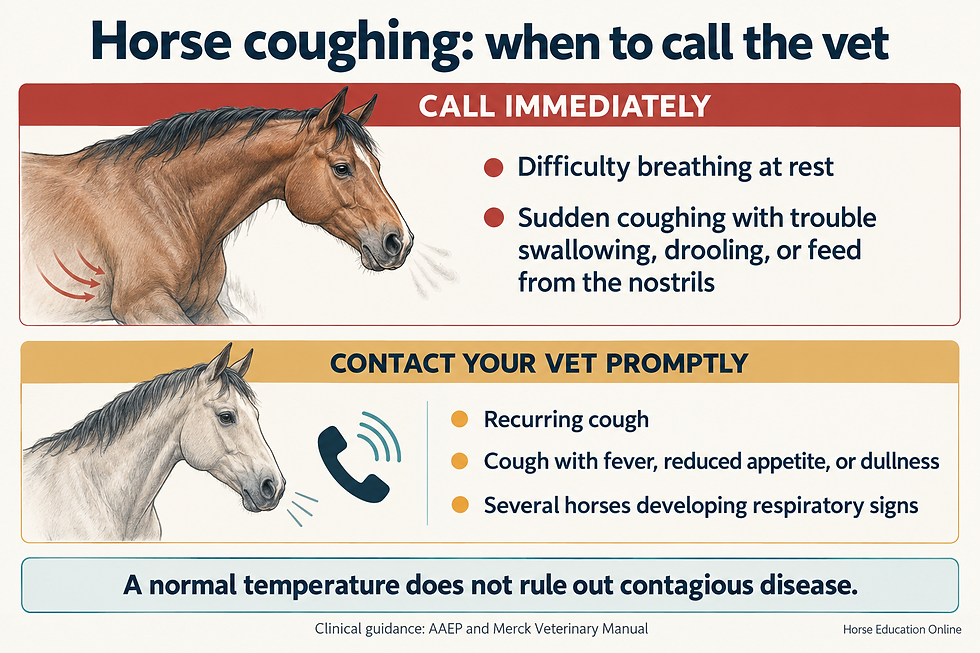
Look at breathing, swallowing, and the horse’s overall condition before trying to classify the cough.
The following guide helps you decide what to report and how quickly to seek advice.
What you notice | Why it matters | What to do |
Obvious breathing effort at rest, persistent nostril flaring, or worsening distress | The horse may be struggling to move air | Call immediately and minimize movement |
Sudden coughing with difficulty swallowing, drooling, or feed from the nostrils | Choke or another swallowing problem is possible | Call immediately; remove access to feed and water pending advice |
Significant or ongoing bleeding from the nose | Bleeding can have several causes, including serious ones | Stop work and call immediately |
Cough with fever, dullness, or reduced appetite | Infection or another significant illness is possible | Contact your veterinarian promptly and separate the horse |
Several horses developing new respiratory signs | A contagious problem needs consideration | Notify the barn manager and veterinarian promptly |
Repeated coughing during work or across several days | Airway disease may be present despite a normal appearance at rest | Arrange veterinary assessment rather than continuing to work through it |
This is an action guide, not a way to diagnose asthma, influenza, pneumonia, or another specific disease.
Recognizing increased breathing effort
Watch the horse’s chest and flank while it stands quietly.
Concerning changes include pronounced nostril flaring, a stronger-than-usual abdominal push, or an obvious struggle with each breath. These signs matter even if you have not counted the breathing rate.
Many healthy adult horses breathe around 8 to 16 times per minute at rest, although published reference ranges vary. Heat, excitement, recent exercise, pain, and illness can all increase the rate.
Count one complete rise and fall of the flank as one breath. Record the rate and whether breathing looks easy or laboured.
Do not use a number within a reference range to dismiss visible breathing difficulty.
UConn Extension’s guide to horse vital signs explains how to measure respiration. Our guide to the horse’s vital signs is a useful reference for routine checks.
A normal temperature does not clear the horse
A coughing horse without fever may have noninfectious airway disease. However, the absence of fever does not rule out a contagious infection.
Temperature can change during an illness, and signs vary between horses. One normal reading should not be used as permission to resume group turnout, travel, or training.
The AAEP’s infectious respiratory disease guidelines explicitly caution against excluding contagious disease because fever is absent.
For help recording and interpreting temperature alongside other signs, see our guide to fever in horses.
What can the timing of a horse’s cough tell you?
The timing helps your veterinarian decide what to investigate. It rarely identifies the cause on its own.
Coughing while eating hay or feed
When a horse coughs repeatedly while eating hay, consider what it is breathing as well as what it is swallowing.
Hay can release fine dust and mold particles close to the nostrils. This exposure can aggravate sensitive or inflamed airways. A cough during feeding may therefore be associated with equine asthma, even when swallowing appears normal.
However, sudden coughing with drooling, repeated swallowing attempts, an extended neck, or feed coming from the nose needs a different response. These signs raise concern for choke.
Do not assume every cough at a hay net is “just dust.” Note whether the horse is swallowing normally and whether the problem repeats with different forage.
Coughing during warm-up or exercise
A cough at the beginning of work is sometimes described as “clearing the throat.” That explanation should not become a reason to ignore a recurring pattern.
Notice whether the horse:
Coughs at the same point in every session
Continues coughing as work progresses
Tires earlier than usual
Shows an unexplained drop in performance
A horse does not need to cough continuously to have airway inflammation.
For example, a horse that regularly coughs during its first trot and has gradually become less willing to maintain work deserves assessment, even if it seems comfortable afterward.
Purdue University’s guidance on recognizing equine asthma early explains why subtle cough and performance changes matter.
Coughing in the stable or at rest
A cough associated with bedding changes, sweeping, or hay feeding may point to an environmental trigger. Record whether signs improve away from that setting. Also note coughing that continues when the horse is resting in a less dusty area.
Improvement after moving the horse is useful information, but it does not prove that the problem was harmless. An environmental exposure may be triggering an underlying inflammatory condition.
Smoke exposure can also produce cough, nasal discharge, and increased breathing effort. UC Davis’s guidance on wildfire smoke and horses explains the respiratory effects.
Coughing after travel
Report a new cough after transport, particularly if it comes with fever, reduced appetite, lethargy, or faster breathing. There are two important considerations: exposure to unfamiliar horses and the effects of the journey itself.
Long-distance transport, especially with the head held high, can interfere with normal clearance of airway secretions. This can contribute to lower-airway infection, including the condition often called shipping fever.
An apparently uneventful journey does not exclude a problem that becomes noticeable afterward.
The Merck Veterinary Manual’s pleuropneumonia guidance explains the connection between transport and pneumonia.
Does a dry or wet cough reveal the cause?
A dry cough sounds harsh and does not seem to involve obvious mucus. A wet-sounding cough may sound rattly or suggest secretions in the airways.
These descriptions are useful observations, but they are not reliable diagnostic labels.
For example, equine influenza can cause a harsh, dry cough. Airway inflammation can also cause coughing, and horses with respiratory disease do not always show visible nasal discharge.
Owners may never see material expelled even when airway secretions are present. Describe what you hear and see rather than deciding that “dry means allergies” or “wet means bacteria.”
A short video can help your veterinarian understand the sound and accompanying breathing pattern.
The AAEP’s equine influenza guidelines describe the typical dry cough, while the Merck Veterinary Manual’s respiratory overview explains the wider range of signs.
What causes coughing in horses?
Several conditions can overlap in their outward signs. A horse may also have more than one problem, such as a viral infection followed by bacterial pneumonia.
Equine asthma: inflammation, mucus, and narrowed airways
Equine asthma affects the lower airways. Inflammation, increased mucus, and narrowing of the airways make airflow less efficient.

The signs range from subtle exercise-related problems to obvious difficulty breathing at rest.
Mild to moderate asthma may cause occasional coughing or reduced exercise tolerance without increased breathing effort at rest. This is why a horse can look healthy in its stable while struggling during more demanding work.
Severe asthma can cause repeated cough, laboured breathing at rest, and a pronounced abdominal effort during exhalation. Over time, extra use of the breathing muscles may produce a visible “heave line.” Its absence does not rule out airway disease.
Older names include inflammatory airway disease, recurrent airway obstruction, and heaves. These are now discussed within the broader classification of equine asthma.
Dust from forage and bedding is important, but some horses have seasonal pasture-associated disease. “Outside” does not always mean “free from triggers.”
The Merck Veterinary Manual’s equine asthma guide explains these differences and why recurring signs need attention.
Equine influenza: a contagious cause of sudden cough
Equine influenza is a highly contagious viral respiratory infection.
A harsh cough may appear with fever, nasal discharge, lethargy, and reduced appetite. Signs vary according to the horse’s age and immunity, so not every infected horse looks equally ill.
The virus can damage the lining and clearance mechanisms of the respiratory tract. This helps explain why recovery involves more than waiting for the fever to disappear and why secondary bacterial complications can occur.
Vaccination reduces risk and severity but does not make infection impossible.
A new cough after a show, sale, or arrival of unfamiliar horses is therefore important history to report. Our guide to the equine influenza vaccine for horses explains vaccination and exposure risk.
Equine herpesvirus and other respiratory viruses
Equine herpesvirus types 1 and 4 can cause respiratory disease with fever, nasal discharge, cough, and reduced appetite.
They cannot reliably be distinguished from influenza by the cough’s sound or the horse’s appearance. Testing may be needed.
EHV-1 also matters because it can cause abortion and neurological disease. If a coughing horse develops weakness, incoordination, or difficulty urinating, tell your veterinarian immediately.
The Merck Veterinary Manual’s owner guide to equine herpesvirus explains the different forms of disease. A respiratory illness that seems mild in one horse may still matter to other horses on the property.
Strangles: cough with throat and lymph-node involvement
Strangles is a bacterial infection caused by Streptococcus equi subspecies equi.
Signs can include fever, thick nasal discharge, and swollen or abscessed lymph nodes under the jaw or around the throat. A softer cough may occur, sometimes during eating.
Inflammation and swelling around the throat can make swallowing uncomfortable. In more serious cases, enlarged lymph nodes can interfere with airflow.
The classic signs are not always equally obvious, especially in horses with previous immunity. Do not wait for a large external abscess before reporting a concerning combination of signs.
The AAEP’s strangles guidelines explain the clinical picture. Our guide to strangles in horses covers isolation and practical barn precautions.
Pneumonia: infection deeper in the lungs
Pneumonia involves inflammation and infection within the lungs. Pleuropneumonia also involves the tissues and space surrounding them.
A horse may show fever, depression, poor appetite, faster breathing, or discomfort. Coughing can occur, but its frequency alone does not tell you how seriously the lungs are affected.
Bacterial pneumonia may follow a viral infection, transport, or aspiration of material into the lungs. A change in the horse’s overall condition therefore matters as much as the cough itself.
For example, a horse that coughs only occasionally but stops eating and breathes faster after a long journey needs prompt attention.
Tell your veterinarian about recent travel, respiratory illness, or choke rather than reporting the cough in isolation.
Choke and aspiration: why swallowing problems can cause cough
Choke is a blockage of the esophagus, the tube carrying food to the stomach.
The airway may remain open, so the horse can still breathe. However, accumulated saliva and feed can spill into the respiratory tract and trigger coughing.
This is why feed from the nostrils, drooling, and difficulty swallowing are urgent signs even when the horse has not collapsed or stopped breathing.
Aspiration means material has entered the airway or lungs. It can lead to pneumonia, including after the original blockage has been relieved.
If you suspect choke, remove access to feed and water and call your veterinarian. Do not try to wash the blockage down with a hose or syringe.
The Merck Veterinary Manual’s guide to choke explains these complications.
Coughing in foals needs particular attention
Foals have different respiratory risks from adult horses. A young foal with cough, increased breathing effort, fever, or reduced nursing needs prompt veterinary advice.
One important cause is Rhodococcus equi, a bacterium associated with pneumonia and lung abscesses in young foals.
The disease can progress gradually, and outward signs may not become obvious until significant disease is present. The absence of a dramatic cough is therefore not reassuring by itself.
UC Davis’s guide to Rhodococcus equi explains the signs and why early recognition matters.
Less common causes: lungworm and exercise-related bleeding
Lungworm can cause cough and airway inflammation. Donkeys are an important source of pasture contamination, so sharing grazing with them is relevant history. Infection is relatively uncommon in horses and can be difficult to confirm.
The Merck Veterinary Manual’s lungworm guide explains why a routine fecal result does not always settle the question.
Exercise-induced pulmonary hemorrhage, or EIPH, involves bleeding into the lungs associated with strenuous exercise. Some owners report cough or reduced performance, but many affected horses have few outward signs.
Most horses with EIPH do not have visible blood at the nostrils. Equally, a nosebleed should not automatically be labelled EIPH because other causes are possible.
The University of Calgary’s Equine Respiratory Lab explains these limitations. These possibilities require veterinary investigation rather than a trial of dewormers or medication chosen at home.
What should you do when you first notice a cough?
Your first actions should protect the horse, reduce possible spread, and preserve useful information.
Stop repeated coughing from becoming part of the routine
Pause ridden work or lunging when coughing repeats. Do not increase the workload to test whether the horse “works through it.”
If the horse is distressed, minimize movement and call immediately. If it is comfortable but the cough recurs, arrange assessment before continuing normal training.
You do not need to decide whether the cause is asthma or infection before seeking advice.
Separate a horse with a new, unexplained cough
Limit contact with other horses while arranging advice, particularly after travel or when fever, discharge, or other affected horses are involved.
Use dedicated buckets and equipment. Notify the barn manager and follow precautions for hands and clothing. If referral is needed, tell the receiving clinic about respiratory signs before arrival.
The AAEP’s general biosecurity guidelines explain how isolation and handling practices reduce spread.
Several horses coughing can also reflect shared environmental exposure, so separation is a precaution while the cause is investigated. It is not proof that an outbreak has been diagnosed.
Reduce irritants without delaying care
Avoid sweeping, blowing aisles, or shaking out bedding beside the horse. Where safe and appropriate, provide a calmer, better-ventilated setting with less airborne dust.
Record whether signs change. Do not repeatedly expose the horse to dusty hay or strenuous exercise to reproduce the cough.
Environmental improvement can help, but it does not replace assessment when coughing persists or breathing is abnormal.
Give your veterinarian a clear timeline
Useful notes are specific:
Detail | Example of a useful observation |
Start | “First noticed yesterday evening; last seen normal that morning.” |
Pattern | “Coughs during hay feeding and occasionally at rest.” |
Breathing | “Breathing comfortably at rest” or “strong abdominal effort with each breath.” |
Temperature | Actual reading, time, and whether the horse had recently exercised |
Other signs | Appetite, energy, nasal discharge, or swallowing changes |
Exposure | Travel dates, new horses, new hay, bedding changes, or smoke |
Treatment | Product, amount, route, and time of anything already given |
If there is nasal discharge, report whether it comes from one nostril or both and whether it contains mucus, blood, or feed. Our guide to nasal discharge in horses explains why these distinctions matter.
Use our horse health log for owners to keep observations together. If a measurement was not taken, write “not measured.”
A short video of naturally occurring coughing or resting breathing may also help. Do not delay an urgent call to obtain one.
How does a veterinarian find the cause of a horse’s cough?
There is no single “cough test.” The investigation depends on the horse’s history, examination findings, and the conditions the veterinarian needs to distinguish.
Three questions guide the process:
Where is the problem? The throat and larger airways, smaller airways, lungs, or surrounding chest tissues?
What is causing it? Infection, inflammation, impaired swallowing, bleeding, or another problem?
How is the horse affected? Comfortable at rest, limited during exercise, or struggling to breathe?
These distinctions matter because similar outward signs can require very different treatment. The Merck Veterinary Manual’s respiratory disease overview explains this approach.
The examination provides a starting point
Your veterinarian may assess temperature, heart rate, breathing rate and effort, nasal airflow, discharge, lymph nodes, and sounds over the trachea and lungs.
The history helps put those findings in context. A sudden cough after a show raises different questions from a recurring winter cough during hay feeding.
A quiet chest examination does not always exclude disease. Some problems are subtle, affect only part of the lungs, or become more apparent during work.
This is why further testing may be recommended even when the horse is eating normally and looks comfortable in the stable.
Nasal swabs investigate particular infections
A nasal or nasopharyngeal sample may be tested for infectious agents such as equine influenza or equine herpesvirus.
PCR testing looks for genetic material from the organism. Results must be interpreted alongside the horse’s signs, exposure history, and the timing and quality of the sample.
A nasal swab is not a general test for every cause of cough. A negative result for selected respiratory viruses does not exclude asthma, pneumonia, or a swallowing problem.
Testing for a suspected infection in the lungs may require material collected from deeper in the respiratory tract.
The AAEP’s infectious respiratory disease guidelines explain how samples are selected for different suspected conditions.
Endoscopy lets the veterinarian see the airways
An endoscope is a flexible instrument with a camera. It allows the veterinarian to examine structures that cannot be assessed simply by looking into the nostrils.
Depending on the investigation, it can help identify mucus, inflammation, structural abnormalities, material in the airway, or bleeding.
However, seeing mucus does not establish why it is there. Additional sampling may be needed.
The University of Illinois’s guide to investigating a horse’s cough explains how endoscopy contributes to the examination.
A tracheal wash and BAL answer different questions

These procedures both collect airway material, but they sample different areas.
A tracheal wash collects material from the trachea. It is particularly useful when an infection is suspected because the sample can be examined for inflammatory cells and microorganisms and submitted for culture.
A bronchoalveolar lavage, usually shortened to BAL, samples material from smaller airways and air sacs. Sterile fluid is introduced and recovered so the cells can be examined.
BAL is especially useful for investigating lower-airway inflammation associated with equine asthma. It can also contribute to other investigations, including exercise-related bleeding.
The veterinarian selects the procedure according to the question being asked and the horse’s condition. These are not interchangeable home tests.
The Merck Veterinary Manual’s diagnostic test guide explains the main uses.
Imaging and blood tests add information
Chest ultrasound can identify certain changes near the lung surface and fluid surrounding the lungs. Radiographs may help investigate deeper chest abnormalities.
Blood tests can reveal inflammation or other changes relevant to the horse’s health. They help assess the whole patient rather than simply naming the cough.
One limitation is particularly important: normal routine bloodwork does not rule out equine asthma. Local inflammation in the airways may require airway sampling to identify.
The test results are interpreted together. No single normal result should be treated as proof that the entire respiratory system is healthy.
For more on individual conditions and investigations, see our guide to respiratory diseases in horses.
How is coughing in horses treated?
Treatment addresses the cause of the cough and the horse’s immediate needs.
A coughing horse with asthma may need inflammation control and environmental changes. A horse with bacterial pneumonia needs a different plan. A horse with choke needs the obstruction assessed and relieved.
The same medication will not be appropriate for all three.
Asthma treatment has two connected parts
For equine asthma, treatment commonly combines:
Reducing exposure to the particles or allergens triggering the disease
Controlling inflammation and airway narrowing with medication when needed
Corticosteroids reduce airway inflammation. Bronchodilators relax muscles around narrowed airways and can make breathing easier.
These drugs have different roles. Opening the airways does not, by itself, adequately treat the inflammation causing the problem.
The Merck Veterinary Manual’s asthma guidance cautions against using bronchodilators as the sole treatment.
Medication also cannot compensate indefinitely for continued exposure to unsuitable forage or a dusty environment.
Inhaled medication still needs a veterinary plan
An inhaler or nebulizer can deliver medication directly to the respiratory tract. Oral or injectable treatment may also be appropriate.
The choice depends on the horse, severity, medication, practical delivery, and possible adverse effects.
An inhaled product is not automatically effective simply because it reaches a mask. Particle size, device performance, breathing patterns, and airway secretions influence where the medication goes.
Use only products and equipment recommended by your veterinarian. Do not put essential oils or homemade mixtures into a nebulizer.
UC Davis’s guide to equine nebulizers explains the advantages and limitations of inhalation therapy.
Viral infections usually need rest and supportive care
For uncomplicated equine influenza, treatment generally centres on rest and supportive care under veterinary direction.
Antibiotics do not treat the influenza virus itself. They may be needed when a secondary bacterial infection is suspected or identified. A horse that becomes brighter or loses its fever may still have damaged respiratory tissues. Returning to demanding work too soon can interrupt recovery.
The UC Davis guide to equine influenza explains why treatment and return to work must account for tissue healing.
Pneumonia may require more intensive care
Bacterial pneumonia can require antimicrobial treatment, fluid and nutritional support, and repeated assessment.
Where possible, culture and susceptibility testing help guide antimicrobial selection. A severely affected horse may need hospital care, oxygen, or drainage of infected fluid from around the lungs.
Treatment length depends on the disease and response. Improvement in appetite does not necessarily mean the lungs have recovered.
The Merck Veterinary Manual’s pleuropneumonia guide explains why treatment can be more involved than a short course of medication.
Tell the veterinarian about medication already given
Report the product, dose if known, route, and time.
Do not restart an old prescription simply because the cough sounds like a previous episode. Corticosteroids, for example, may be useful in asthma but can worsen an existing infection and require particular caution in horses predisposed to laminitis.
The University of Saskatchewan’s asthma resource explains these treatment considerations.
If your horse already has an asthma plan, ask your veterinarian which changes should trigger a call rather than an automatic repeat of treatment.
How can you reduce airway irritation in everyday management?
For a horse with an environmental component to its cough, focus on what it actually inhales throughout the day.
A clean-looking aisle does not guarantee clean air around the nostrils.
Start with the horse’s breathing zone
The breathing zone is the area around the horse’s nose. Forage often sits directly within it for hours.

Ask:
Does the horse bury its muzzle in a round bale?
Does opening a hay net release particles beside its nostrils?
Are neighbouring horses being fed dusty hay in shared airspace?
Is the horse present during sweeping or bedding changes?
Does arena dust coincide with coughing?
These questions identify exposures that a general tidy-up can miss.
The AAEP’s guide to reducing respirable particles explains why the breathing zone deserves particular attention.
Choose forage management that fits the horse
There is no single forage choice that works for every coughing horse.
Option | Potential benefit | Important limitation |
Good-quality dry hay | Provides familiar forage without additional preparation | Even apparently good hay can release respirable particles |
Soaked hay | Can reduce airborne dust during feeding | Nutrient losses and handling of wet leftovers need consideration |
Properly steamed hay | Can reduce particles and microbial contamination | Equipment performance matters; it does not guarantee control of asthma |
Forage cubes or pellets | May provide a lower-dust fibre source | Products differ and may need preparation or ration balancing |
A suitable complete feed | Can replace forage when specifically formulated and prescribed for that purpose | A regular concentrate or grain pellet is not automatically a forage replacement |
Pasture | May reduce exposure to stable hay and bedding | Seasonal pasture-associated asthma or other health constraints may limit suitability |
Discuss substantial changes with your veterinarian or equine nutritionist.
The research review Environmental Management of Equine Asthma explains the differences between forage options. Our guide to the basics of equine nutrition provides background on balancing the whole diet.
Soaking hay requires a complete routine
Ask your veterinarian about soaking time, feeding method, and handling of leftovers. Simply spraying the outside of a flake may leave much of it dry. Wet hay needs prompt, appropriate handling. Allowing soaked forage to sit, deteriorate, or dry out again can undermine the intended benefit.
Soaking can also remove nutrients. If it becomes part of the daily routine, review the ration and monitor intake and body condition. University of Minnesota Extension’s guidance on soaking and steaming explains practical trade-offs.
There is evidence that careful soaking can help. In a small six-week study involving ten horses with severe asthma, soaked hay improved lung function, but the protocol included thorough soaking and removal of dried-out leftovers.
That result supports a consistent management routine. It does not mean briefly wetting hay will provide the same outcome.
The study, Effects of soaked hay on lung function and airway inflammation, also illustrates why improved breathing and complete resolution of inflammation are different outcomes.
Steaming is useful, but it is not a cure
Proper steaming can reduce dust and microbial contamination. Results depend on the equipment and process used.
Do not use steaming as a reason to continue feeding unsuitable forage. Start with appropriate hay and follow the equipment’s validated instructions.
Reducing particles in the hay does not prove that the horse’s airway inflammation is adequately controlled.
RCVS Knowledge’s review of a hay-steaming study explains this limitation. Continue monitoring the horse and following the veterinary treatment plan.
Review bedding, ventilation, and turnout together
Choose bedding that is genuinely low in dust. A material’s name alone does not tell you how dusty the particular batch will be.
Improve ventilation and avoid creating dust beside the horse during cleaning. Consider the surrounding stalls and shared airspace as well as the affected horse’s own stall.
Turnout can help when it reduces exposure, but it should suit the horse’s trigger pattern. A horse with seasonal pasture-associated asthma may need a different arrangement.
The Royal Veterinary College’s respiratory disease guidance discusses environmental changes, while the review of equine asthma by Couëtil and colleagues explains why triggers vary between horses.
What if the cough might be contagious?
Until the cause is clarified, a new respiratory illness should be managed with the other horses in mind.
Separation is only one part of the plan. Hands, clothing, buckets, tack, and handling routines can also move infectious material.
Make isolation workable
Ask your veterinarian and barn manager to agree on:
Where the affected horse will stay
Which equipment will be dedicated to it
Who will provide care
How hands, clothing, and footwear will be managed
Which other horses need monitoring
Whether movement on or off the property should stop
What is required before isolation ends
If the same person must care for several groups, healthy unexposed horses should generally be handled before exposed horses, with sick horses last.
The AAEP’s general biosecurity guidelines explain how to organize these precautions.
Improvement does not determine when isolation ends
A horse that looks brighter may still require separation. Release depends on the suspected or confirmed disease, testing where appropriate, and the veterinarian’s instructions.
Do not use “no cough heard today” as the only release criterion.
For a disease-specific example, our guide to strangles in horses explains why outward recovery and infectious risk may follow different timelines.
Vaccination supports prevention but does not replace it
Review vaccination with your veterinarian according to travel, competition, boarding, age, and local risk.
Vaccination can reduce the risk and severity of certain respiratory infections. It does not prevent every cause of coughing or remove the need for isolation when illness appears.
The AAEP’s equine influenza vaccination guidelines provide professional recommendations. Our guide to the equine influenza vaccine for horses explains common owner questions.
How do you know whether the horse is recovering?
Recovery involves more than counting coughs.
Depending on the diagnosis, your veterinarian may want you to monitor resting breathing, temperature, appetite, energy, discharge, medication response, and tolerance of permitted activity.
Record changes you can actually compare
Use similar observation conditions where possible. A breathing count after excitement is not directly comparable with one taken during quiet rest.
Describe the context:
“No cough observed during twenty minutes of morning feeding.”
“Coughing restarted when dry hay was fed in the neighbouring stall.”
“Breathing effort has increased despite medication.”
“Temperature has risen again after appearing normal yesterday.”
These are observation examples, not diagnostic rules. A quiet twenty-minute period cannot prove that a cough has resolved.
Our horse health log for owners helps organize readings and changes. Our guide to the horse’s vital signs explains routine measurements.
Ask what improvement should look like
Before the visit ends, clarify:
Which signs should improve first?
When should progress be reassessed?
What should prompt an earlier call?
Will further examination or testing be needed?
Which environmental changes must continue?
Do not change or discontinue prescribed medication simply because the horse coughs less. Follow the plan and report unexpected changes.
A persistent or returning cough may mean that exposure continues, treatment needs adjustment, a complication has developed, or the original explanation needs reconsideration.
When can the horse return to riding?
The diagnosis determines the plan. There is no safe universal rule such as “three days without coughing.”
After an infection, allow time for airway healing
A horse may recover its appetite and lose its fever before the respiratory lining has healed.
For equine influenza, the Merck Veterinary Manual’s owner guidance describes a minimum rest period of three weeks and a general guideline of one week of rest for each day of fever.
These are influenza-specific recommendations, not rules for every cough. Your veterinarian must adapt rest and return to work to the horse’s illness and any complications.
The Equine Disease Communication Center’s influenza factsheet also explains the importance of avoiding strenuous activity during recovery.
For asthma, assess control rather than waiting for a calendar date
Asthma may require ongoing management even when the horse is comfortable.
Before resuming work, discuss breathing comfort, treatment response, environmental control, and whether reassessment is needed. Some horses can return to useful work with appropriate care; the plan depends on severity and individual response.
Do not use medication to make a horse appear ready for work while exposure and inflammation remain inadequately controlled.
Restart gradually under the agreed plan
Ask what activity is permitted and how to increase it.
If coughing, unusual breathing effort, reduced willingness to work, or abnormal recovery appears, stop the session and contact your veterinarian.
A successful return is one the horse tolerates comfortably. Completing the planned ride is not evidence that the respiratory problem has resolved.
Frequently asked questions about coughing in horses
Is a horse’s cough always caused by allergies?
No. Asthma is one possibility, but infections, pneumonia, swallowing problems, parasites, and other conditions can also cause coughing.
Even when hay or bedding seems to trigger the cough, veterinary assessment may be needed to identify the underlying problem.
Can a horse have asthma without obvious breathing difficulty?
Yes. Mild to moderate asthma may cause cough or reduced exercise tolerance without increased breathing effort at rest.
This is why repeated warm-up coughing or an unexplained performance change deserves attention even when the horse looks comfortable in the stable.
Does yellow or green nasal discharge mean antibiotics are needed?
Colour alone cannot establish the cause or determine treatment. Your veterinarian considers duration, distribution, other signs, examination findings, and tests where appropriate.
Report the discharge accurately. Do not choose antibiotics from its colour.
Our guide to nasal discharge in horses explains which observations are useful.
Can I give a cough supplement before calling the vet?
A supplement should not delay assessment or substitute for treatment of the cause.
A cough associated with pneumonia, choke, or significant airway inflammation needs an appropriate veterinary plan. Ask whether a particular product has evidence for your horse’s diagnosed condition rather than assuming a “respiratory support” label makes it suitable.
Why does the cough return after medication stops?
In an asthmatic horse, medication may reduce signs while continued exposure keeps driving inflammation. Recurrence can also mean that the treatment plan or diagnosis needs review.
Tell your veterinarian when the cough returned and what changed in feed, bedding, housing, or workload. Do not automatically restart old medication without advice.
Can horses with chronic coughing still have a good quality of life?
Often, appropriate diagnosis and management can improve comfort and allow suitable activity. The outlook depends on the cause, severity, lung changes, and ability to maintain the required care.
Chronic cough should therefore become a reason to establish a workable plan, rather than a symptom accepted as normal for that horse.



Comments