Colic in Horses: Early Signs, Causes, and What to Do

Updated: Sep 14
Colic in horses means abdominal pain. It is not one specific disease, and the underlying cause can range from relatively simple digestive upset to a serious intestinal problem requiring hospital care or surgery.
Because different causes can produce similar signs, owners cannot reliably determine the severity of colic from one behavior alone. The safest approach is to recognize changes early, contact your veterinarian, and provide clear information about what you are seeing.
If you think your horse may be showing signs of colic, call your veterinarian. Do not wait until you have checked every vital sign or tried walking the horse before making the call. Your veterinarian can tell you what to do while help is being arranged. Severe abdominal pain can also make a normally quiet horse unpredictable, so keep yourself and other handlers safe. World Horse Welfare provides additional guidance on recognizing and responding to colic.
What are the early signs of colic in horses?
The signs of colic in horses can be subtle or dramatic. Some horses show obvious abdominal pain, while others simply behave differently from normal.
Knowing your own horse's usual appetite, manure production, activity level, and behavior can make early changes easier to recognize.
Subtle changes in appetite, behavior, and manure
Early signs may include:
Eating less than normal or refusing feed
Showing less interest in water
Appearing unusually quiet or withdrawn
Standing away from other horses
Spending more time lying down than usual
Producing less manure than normal
Passing manure that is noticeably different from the horse's usual pattern
Repeatedly looking toward the abdomen
Showing a general change in normal behavior


A single change does not tell you what type of colic is occurring, but a cluster of changes can be important.
For example, a normally enthusiastic eater that suddenly ignores feed and becomes quiet deserves attention even if the horse is not rolling or showing dramatic pain.
The University of Minnesota Extension's colic guidance emphasizes the importance of recognizing changes from an individual horse's normal behavior.
More obvious signs of abdominal pain
As discomfort becomes more apparent, a horse may:
Paw repeatedly
Look or kick toward the flank
Stretch as though trying to urinate
Lie down and get back up repeatedly
Roll
Sweat without an obvious reason
Become restless
Move around the stall repeatedly
Show reduced interest in surroundings
A horse does not need to show every sign on this list to have colic.
Likewise, one dramatic behavior does not tell you exactly what is happening inside the abdomen. Veterinary assessment is needed to determine the likely cause and severity.
The Merck Veterinary Manual's overview of colic in horses describes the range of behavioral signs that may occur with abdominal pain.
Quick recognition checklist
What you notice | What to do |
Horse suddenly refuses feed | Note when the horse last ate normally and contact your veterinarian if colic is suspected |
Less or abnormal manure | Record the last normal manure and any changes you have noticed |
Pawing or looking at the flank | Observe safely and report the behavior to your veterinarian |
Repeated lying down or getting up | Keep handlers safe and call your veterinarian |
Rolling or intense restlessness | Call promptly and avoid putting yourself in danger trying to physically restrain the horse |
Sweating or obvious discomfort | Report the change along with any other signs you can safely observe |
This checklist helps you recognize changes. It cannot tell you whether the horse has gas colic, an impaction, a displacement, or another specific condition.
What should you do if you think your horse has colic?
When owners search what to do when a horse colics, they often find long lists of tasks to complete before calling a veterinarian.
The order should be simpler:
Call first. Then collect useful information and follow your veterinarian's instructions.
Call your veterinarian and keep people safe
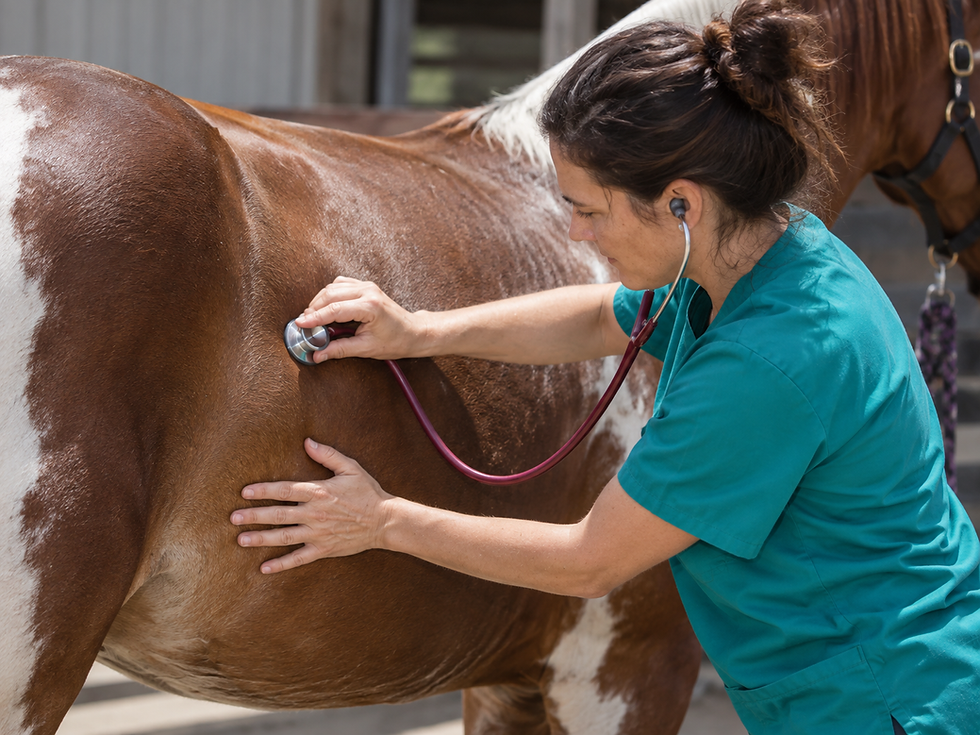
Contact your veterinarian as soon as you suspect colic.
Be prepared to explain what changed and when you first noticed it. If your horse is showing severe pain, tell the veterinarian immediately.
Do not delay the call because you are trying to collect a perfect set of measurements.
A horse in significant abdominal pain may roll, strike, kick, or move suddenly. Your safety matters. Do not put yourself between the horse and a wall or attempt to physically stop a large horse from going down if doing so puts you in danger.
World Horse Welfare's colic guidance recommends contacting a veterinarian when signs of colic are identified rather than waiting for the condition to become more severe.
Follow instructions about feed, water, and movement
Your veterinarian may give specific instructions about feed, water, and whether the horse should be walked.
In general, do not keep feeding a horse that is actively showing signs of colic while waiting for veterinary advice. Follow your veterinarian's directions regarding access to water.
Walking is sometimes used to keep a horse safely occupied or to reduce the risk of injury from uncontrolled rolling, but walking is not a cure for colic.
Do not exhaust a horse by forcing it to walk continuously.
If the horse is quiet and safe, your veterinarian may prefer that it remain calm rather than being marched around unnecessarily.
The appropriate choice depends on the individual situation. University of Minnesota Extension provides additional owner guidance on what to do while veterinary care is being arranged.
Record observations without delaying care
Information from the owner can help the veterinarian understand how the episode started and whether the horse is changing over time.
If it can be done safely, record:
Information to report | What to note |
Start time | When signs were first noticed and when the horse was last seen acting normally |
Behavior | Pawing, flank-watching, lying down, rolling, sweating, restlessness, or quieter-than-normal behavior |
Manure | When the horse last passed normal manure and whether anything has changed |
Appetite | Whether the horse ate its last meal and whether it is interested in food now |
Water | Any obvious change in normal drinking |
Recent changes | Feed changes, turnout changes, travel, exercise, new hay, or other management changes |
Medication | Anything already given, including the product, amount if known, and time it was given |
Measurements | Temperature, pulse, or other observations obtained safely |
If you did not measure something, say “not measured.”
Do not assume that an unmeasured temperature, heart rate, or other value was normal.
Our guide to checking your horse's vital signs can help owners become familiar with collecting baseline information before an emergency occurs.
For a practical preparation checklist, see our emergency colic kit and first-hour checklist.
Give medication only under veterinary direction
Do not give Banamine, bute, mineral oil, or another treatment simply because you believe you know what type of colic the horse has.
Pain-relieving medication can be an important part of veterinary treatment, but the veterinarian needs to know what has already been given and when. Medication may also change the horse's visible signs without correcting the underlying problem.
If your veterinarian instructs you to give a medication you already have, follow their directions and tell them exactly what was administered.
Do not attempt procedures such as passing a stomach tube or giving mineral oil yourself.
These are veterinary procedures.
The American College of Veterinary Internal Medicine's VetSpecialists resource on colic provides additional information about veterinary assessment and treatment.
Why can apparently mild colic still be serious?
A horse that is standing quietly or has stopped rolling is not automatically out of danger.
The amount of visible pain does not always reveal what is happening inside the abdomen. Pain can change over time, return after temporary improvement, or become less obvious after medication.
This is why a single behavior or measurement should not be used as a clearance rule.
For example:
A horse does not need to be rolling violently to have an important intestinal problem.
Temporary improvement does not always mean the cause has resolved.
One heart-rate measurement should not be used by itself to decide whether veterinary care is necessary.
Passing manure does not automatically prove that the episode is over.
If pain persists, returns, or the horse's condition changes, update your veterinarian.
The Merck Veterinary Manual and World Horse Welfare both emphasize evaluating the whole clinical picture rather than relying on one sign.
What causes colic in horses?
There is no single answer to what causes colic in horses.
Colic describes abdominal pain, and many different problems involving the gastrointestinal tract can produce it. Some cases respond to medical treatment, while others require more intensive care.
The signs an owner sees are often not specific enough to identify the cause at home.
Gas and spasmodic colic
Gas can accumulate within parts of the intestinal tract and stretch the bowel, producing discomfort.
Spasmodic colic involves increased intestinal contractions or spasms that can also cause abdominal pain.
These types of colic may respond to medical treatment, but an owner cannot safely conclude that an episode is “just gas” based on pawing, rolling, gut sounds, or another outward sign.
A veterinarian still needs to evaluate the horse and consider other possible causes.
Impaction colic

An impaction occurs when intestinal contents become packed together and do not move normally through part of the digestive tract.
Several factors can contribute to impaction risk, including changes in feed or water intake and other management or health factors.
A horse with an impaction may show reduced appetite, decreased manure production, or abdominal discomfort, but these signs are not exclusive to impaction.
The diagnosis requires veterinary assessment.
Sand accumulation and enteroliths
Horses living or feeding in sandy environments can ingest sand. In some horses, accumulated sand can contribute to intestinal irritation, obstruction, or other digestive problems.
Enteroliths are mineral concretions that form within the intestinal tract of some horses. Depending on their size and location, they can contribute to intermittent or more serious obstruction.
Neither problem can be diagnosed simply from the horse's visible pain behavior.
Geography, feeding environment, history, examination findings, and diagnostic tests may all contribute to the veterinarian's assessment.
Intestinal displacement and strangulation
Parts of the intestine can sometimes move from their normal position. In other situations, blood flow to a section of intestine can become compromised.

These conditions are among the reasons colic must be taken seriously.
Some intestinal displacements may be managed medically, while other conditions require surgical treatment. A horse's outward behavior alone cannot reliably distinguish a surgical problem from one that can be treated medically.
Early veterinary assessment and repeated evaluation can be important when the horse's condition is changing.
Inflammation and other gastrointestinal problems
Inflammation affecting the stomach or intestines can also result in abdominal pain.
Colic may additionally be associated with a variety of other gastrointestinal problems, which is why veterinarians consider the horse's history, examination findings, response to treatment, and diagnostic tests together.
The goal is not simply to label the horse as “colicky.” It is to determine, as far as possible, why the horse is in pain and what treatment is appropriate.
The ACVIM VetSpecialists overview and University of Minnesota Extension's colic resource provide owner-level explanations of several common causes.
Factors that can increase the risk
A specific cause cannot be identified in every episode of colic, and a risk factor is not the same thing as a diagnosis.
However, long-term management factors that may be relevant to colic risk include:
Sudden changes in feed or feeding routine
Inadequate or inconsistent access to water
Changes in turnout or activity
Dental problems that interfere with normal chewing
Parasite burdens or inappropriate parasite-control practices
Individual history of previous colic
Certain environmental or management conditions
Rather than making several major changes at once, aim for consistent management and discuss your horse's individual feeding, dental, hydration, and parasite-control needs with your veterinarian.
For the broader principles behind forage, concentrates, and feeding management, see our guide to the basics of equine nutrition.
If reduced drinking or hydration is a concern outside an active emergency, our guide to signs of dehydration in horses explains what owners can monitor.
The important distinction is this: good management can help reduce risk, but it cannot guarantee that a horse will never develop colic.
How does a vet diagnose colic?
Veterinarians diagnose colic by combining the horse's history with a physical examination and, when needed, additional tests.
There is no single test that identifies every cause of abdominal pain.
The goal is to determine how the horse is doing, whether the condition is changing, and whether the findings suggest a problem that can be managed medically or requires more intensive treatment.
History, examination, and reassessment
The information you provide can be important.
Your veterinarian may ask:
When the horse was last seen acting normally
When signs of colic began
Whether the horse has eaten or drunk normally
When the horse last passed manure
Whether manure production has changed
Whether the horse has been rolling, pawing, sweating, or repeatedly lying down
Whether there have been recent feed or management changes
Whether the horse has had previous episodes of colic
Whether any medication has already been given
The physical examination may include assessment of the horse's heart rate, breathing, hydration, mucous membranes, abdominal sounds, temperature, pain level, and overall condition.
One examination may not tell the whole story.
A horse's findings can change over time, so reassessment can be important, particularly if pain continues, returns after treatment, or the horse's condition deteriorates.
Tests that may be needed
Depending on the findings, your veterinarian may recommend additional procedures.
Test or procedure | What it helps the vet assess |
Physical examination | Pain, circulation, hydration, vital signs, abdominal sounds, and overall condition |
Nasogastric tube | Stomach contents and pressure, including whether fluid is accumulating in the stomach |
Rectal examination | Position, size, contents, and tension of portions of the abdomen that can be reached safely |
Ultrasound | Appearance, position, movement, and fluid patterns involving parts of the abdomen |
Blood tests | Hydration, inflammation, organ function, circulation, and other systemic changes |
Abdominal-fluid sampling | Information about changes occurring within the abdominal cavity |
These are veterinary procedures.
Not every horse needs every test, and the order of testing depends on the individual case.
The Merck Veterinary Manual's colic overview explains several of the examinations and diagnostic procedures commonly used in horses with abdominal pain.
The University of Minnesota Extension colic guide also provides a useful owner-level explanation of the veterinary examination.
How is colic in horses treated?
There is no universal treatment for colic.
Treatment depends on the suspected cause, how severe the horse's condition is, the findings on examination, and how the horse responds over time.
Medical treatment
Many cases of colic can be treated medically.
Depending on the cause and the horse's condition, veterinary treatment may include:
Pain relief
Fluid support
Treatment to correct dehydration or circulation problems
Management of intestinal contents
Monitoring and repeated examination
Other medications or procedures selected for the specific problem
The exact treatment plan varies considerably.
For example, the appropriate management for a mild spasmodic episode may be very different from the plan for an impaction or an inflammatory intestinal disease.
Owners should not attempt to choose a treatment based only on what the horse looks like.
When surgery or hospital care may be needed
Some horses need referral to a veterinary hospital for more intensive monitoring, diagnostics, treatment, or surgery.
Referral does not automatically mean that surgery will be performed.
Hospital care can also provide access to continuous monitoring, intravenous fluids, advanced imaging, repeated examinations, and specialist assessment.
Surgery may be recommended when the veterinarian is concerned about a problem that cannot be corrected medically, such as certain intestinal displacements, obstructions, or conditions that compromise blood supply to the bowel. The decision is based on the horse's complete clinical picture rather than on one outward sign.
Discussing treatment options and prognosis
If hospital care or surgery is being considered, ask the veterinary team to explain:
What they suspect is happening
What further testing may clarify
What treatment options are available
Whether referral is recommended
What changes would make surgery more or less likely
What recovery may involve
What the expected costs are for that specific case
There is no single survival percentage, treatment cost, or recovery estimate that accurately applies to every horse with colic.
The cause, severity, timing, response to treatment, and the horse's overall health all affect prognosis.
The Merck Veterinary Manual and ACVIM VetSpecialists provide additional information about medical and surgical management of colic.
Recovery and feeding after colic
Once a horse appears more comfortable, it can be tempting to assume the episode is completely over.
Recovery still depends on the underlying cause and treatment.
A horse that had a mild medically managed episode may have very different instructions from a horse recovering from a significant impaction, hospitalization, or abdominal surgery.
Follow the discharge and refeeding plan
Before returning to the horse's normal routine, make sure you understand your veterinarian's instructions for:
When feed can be reintroduced
What type of feed should be offered
How much should be offered at first
Access to water
Medication
Turnout and exercise
Monitoring manure production
Follow-up examination or testing
There is no single refeeding timetable that is appropriate after every type of colic.
Do not assume that a horse should immediately receive its normal meal because the visible pain has stopped.
Likewise, do not apply a prolonged fasting plan unless your veterinarian has specifically instructed you to do so.
Know when to contact the vet again
During recovery, contact your veterinarian if signs of abdominal pain return or if the horse develops new concerns.
These may include:
Reduced appetite again
Renewed pawing or flank-watching
Repeated lying down
Rolling
Reduced or abnormal manure production
Increasing lethargy
Abnormal sweating
Worsening discomfort
Any other change your veterinarian has asked you to monitor
A written record can help you recognize patterns, but a good-looking observation log does not prove that the original problem has fully resolved.
The ACVIM VetSpecialists colic resource and University of Minnesota Extension both emphasize that follow-up depends on the individual horse and the underlying problem.
How can you reduce the risk of colic?
Not every case of colic can be prevented.
The goal of prevention is to reduce avoidable risk and create a consistent management routine that supports normal digestive function.
Consistent feeding, water access, and routine
Horses generally benefit from consistency.
Useful long-term management principles include:
Avoiding sudden feed changes
Introducing new feeds gradually
Providing regular access to appropriate forage
Ensuring consistent access to clean water
Monitoring changes in drinking during hot weather, cold weather, travel, or illness
Avoiding abrupt changes in turnout or feeding routine when possible
Watching individual horses that have a history of digestive problems more closely
These are prevention principles, not instructions for managing an active colic episode.
If you are currently dealing with colic, follow your veterinarian's directions about feed and water.
For broader feeding guidance, see the basics of equine nutrition.
If you are concerned that your horse may not be drinking enough, review our guide to how to tell if a horse is dehydrated.
Dental care and a vet-led parasite-control plan
Poor dental function can affect how effectively a horse chews forage.
Regular dental assessment based on the horse's individual needs can help identify problems that may interfere with normal eating.
Parasite control should also be individualized.
Modern parasite-management plans may use fecal testing, the horse's age, management conditions, geographic risk, and veterinary guidance rather than relying on a universal calendar or rotating dewormers automatically.
Discuss an appropriate parasite-control program with your veterinarian rather than assuming every horse should follow the same schedule.
Know your horse's normal behavior and plan for emergencies
Prevention also includes preparation.
Knowing what is normal for your horse makes abnormal behavior easier to recognize.
It is useful to know:
Your veterinarian's emergency contact information
How you would arrange transport if referral is needed
Where the nearest appropriate referral hospital is
How to safely obtain basic observations
What medications you currently have on hand
Your horse's important medical history
Keep that information somewhere accessible before an emergency occurs.
Our emergency colic kit and first-hour checklist covers preparation in more detail.
The World Horse Welfare colic guidance and University of Minnesota Extension provide additional information about risk reduction and management.
Good management can lower risk, but no feeding, dental, hydration, or parasite-control program can guarantee that a horse will never experience colic.
Questions about colic in horses
Can colic be treated at home?
Sometimes colic can be treated successfully at the farm, but that does not mean owners should diagnose and treat it independently.
Your veterinarian may examine the horse and recommend medical treatment at home. The important distinction is that treatment should follow veterinary assessment and direction rather than assumptions about the type of colic.
Should you walk a horse with colic?
Walking is not a universal treatment for colic.
Your veterinarian may recommend limited walking in some situations, particularly if it helps keep the horse calm and safe. Do not force an exhausted or painful horse to walk continuously. The decision should be based on veterinary advice, the horse's comfort, and handler safety.
Should a horse with colic have food or water?
Do not continue feeding a horse that is actively showing signs of colic while waiting for veterinary advice.
Follow your veterinarian's instructions regarding water because the appropriate advice can depend on the individual situation and suspected problem. Do not force food, water, or other substances into the horse.
Can you give Banamine or bute for colic?
Only under veterinary direction.
Pain-relieving medications such as flunixin meglumine, commonly known by the brand name Banamine, may be used in veterinary management of colic, but the veterinarian needs to know what was given and when.
Do not give medication simply to see whether the horse improves, and do not use the response to medication as proof that the underlying problem is minor.
Does every horse with colic need surgery?
No.
Many cases of colic are managed medically. Surgery is considered when the veterinarian suspects a problem that is unlikely to resolve with medical treatment alone or when the horse's condition indicates that surgical exploration may be necessary.
Referral to a hospital also does not automatically mean surgery will occur.
How long does it take a horse to recover from colic?
There is no single recovery timeline.
Recovery depends on the cause of the colic, how severe it was, the treatment required, and whether surgery or hospitalization was necessary.
Follow the individual feeding, medication, exercise, and monitoring plan provided by your veterinarian rather than relying on a fixed number of days.
Know the signs, but do not try to diagnose the cause yourself
The most important owner skill with colic is not identifying whether a horse has gas, an impaction, or a displacement.
It is recognizing that something has changed and responding appropriately.
Loss of appetite, reduced manure, pawing, flank-watching, repeated lying down, rolling, sweating, or unusual behavior can all be signs of colic in horses.
When colic is suspected, call your veterinarian and let the examination guide the next steps.
For emergency preparation, keep our colic kit and first-hour checklist somewhere easy to access.
You can also explore other horse symptoms through the Horse Education Online Health Hub.
Keep your horse's health information organized
Knowing when something changed is often easier when you have a record of your horse's normal routines, observations, and health history.
Explore Horse Tracker to learn more about keeping important horse information organized in one place.
References
American College of Veterinary Internal Medicine, VetSpecialists. Colic in Horses.
Merck Veterinary Manual. Colic in Horses.
University of Minnesota Extension. Colic in Your Horse.
World Horse Welfare. Colic in Horses.


Comments