
Diarrhea in Horses: Causes, Warning Signs, and What to Do

Diarrhea in horses is a symptom, not a diagnosis. It can develop when the intestine is inflamed, normal digestion is disrupted, or water is no longer absorbed and retained in the usual way.
A horse passing softer manure after a feeding change presents a different situation from one producing repeated watery diarrhea, refusing feed, or becoming weak. Formed manure with a separate stream of fecal water is different again.
The important questions are: What has changed in the manure? How is the horse behaving? Are there signs of dehydration, pain, or illness?
Because different causes produce similar signs, appearance alone cannot identify the problem. The Merck Veterinary Manual’s overview of intestinal disorders explains the range of conditions involved.
Contact your veterinarian immediately for sudden watery or profuse diarrhea, particularly if the horse has fever, reduced appetite, colic signs, weakness, or signs of dehydration. Seek prompt advice for any foal with diarrhea. Do not wait for the horse to look severely ill or for diarrhea to continue for a set number of days before calling.
What counts as diarrhea in a horse?
Healthy adult horses usually pass formed manure balls. Their exact appearance varies with forage, hydration, and the individual horse.
Diarrhea involves an abnormal increase in the liquid component of the manure, often with loss of its usual formed structure. It may appear as soft, unformed piles, loose liquid manure, or profuse watery output.
It is useful to describe what you actually see rather than simply saying the horse has “the runs.”
Soft manure, watery diarrhea, and free fecal water
These descriptions help your veterinarian understand the pattern.
What you see | How to describe it | Why the distinction matters |
Manure is softer but still partly formed | “Softer than normal, with some formed balls remaining” | A change that needs context, especially if it persists or comes with illness |
Manure forms a loose pile without normal balls | “Unformed or cow-pat consistency” | Can occur with intestinal disease; appearance does not establish the cause |
Mostly liquid manure with little formed material | “Watery diarrhea” | Fluid losses can become significant quickly |
Normal manure balls with liquid passed separately before, during, or afterward | “Formed manure with separate fecal water” | May fit free fecal water syndrome, which differs from true diarrhea |
These are observation categories, not stages that every horse progresses through.
Free fecal water is not the same as watery diarrhea

With free fecal water syndrome, the horse passes otherwise formed manure along with a separate liquid component. That water may stain the tail, hind legs, and skin around the anus.
The condition is distinct from diarrhea in which the manure itself loses its normal structure. Its causes are not fully established, and it should not automatically be blamed on one feed ingredient or treated as proof of infection.
However, owners should not use the label to dismiss a new problem. If the horse also has fever, poor appetite, pain, weight loss, or genuinely watery manure, veterinary assessment is needed.
Recurrent fecal water also deserves discussion with your veterinarian, particularly if it causes skin irritation or the pattern changes.
The Merck Veterinary Manual’s free fecal water guide explains the distinction.
Colour and smell do not identify the disease
A change in colour or smell is worth reporting, but neither reliably tells you whether the cause is a feed change, Salmonella, parasites, or another condition.
Greenish manure, for example, should not be used by itself to conclude that the horse is simply reacting to grass. Likewise, a strong smell does not establish a bacterial diagnosis.
Report visible blood promptly. Also describe consistency, frequency, appetite, behaviour, and any recent changes.
The AAEP’s acute infectious diarrhea guidelines show why veterinarians consider several infectious and noninfectious possibilities rather than choosing a diagnosis from manure appearance.
Why can diarrhea become serious so quickly?
The horse’s large intestine normally handles substantial amounts of water and electrolytes while its microbial population helps digest fibre.
When intestinal function is disrupted, fluid may remain in the manure instead of being absorbed. An inflamed intestinal wall can also lose fluid and proteins from the body into the gut.
The result can be much more than a dirty tail.
Fluid and electrolyte losses affect the whole horse
Repeated liquid output can cause dehydration and loss of electrolytes needed for normal body function.
A horse may be drinking but still losing fluid faster than it can replace it. Standing near a water bucket, or taking a drink, does not prove that hydration is adequate.
As circulating fluid volume falls, the horse’s circulation and organ function can be affected. This is one reason a veterinarian may recommend intravenous fluids rather than relying on drinking alone.
The Merck Veterinary Manual’s diarrhea guidance emphasizes that large fluid losses can occur in a short time.
Colitis can disrupt the intestinal barrier
Colitis means inflammation of the colon. You may also hear enteritis for inflammation of the small intestine or enterocolitis when both are involved.
Severe inflammation can impair the barrier that normally separates intestinal contents from the rest of the body. Bacterial products, including endotoxin, may enter the circulation and trigger widespread inflammation.
This is why a horse with serious intestinal disease can develop changes in heart rate, gum appearance, circulation, and overall condition.
Diarrhea is an important sign of colitis, but colitis and diarrhea are not interchangeable terms. Some horses develop significant intestinal inflammation before obvious diarrhea appears.
The ACVIM VetSpecialists guide to colitis in adult horses explains these effects.
Complications can include protein loss and laminitis
Protein loss through a damaged intestine can contribute to swelling under the abdomen or in the limbs. This is an important change to report, particularly with ongoing diarrhea or weight loss.
Horses with severe colitis are also at risk of laminitis, a painful condition affecting the tissues supporting the hoof bone.
If a horse with diarrhea becomes reluctant to move, shifts weight unusually, or develops foot pain, tell your veterinarian immediately. Do not assume every change in movement is simply tiredness.
These complications are reasons to assess the whole horse rather than judging severity only by the amount of manure on the ground.
When should you call the veterinarian?
For sudden watery diarrhea in an adult horse, call promptly even if the horse is still standing, eating a little, or showing a normal temperature.
Tell the veterinarian immediately if any of the following are present:
Frequent or profuse watery output
Fever or a noticeable change from the horse’s usual temperature
Reduced appetite or refusal to drink
Unusual dullness, weakness, or difficulty standing
Pawing, flank-watching, rolling, or other signs of abdominal pain
Dry or tacky gums, abnormal gum colour, or suspected dehydration
Blood in the manure
Swelling under the abdomen or in the legs
New foot pain or reluctance to move
A horse does not need to show every sign before the situation is serious.

Do not use “wait a day or two” as a rule for watery diarrhea
Some general resources advise assessment for diarrhea that lasts more than a day or two or repeatedly returns. That should not be interpreted as permission to wait with sudden liquid diarrhea or a horse showing other signs of illness.
The urgency depends on the horse’s condition and losses, not only how long the symptom has been present.
An isolated softer pile in an otherwise bright horse is different from repeated watery output. If the distinction is unclear, describe it to your veterinarian and ask how to proceed.
Thal Equine’s guidance on diarrhea and colitis recommends contacting a veterinarian when diarrhea is noticed.
Several affected horses raise a different concern
When more than one horse develops diarrhea, fever, or reduced appetite, report the pattern immediately.
An infectious disease needs consideration, but shared feed, water, or environmental exposure can also affect several horses. A cluster of cases is important information, not proof of a particular diagnosis.
Limit contact and shared equipment while veterinary advice is arranged.
The AAEP’s acute diarrhea guidelines emphasize biosecurity when gastrointestinal illness and fever suggest infection.
What other signs should you look for?
Useful observations help the veterinarian understand whether this is primarily a manure change or part of a wider illness.
Appetite, behaviour, and abdominal discomfort
Notice whether the horse approaches feed normally, finishes meals, interacts with others, and rests in its usual way.
A normally enthusiastic eater that becomes quiet and leaves its hay deserves attention, even if it is not rolling or showing dramatic pain.
Diarrhea and colic can occur together. Passing liquid manure does not rule out an important abdominal problem.
Our guide to colic in horses explains subtle and more obvious signs of abdominal discomfort.
Hydration and vital signs
If it can be done safely, record temperature, heart rate, breathing, gum appearance, and changes in drinking or urination.
Dry or tacky gums and other changes may suggest dehydration, but no single home check accurately measures the horse’s total fluid deficit.
Skin elasticity, for example, is affected by factors beyond hydration. A reassuring skin-tent result should not override repeated watery losses or an unwell horse.
Use our guides to recognizing dehydration in horses and checking the horse’s vital signs as preparation for collecting observations.
For temperature interpretation, see fever in horses. Do not delay an urgent call to obtain every measurement.
What causes diarrhea in adult horses?
Causes fall into several broad groups. The history helps prioritize them, but there is considerable overlap in outward signs.
Feed changes and disruption of normal digestion
The hindgut contains microorganisms that help ferment fibre. Feeding and management changes can alter the conditions those organisms depend on.
Sudden changes in forage, substantial dietary imbalance, or access to excessive grain can contribute to digestive disturbance. Stress and changes in routine may also be relevant.
However, a recent feed change does not establish that the problem is harmless or purely dietary. Infectious disease and other intestinal problems can develop at the same time.
Tell your veterinarian exactly what changed: the hay batch, pasture access, concentrate, amount fed, or possibility of accidental access to stored feed.
If grain overload is possible, report it immediately rather than waiting to see whether manure returns to normal.
Our guide to the basics of equine nutrition explains the importance of forage, consistency, and gradual changes.
Salmonella: an infectious cause with risks to horses and people
Salmonella can cause fever, diarrhea, reduced appetite, lethargy, and colic.
It spreads through contaminated manure, feed, water, surfaces, and equipment. Some horses carry or shed the organism without obvious illness.
Stressors such as transport, hospitalization, other disease, or antimicrobial treatment may precede an episode. That history is relevant, but Salmonella cannot be diagnosed from the smell or colour of the manure.
Because Salmonella can also infect people, handling manure and contaminated equipment requires care. Separate the affected horse and follow veterinary instructions for hygiene and testing.
The UC Davis guide to salmonellosis explains transmission and clinical signs.
Clostridial disease and antibiotic-associated diarrhea
Certain strains of Clostridioides difficile and Clostridium perfringens can produce toxins that damage the intestine.
Disease may cause diarrhea, abdominal pain, fever, reduced feed intake, and rapid deterioration. Some episodes follow antibiotic treatment or other disruptions to the intestinal microbial population, but they can also occur without an obvious trigger.
An important distinction is that these organisms may be present in healthy horses. Detecting a bacterium is not automatically the same as proving it caused the illness; toxin testing and clinical interpretation matter.
If diarrhea develops during an antibiotic course, contact the prescribing veterinarian immediately and ask what to do before the next dose. Do not assume a probiotic makes continued treatment safe without advice.
The AAEP’s clostridial enterocolitis guidance explains the association with microbial disruption.
Potomac horse fever: infectious does not always mean contagious
Potomac horse fever can cause fever, reduced appetite, lethargy, colic, diarrhea, and laminitis. It is associated with organisms carried through an aquatic life cycle. Horses can become infected by ingesting infected aquatic insects.
Unlike Salmonella or equine coronavirus, it is not normally spread directly from horse to horse. Several horses may nevertheless be exposed to the same environmental source.
Diarrhea may be absent, mild, or severe, and the order of signs varies. Do not wait for watery manure before seeking advice about an unexplained fever and an unwell horse.
The AAEP’s Potomac horse fever guidelines explain the variable presentation. Our guide to Potomac horse fever symptoms and vital-sign changes provides further background.
Equine coronavirus: diarrhea is only one possible sign
Equine coronavirus can cause fever, lethargy, and reduced appetite in adult horses. Some affected horses also develop colic or changes in manure consistency.
It spreads between horses through exposure to contaminated fecal material.
The name should not lead owners to expect coughing or other respiratory signs. Its clinical presentation in horses often centres on fever, appetite, behaviour, and gastrointestinal illness.
A barn with several quiet, off-feed horses needs attention even if only one has obvious diarrhea.
The UC Davis guide to equine coronavirus explains the signs and transmission.
Parasites, including encysted small strongyles
Parasites can contribute to diarrhea, poor condition, and weight loss.
One important condition is larval cyathostominosis, associated with the emergence of small-strongyle larvae from the large intestinal wall. It can produce substantial inflammation, diarrhea, protein loss, and illness.
A routine fecal egg count does not reliably establish or exclude parasitic disease. Egg shedding does not directly measure the full parasite burden, including larvae within the intestinal wall.
Tell your veterinarian about the parasite-control history, products used, dates, and previous testing. Do not choose a dewormer simply because diarrhea is present.
The AAEP’s internal parasite guidelines explain these diagnostic limitations.
Sand accumulation
Horses may ingest sand while eating from sandy ground or grazing sparse pasture. Accumulation can contribute to irritation, diarrhea, weight loss, or colic.
Living in a sandy area raises a question to investigate; it does not confirm that sand is causing the symptom.
Likewise, a home manure-settling test cannot reliably determine how much sand remains in the intestine. Failing to see sand in one sample does not exclude accumulation.
The Cornell University guide to fecal sand testing explains why results must be interpreted alongside signs and other investigations.
Medication-related intestinal injury
Nonsteroidal anti-inflammatory drugs, or NSAIDs, include phenylbutazone and flunixin meglumine.
These drugs have important veterinary uses, but they can also cause gastrointestinal injury. One recognized condition is right dorsal colitis, which can produce diarrhea or soft manure, colic, protein loss, swelling, and weight loss.
Risk is influenced by dose, duration, individual sensitivity, and the horse’s condition. Injury is not restricted to obvious overdoses.
Report diarrhea or other new signs during NSAID treatment immediately and seek instructions before giving another dose. Tell the veterinarian about every product used, including combinations and medication supplied by someone else.
The Merck Veterinary Manual’s guide to NSAID toxicity and right dorsal colitis explains this problem.
Chronic intestinal disease and other causes
Persistent or recurring diarrhea may be associated with inflammatory bowel disease, abnormal absorption, intestinal tumors, or other disorders.
Weight loss, declining condition, swelling, and a repeated change in manure are important even when the horse does not appear acutely distressed.
Do not assume that a long-standing problem is safe because the horse has “always had loose manure.” Chronicity changes the investigation; it does not eliminate the need for one.
Some cases remain unexplained despite testing. Veterinary care can still address the horse’s losses and condition while the investigation continues.
How is diarrhea in foals different?
Foals have different risks from adult horses and can deteriorate quickly. Age, nursing, alertness, hydration, and the pattern of illness are particularly important.
Contact your veterinarian about diarrhea in a foal rather than deciding from age alone that it is normal.
What “foal heat diarrhea” means
A mild, temporary diarrhea often occurs around 4 to 14 days after birth. It is traditionally called foal heat diarrhea because it coincides with the mare’s first return to estrus.
However, it also occurs in orphan foals, so the mare’s hormonal cycle is unlikely to be the cause.
In the typical mild presentation, the foal remains bright, active, and interested in feeding, with normal vital signs. Changes in intestinal development, microorganisms, and early feeding behaviour may contribute, but the cause is not fully established.
The Merck Veterinary Manual’s foal heat diarrhea guide explains the condition.
A dull, poorly nursing, painful, feverish, or dehydrated foal should not be labelled “foal heat diarrhea” without assessment.
Other causes include infection and feeding problems
Foal diarrhea can be associated with bacterial, viral, or parasitic infections, as well as feeding problems and other intestinal disorders.
A very young foal with diarrhea and reduced nursing needs urgent attention. Infection can involve more than the intestine, and fluid losses may require treatment before an exact cause is confirmed.
For hand-reared foals, report the milk replacer, preparation, quantity, and feeding schedule. Inappropriate products or feeding arrangements can contribute to diarrhea, but infection still needs consideration.
The Merck Veterinary Manual’s overview of diarrhea in foals describes these different possibilities.
What should you do while veterinary advice is being arranged?
The initial priorities are to arrange assessment, avoid adding risk, and limit possible spread.
Keep water available and ask about feeding
Keep clean drinking water available unless your veterinarian gives different instructions.
Do not try to correct significant fluid losses by forcing water, homemade electrolyte mixtures, or other treatments into the horse’s mouth. A horse with substantial diarrhea may need veterinary fluid therapy.
Ask what the horse should eat while awaiting examination. Do not apply a blanket fasting rule or make several major ration changes at once. Feeding decisions depend on the condition and the horse’s appetite and intestinal function.
Separate the horse and handle manure carefully
For new, unexplained diarrhea, limit contact with other horses and use dedicated buckets and equipment while seeking advice.
Avoid carrying contaminated manure or tools between areas. Follow hand hygiene and clothing precautions, and keep children away from the affected horse’s manure and contaminated surroundings.
These are precautions while the cause is investigated. They do not mean that every episode is contagious.
If referral is needed, tell the receiving clinic about the diarrhea before arrival so it can prepare appropriately.
Record the timeline without delaying the call
Useful details include:
Information | What to report |
Onset | When the change began and when manure was last normal |
Appearance | Partly formed, unformed, watery, bloody, or formed manure with separate water |
Frequency | Whether losses are occasional, repeated, or ongoing |
Overall condition | Appetite, drinking, energy, pain, and ability to stand |
Measurements | Actual temperature and other observations obtained safely |
Recent changes | Feed, pasture, travel, hospitalization, new horses, or possible grain access |
Medication | Antibiotics, NSAIDs, dewormers, supplements, and when each was given |
Other horses | Whether others have diarrhea, fever, or reduced appetite |
Photographs of the manure can help communicate its appearance. If a measurement was not taken, say “not measured.”
Our horse health log for owners provides a simple way to keep the observations together.
Do not delay an urgent call while trying to collect a sample, photograph every episode, or obtain a complete set of vital signs.
How vets investigate diarrhea in horses
Your veterinarian needs to answer two questions: How sick is this horse, and what might be causing the diarrhea?
Those questions overlap, but they are not identical. A horse may need urgent treatment for dehydration before a laboratory identifies an infectious organism. Conversely, a horse with recurring loose manure and weight loss may need a broader investigation even without dramatic watery diarrhea.
The Merck Veterinary Manual’s overview of equine diarrhea explains that a definite cause is not always found. Supportive treatment can still help, even when the initial trigger remains uncertain.
The examination looks beyond the manure
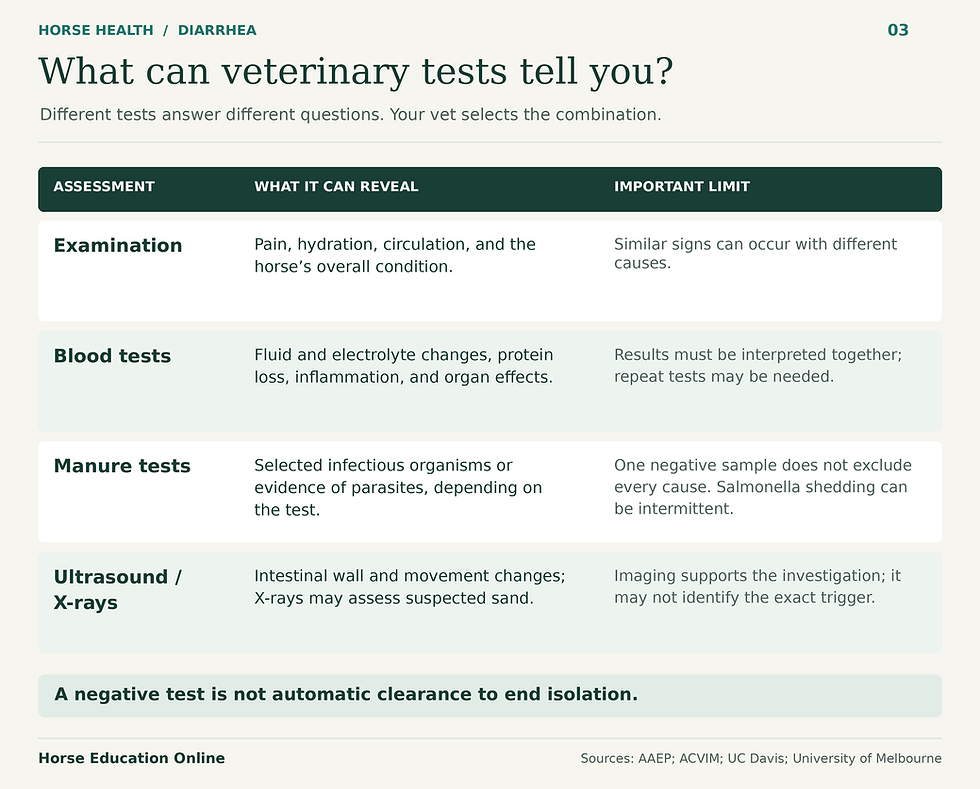
The vet will assess the horse’s circulation, hydration, temperature, pain, and overall condition. Depending on the findings, the investigation may include blood tests, ultrasound, rectal examination, or other procedures.
Ultrasound can help assess intestinal wall thickness and movement. A rectal examination or stomach tube may be needed when abdominal pain raises concern about another intestinal problem.
Passing diarrhea does not rule out a serious cause of colic. Tell the vet about pain, distension, or reduced manure output, even if some liquid manure is still passing.
The ACVIM resource on colitis in adult horses describes how these examinations help guide care. For signs owners can recognize, see our guide to colic in horses.
Blood tests help assess the damage
Blood testing can reveal changes that are difficult to judge from appearance alone:
What the vet may assess | Why it matters |
Red blood cell concentration and circulating proteins | Helps evaluate dehydration and protein loss |
White blood cells | Provides information about inflammation and possible infection |
Electrolytes | Identifies losses or imbalances that may need correction |
Kidney values | Helps assess the effects of poor circulation or kidney injury |
Lactate, when appropriate | Helps assess tissue circulation and response to treatment |
These results need interpretation together. For example, dehydration can initially make blood proteins look more concentrated, potentially hiding protein loss. Repeat measurements may reveal more than a single result.
Ask your vet: “Which changes are most concerning, and what will you recheck to know treatment is working?” Blood results and treatment monitoring are discussed in this multicenter study of acute diarrhea.
Manure tests are selected for the individual horse
There is no single manure test that checks every possible cause.
Depending on the horse’s age, location, symptoms, and exposure history, a vet may investigate Salmonella, equine coronavirus, clostridial disease, parasites, or other causes. Potomac horse fever testing may involve blood, manure, or both.
Cornell University’s equine diagnostic plans show how testing differs between adult horses, foals, and acute or chronic cases.
If you are asked to collect manure, get instructions about the container, amount, storage, and delivery. Different tests have different handling requirements. A sample prepared for a routine worm egg count may not be suitable for every infectious disease test.
Why a negative test may not settle the diagnosis
A negative result means that the test did not detect its target in that sample. It does not automatically mean the horse has no intestinal disease or poses no infection risk.
Salmonella, for example, can be shed intermittently. UC Davis explains why multiple fecal cultures may be needed to identify some shedders.
Other tests answer different questions. A worm egg count measures egg shedding rather than the entire parasite burden. A negative manure sand test does not reliably exclude sand accumulation.
Ask what the result changes: Does it alter treatment, justify further investigation, or affect isolation? Do not release a horse from isolation based on your own interpretation of one negative result.
How diarrhea in horses is treated
Treatment depends on severity and cause. The first priority in a seriously ill horse is often restoring circulation and correcting fluid losses.
Hospital referral may be recommended when a horse needs intensive fluids, repeated blood tests, frequent reassessment, or nursing care that cannot be provided safely at home. Ask about referral early if your horse is deteriorating.
Fluids replace more than the water already lost
Fluid treatment must account for existing dehydration, normal daily needs, and continued losses through diarrhea.
That is why a horse may still need fluids after becoming brighter. If significant losses continue, the treatment plan needs adjustment.
The vet also monitors how the horse handles those fluids. Protein loss and changes in circulation can complicate fluid balance, so giving more fluid is not automatically better.
This veterinary review of fluid therapy in horses explains how clinicians tailor a fluid plan.
Drinking voluntarily is encouraging, but it does not prove that a horse is replacing everything it is losing.
Some horses need support for protein loss
Albumin helps keep fluid within the circulation. Substantial intestinal protein loss can contribute to swelling under the belly or in the limbs.
Plasma transfusions may be considered in selected severe cases, depending on blood results and clinical condition. Report new swelling rather than assuming it is simply from time spent in the stable.
Antibiotics are useful in some cases, but not every case
“Diarrhea” is not, by itself, a reason to prescribe antibiotics.
In adult horses with Salmonella-associated intestinal disease, treatment is primarily supportive. Antibiotic decisions depend on factors such as the risk of infection spreading beyond the intestine; routine use does not reliably clear carriage.
Other diseases are different. Potomac horse fever requires appropriate antimicrobial treatment, and some clostridial infections also warrant targeted medication.
Young foals may need antibiotics when sepsis is suspected. Their treatment cannot simply be copied from an adult horse’s plan.
These distinctions are explained in veterinary resources on Salmonella, Potomac horse fever, and bacterial diarrhea in foals.
If diarrhea develops during a course of antibiotics, contact the prescribing vet promptly for instructions before the next dose. Share the drug name, dose, route, and time of the last administration.
Pain relief needs a medication review
A painful horse may need medication, but dehydration and intestinal injury affect which drugs are appropriate.
NSAIDs such as phenylbutazone and flunixin can themselves cause intestinal or kidney injury. With suspected right dorsal colitis, further NSAID use may be inappropriate.
Give the vet a complete medication list, including products administered by anyone else caring for the horse. Do not add extra doses or combine pain medicines without instructions.
The Merck guide to NSAID toxicity and right dorsal colitis explains why medication history matters.
Why the vet may monitor the feet
Severe intestinal inflammation can put a horse at risk of laminitis. This complication involves damage to the tissues supporting the coffin bone within the hoof.
The treatment team may recommend continuous cooling of the lower limbs and feet in a high-risk horse, sometimes before obvious foot pain develops.
Watch for new reluctance to move, a short or stiff stride, repeated weight shifting, or unusually strong digital pulses. Report these promptly. Hoof warmth alone is not a reliable diagnosis.
Do not force a foot-sore horse to walk. Ask the vet about movement, bedding, and foot support. The Merck Veterinary Manual’s laminitis guide explains the connection with colitis and the role of early cooling.
What should a horse with diarrhea eat?
There is no feeding plan suitable for every horse with diarrhea.
A horse with severe shock or reduced intestinal movement may temporarily be unable to tolerate feeding normally. Another horse may be ready for a carefully managed return to food.
Ask for clear instructions about:
Which feed or forage to offer.
How much to provide at each meal.
Whether pasture is permitted.
How to increase feeding as appetite returns.
What to do if the horse refuses food or becomes uncomfortable after eating.
Do not force-feed an unwilling horse or impose a prolonged fast without veterinary direction. Published veterinary guidance acknowledges that refeeding strategies vary and evidence is limited.
A diagnosis can change the usual feeding advice
Right dorsal colitis illustrates why general advice can be misleading. A vet may prescribe a complete pelleted diet with reduced bulk rather than unrestricted long-stem hay to support recovery of the affected colon. That is a disease-specific plan. It is not a reason to remove forage from every horse with loose manure.
Ask whether the prescribed feed is a complete ration, how the daily amount should be divided, and when the diet should be reviewed. Keep all carers working from the same written instructions.
For the principles behind everyday feeding once your horse has recovered, read the basics of equine nutrition.
Do probiotics and gut supplements help?
Probiotics are often marketed as a way to restore intestinal balance. The evidence is more limited than many product claims suggest.
Some studies have reported benefits from particular preparations, but those findings do not establish that every probiotic treats diarrhea. Results depend on the organism, formulation, horse population, and condition being studied.
For example, a small clinical trial of Saccharomyces boulardii reported reduced severity and duration of signs in horses with acute enterocolitis. That finding supports further investigation; it does not establish a universal cure.
Caution is especially important in foals. Research has reported adverse effects with at least one probiotic preparation. The ISAPP evidence overview discusses both promising and disappointing findings.
Before buying a product, ask:
Is there evidence for this exact preparation in horses with this problem?
Is it appropriate for my horse’s age?
What improvement should we expect?
When should we reassess if nothing changes?
A supplement should not delay fluids, diagnostics, or treatment of the underlying disease.
Supporting recovery at home
Before discharge, or when treatment continues on the farm, get a written plan. It should specify feeding, medication, observation frequency, rechecks, and the signs that require another urgent call.
Make sure everyone responsible for the horse can find it. A clear handover reduces missed doses, duplicate medication, and conflicting feeding changes.
Follow the whole horse, not just manure consistency
Ask your vet which observations matter most for this case.

More formed manure is encouraging, but recovery assessment also includes hydration, appetite, circulation, and any blood abnormalities.
Use our horse health log for owners to keep observations together. Our guide to the horse’s vital signs explains how to take basic measurements safely.
Ask what each recheck will tell you
Useful questions include:
Has hydration remained stable without additional fluids?
Do blood proteins or electrolytes need checking again?
Is the feeding plan still appropriate?
Have we addressed the suspected trigger?
When can turnout, exercise, and travel resume?
There is no single recovery timetable for all causes of diarrhea. Mild disturbances and severe colitis require different expectations. Complications can prolong recovery.
If your horse worsens between planned appointments, contact the vet then. A scheduled recheck is not a reason to wait through new symptoms.
Protect manure-soiled skin
Repeated contact with liquid manure can irritate the skin beneath the tail and along the hind legs.
Gently clean affected areas and dry them. Ask your vet whether a suitable barrier product is needed, especially if the skin is already sore.
The Merck resource on free fecal water syndrome discusses this problem and protective skin care. Skin care improves comfort while the underlying manure problem is investigated.
When can isolation end?
A horse can look better and still shed an infectious organism. Salmonella shedding, for example, can continue after recovery.
Let your vet decide when restrictions can end using the diagnosis, exposure history, progress, and testing. Ask for instructions about exposed companions, shared turnout, returning to another yard, and attending events. Normal-looking manure alone does not establish that contact is safe.
Make the daily routine work for isolation
The AAEP’s general biosecurity guidelines support practical measures such as dedicated equipment and controlling movement between groups.
For a horse with suspected infectious diarrhea:
Keep feed buckets, water buckets, manure tools, and grooming equipment dedicated to that horse.
Care for healthy horses before the isolated horse.
Use the clothing and footwear precautions your vet recommends.
Wash hands with soap and running water after handling the horse or contaminated equipment.
Manage manure and bedding so they cannot contaminate feed, water, or areas used by other horses.
Because some causes can affect people, make sure every person helping with care understands the hygiene instructions.
Cleaning comes before disinfection
Disinfectant sprayed onto manure-covered equipment is not reliable sanitation.
Remove manure and other organic material, clean the surface, and then use a disinfectant suitable for the suspected organism. Follow the product’s dilution, contact time, and safety instructions.
Remember bucket handles, wheelbarrows, door latches, and footwear as well as the stall itself. Ask the vet which surfaces and equipment need attention.
The Equine Disease Communication Center’s sanitation guide explains the cleaning sequence.
Reducing the risk of another episode
Prevention should address the likely cause and the horse’s normal management. No supplement or feeding rule prevents every form of diarrhea.
Make feed and pasture changes gradually
Avoid abrupt switches between feeds, hay sources, or turnout routines when a gradual transition is possible. Secure concentrate stores against accidental access.
Spring pasture deserves particular attention. The University of Illinois explains how sudden access to lush grass can contribute to intestinal disturbance, colic, and diarrhea.
Discuss pasture introduction with your vet, especially if your horse has insulin dysregulation or a history of laminitis. If several horses become unwell after the same feeding change, report the shared exposure rather than assuming each horse has a separate problem.
Use a parasite program that is checked for effectiveness
An appropriate parasite plan considers age, environment, egg shedding, and whether the drugs used remain effective.
The AAEP internal parasite control guidelines recommend assessing treatment effectiveness with fecal egg count reduction testing.
A recent deworming date is useful history, but it does not prove that parasites have been excluded. Do not use repeated deworming as a trial-and-error treatment for unexplained diarrhea.
Reduce sand exposure where it matters
On sandy properties, review where horses eat and whether sparse grazing encourages ingestion of soil.
Feed from suitable containers and use a barrier beneath them where needed to reduce contact between spilled feed and sand. Avoid allowing grazing areas to deteriorate to short stubble.
Thal Equine’s prevention guidance explains these management measures.
If sand accumulation is suspected, ask about investigation and treatment. A supplement routine cannot demonstrate that the intestine is free of sand.
Review medications and farm hygiene
Use antibiotics and pain medicines according to the prescribing vet’s instructions. Report new diarrhea, loss of appetite, or swelling during treatment.
Keep drinking water and feed storage clean, and discuss a plan for incoming horses before they mix with residents.
Where Potomac horse fever is a local risk, ask about vaccination and exposure management. Vaccination does not eliminate every risk or replace prompt assessment of symptoms.
Our Potomac horse fever guide explains the signs owners should recognize.
Frequently asked questions about diarrhea in horses
Can my horse have diarrhea without a fever?
Yes. A normal temperature does not exclude serious intestinal disease. Sudden watery or profuse diarrhea still warrants an urgent veterinary call, particularly if appetite, comfort, or behavior changes.
Can stress cause loose manure?
Some horses pass looser manure around stressful events. However, watery diarrhea after transport cannot safely be diagnosed as “just stress.” Transport may also coincide with feed changes or illness. Tell the vet about the timing and the horse’s other signs.
Is free fecal water the same as diarrhea?
No. Free fecal water describes liquid passed separately from otherwise formed manure. In true diarrhea, the manure itself is abnormally loose or watery. Describe exactly what you see, and report persistent changes or additional signs.
Should I deworm a horse because it has diarrhea?
Do not assume that parasites are the cause. Treatment choice matters, and a low egg count cannot exclude every parasite-related problem. Ask the vet to assess the history and select an appropriate investigation or treatment.
What if the diarrhea keeps coming back?
Arrange a veterinary investigation rather than repeatedly changing supplements. Recurring diarrhea, weight loss, poor appetite, or swelling may justify assessment for intestinal inflammation, sand, parasites, medication injury, or other disease. Bring a dated record of episodes and feeding changes.
Persistent diarrhea can be difficult to diagnose, as the Merck Veterinary Manual explains.
How do I know whether treatment is working?
Ask which changes your vet expects in your horse. Progress may include improved appetite and attitude, more stable hydration and vital signs, and better blood results. Manure consistency is one part of that assessment.
Report deterioration promptly, even if an earlier observation seemed encouraging.
Diarrhea is a symptom that deserves attention to the whole horse. Recognizing changes early, giving the vet a clear history, and following a specific treatment and recovery plan give owners practical ways to help.


Comments