
Horse Muscle Anatomy Explained: Major Muscle Groups, What They Do, and Why They Matter
- Horse Education Online

- 5 days ago
- 16 min read
Horse muscle anatomy is the study of the major muscle groups that help a horse move, support posture, stay balanced, and generate power. For horse owners and students, understanding horse muscles can make it easier to evaluate topline, conditioning, movement, and changes in the body over time.
This guide explains the main muscle regions of the horse, what they do, and why they matter in practical everyday terms.
Horse muscle anatomy at a glance
Neck supports balance and head carriage
Shoulder and forelimb help move and stabilize the front end
Back and topline support posture and body control
Core and abdomen help stabilize the trunk and back
Hindquarters provide pushing power and engagement
What horse muscles do
Horse muscles do much more than make the body look strong. Their main jobs can be grouped into five practical functions: movement, propulsion, posture, stability, and support for the skeleton and joints.
Movement and propulsion
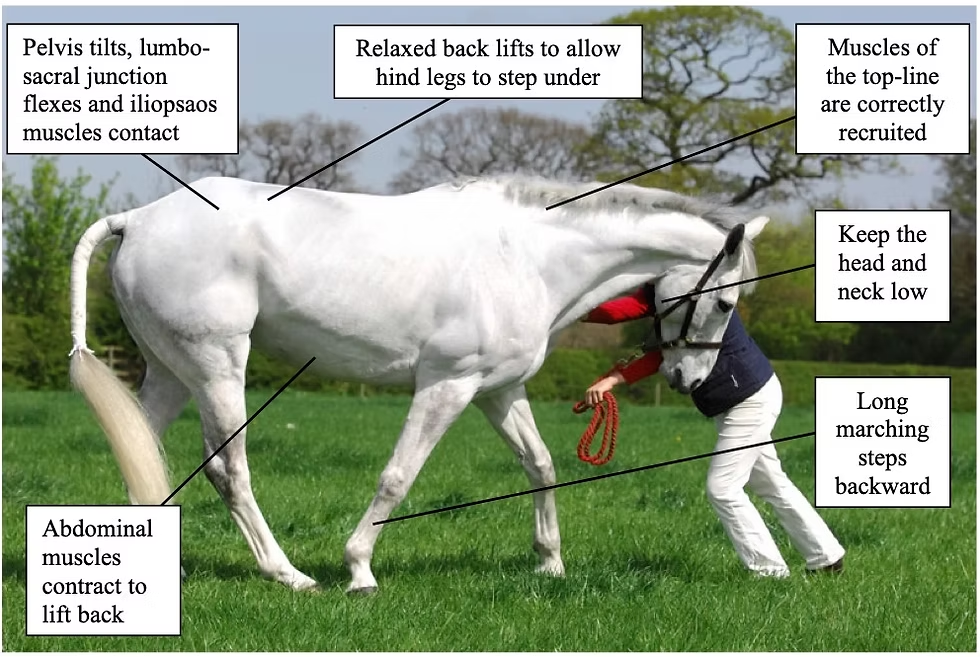
Muscles create motion by contracting and pulling on bones across joints. That is how the horse lifts a limb, swings it forward, pushes off the ground, raises the neck, rounds the body, or powers from behind. Bigger and better conditioned muscle groups do not automatically mean better performance, but they do matter because muscles are the tissues that generate force for locomotion.
In plain language, muscles are what let the horse go somewhere. The neck and shoulder muscles help position the front end. The back and abdominal muscles help transfer force through the body. The hindquarter muscles provide much of the pushing power that drives the horse forward. University of Minnesota Extension notes that the hindquarters are especially important for propelling power, speed, and strength for collection.
Posture and stability
A horse is not using muscles only when moving fast or working hard. Muscles are active all the time to help the body stay organized. They help support the spine, steady the limbs during weight bearing, and maintain posture during standing, turning, and transitions. That is one reason muscle development affects how a horse carries its head and neck, how stable the topline looks, and whether the body appears balanced from front to back. Skeletal muscle’s role in posture is a core part of basic equine musculoskeletal function.

This is also why a horse can look “off” without having an obvious wound or swelling. Loss of support, weakness, uneven development, or guarding in one region can change how the whole horse stands and travels.
Why muscles matter in soundness
Muscles do not work alone. They are part of the larger musculoskeletal system, which includes bones, joints, tendons, ligaments, and connective tissues. When muscles are functioning well, they help the horse move efficiently and support the body during work. When they are not, you may notice stiffness, weakness, poor posture, reduced performance, soreness, or reluctance to go forward. Muscle disorders in horses can show up as stiffness, pain, weakness, exercise intolerance, and muscle atrophy.
That does not mean every topline issue or asymmetry is a muscle disease. It does mean muscles matter in any big-picture discussion about comfort, performance, and movement quality.
To connect anatomy with practical assessment, read our article on equine lameness and on the horse skeleton.
The main muscle regions of the horse
Before going muscle by muscle, it helps to divide the horse into a few major muscle regions. This gives a practical map of the body and makes the rest of the article easier to follow.
The five main regions most owners should know are the neck, shoulder and forelimb, back and topline, abdomen and core, and hindquarters. These regions do not work in isolation. They work together every stride. Still, separating them is useful because each region has a different job and different everyday importance.
Region | Main job | Why owners care |
Neck | Balance, head and neck carriage, helping organize movement | Affects outline, balance, and how the horse carries itself |
Shoulder and forelimb | Advancing the limb, absorbing load, stabilizing the front end | Important for stride quality and front end comfort |
Back and topline | Supporting the spine, transmitting force, helping carry rider weight | Central to topline development and ridden comfort |
Abdomen and core | Stabilizing the trunk and supporting controlled movement | Helps with posture, back support, and body control |
Hindquarters | Power, engagement, forward thrust, collection | Key for impulsion, strength, and athletic effort |
Neck

The neck muscles help support the head and neck and play a major role in balance. Because horses use the head and neck as part of overall balance during motion, this region influences how the whole body organizes itself. Changes in neck muscle development can reflect training, posture, and how the horse uses its body during work.
Shoulder and forelimb
This region helps move the forelimb forward and stabilize the front end during weight bearing. It matters because the front limbs are heavily involved in support, shock handling, and stride expression. Owners often notice this region when a horse looks tight through the shoulder, short strided in front, or uneven in front end muscling.
Back and topline
This is one of the most important regions for everyday horse people. The topline generally refers to the upper line of the horse, including the neck, withers, back, loin, and croup in a broad visual sense, while the muscular support underneath includes important back muscles that help stabilize and move the spine. A weak topline can affect posture, comfort, and how a horse handles work. The back also transfers driving force generated behind through the rest of the body.
Abdomen and core
The abdominal and deeper supporting muscles help stabilize the trunk and support the back. In practical terms, the core helps the horse stay organized rather than hollow, loose, or unstable through the middle of the body. This region matters for balance, posture, and controlled movement, especially in ridden horses.
Hindquarters
The hindquarters are the main engine room of the horse. This region includes the powerful muscles of the croup, hip, thigh, and gaskin that contribute to thrust, engagement, and collection. Minnesota Extension specifically highlights the hindquarters’ role in speed, propelling power, and strength for collecting.
The big takeaway is this: if you can identify these five regions on sight, you already have a much better working knowledge of horse muscle anatomy than most beginners. From here, the next sections can zoom in on each region in a way that is practical, not overwhelming.
To visualize these areas, visit interactive horse muscles tool and read horse skeleton explainer.
Neck muscles

The neck muscles help the horse support and move the head and neck, but their job goes beyond that. The neck is a major balancing structure during motion, and its position can influence the rest of the body, including how the horse organizes the back and forelimbs during locomotion. The equine neck is also anatomically complex, with more than 100 muscles associated with the seven cervical vertebrae.
Superficial neck muscles
The superficial neck muscles are the ones owners notice first because they shape the visible outline of the neck. These muscles help raise, lower, bend, and stabilize the head and neck. In practical terms, they influence head carriage, the appearance of the crest and underline, and how the horse carries itself in work. Because these muscles are easy to see, owners often focus on them, but visible neck muscle alone does not always tell you whether the horse is using the whole body well. The neck should work as part of a connected system, not as an isolated showpiece.
Deep neck support muscles
Deeper neck muscles matter because they help stabilize the cervical spine and fine tune movement. They are less obvious from the outside, but they contribute to control, coordination, and support of the neck as the horse moves. Research on neck function describes the head and neck as a major craniocaudal and lateral balancing mechanism, using visual, vestibular, and proprioceptive input to help the horse stay organized in motion. That is one reason changes in neck use can affect the whole way of going.
Why neck muscle development matters
Neck development can look very different depending on posture, training, discipline, age, and how the horse uses its body. A well developed neck is not just a thick neck. Ideally, the neck should blend into the shoulder and support balanced movement rather than looking overbuilt in one area and weak in another. For owners, the useful takeaway is this: neck muscles matter because they help the horse balance, carry the head and neck efficiently, and connect front end movement to the rest of the body.
To compare structures visually, visit interactive horse anatomy guide and your read about the equine nervous system.
Shoulder and forelimb muscles

The shoulder and forelimb muscles are essential for advancing the limb, supporting body weight, and helping the horse absorb and redirect force with every stride. Unlike people, horses do not have a bony collarbone attaching the forelimb to the trunk. Much of the forehand is supported by muscle and soft tissue, which makes this region especially important for both movement and stability.
Muscles that move the shoulder
The shoulder region helps bring the forelimb forward and backward and contributes to stride length and reach. When this area is not functioning well, extension of the shoulder can become difficult, and that can show up as a shorter step or reluctance to move freely in front. Merck notes that injury in this region often makes extension of the shoulder more difficult, which is a very practical clue for owners and students trying to connect anatomy to movement.
Muscles that support the forelimb
This region also has a major support role. The muscles around the shoulder and upper forelimb help stabilize the limb during weight bearing and keep the shoulder functioning normally under load. When these muscles weaken significantly, the shoulder can appear unstable, and muscle loss around the scapular spine may become more visible. That matters because the front limbs do a large share of weight support during standing and movement, so muscular support here is not optional.
Why this region matters in movement
For owners, this region matters because front end muscle function affects how the horse travels, lands, turns, and carries weight. A horse that looks tight in front, short strided, or uneven through the shoulder may be showing you that this region is not working as well as it should.
Because the front limb works as a connected chain rather than as one isolated part, it helps to understand this region alongside the larger picture of movement and soundness. If you want to keep learning, see our guide to equine lameness and our article on the fetlock joint.
Back and topline muscles

The back and topline muscles are some of the most important muscles for horse owners to understand because they affect posture, spinal support, movement, and ridden comfort. The horse’s back is not just a row of bones under the saddle. It includes muscles, fascia, tendons, ligaments, and other soft tissues that work together to support the horse during movement and work.
What the topline includes
In everyday horse language, the topline usually refers to the upper outline from the neck over the withers and back into the loin and croup. From a practical anatomy standpoint, the topline reflects both body structure and muscle development in these upper regions. Owners often use the topline as a visual summary of conditioning, but what you are seeing is the result of several body systems working together, not just one muscle.
Why topline matters
A functional topline matters because the back has to support the horse’s own internal weight, help transmit force generated from behind, and in ridden horses, also manage the load and influence of tack and rider. Recent veterinary discussion of equine back function emphasizes that conformation, saddle fit, rider body weight, and training practices can all affect topline function and dysfunction. This is why topline is not just a cosmetic issue. It is tied to how comfortably and effectively the horse uses the body.
Common reasons topline is weak
A weak topline can happen for several reasons, including insufficient conditioning, time off work, poor posture in movement, saddle fit problems, pain, or asymmetrical use of the body. Veterinarians assessing the topline also watch for muscle asymmetry or atrophy, because these can be clues that deserve closer attention. For owners, the key point is not to assume that every weak topline is just a fitness problem. Sometimes it is. Sometimes it reflects a bigger comfort or management issue.
Core and abdominal muscles
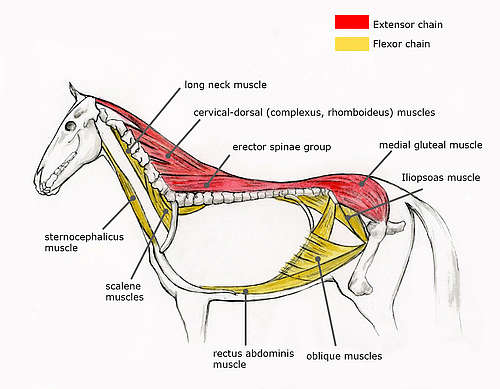
The horse’s core and abdominal muscles help stabilize the trunk, support the back, and control movement through the middle of the body. This area matters more than many owners realize because the horse does not move well by using the neck or hindquarters alone. The body has to transfer force through the back and abdomen in a coordinated way.
What the equine core does
In simple terms, the core helps hold the horse together during motion. The abdominal muscles help support the abdomen and assist with spinal stability, while the back and deeper stabilizing muscles help manage posture and movement. Recent veterinary discussion of topline function notes that the abdominal tunic, which covers the oblique muscles and supports the abdomen, helps support the back. When core stability is lacking, the back and neck may try to compensate, and that can contribute to discomfort.
Why core strength matters in ridden horses
Core strength matters because it affects posture, balance, and how efficiently a horse handles work. A horse with better core support is generally better able to organize the body during transitions, turns, hill work, and ridden exercise. This does not mean owners need to think in terms of bodybuilding. It means that the horse needs enough support through the trunk to move without falling onto the forehand or hollowing through the back. Hill work is often used in conditioning because it helps develop the haunches, back, and core abdominal muscles together.
Core support and back comfort
For owners, this section matters because weak core support can show up as poor posture, difficulty building topline, stiffness through the back, or trouble working comfortably under saddle. That does not mean every back issue is a core issue, but the connection is real.
Also, because trunk support affects how the whole horse functions, it also helps to understand how the core relates to soundness and hind end mechanics. You can explore that further in our article on the equine hip joint and our equine lameness guide.
Hindquarter muscles

The hindquarters are the horse’s main power source. This region includes the muscles around the croup, hip, thigh, and gaskin that help create propulsion, support engagement, and contribute to athletic effort. If the front end helps carry and organize the horse, the hindquarters do much of the pushing.
Gluteal muscles and power
The gluteal region is especially important because it contributes to powerful extension of the hindlimb and helps generate forward thrust. In practical terms, this is the region owners often think of when they say a horse is strong behind or weak behind. A better developed hindquarter usually supports better impulsion, but function still matters more than bulk alone. A large-looking hindquarter is not automatically a well functioning one.
Upper hindlimb muscle groups
The thigh and gaskin muscle groups also matter because they help power running, jumping, and other forward movements. University of Minnesota Extension specifically notes that the hindquarters influence speed, propelling power, and strength for collecting, and that the gaskin and thigh muscles power running, jumping, and other forward movements. That is one of the clearest plain language summaries of why this region matters.
Why hindquarter development matters
For horse owners and students, hindquarter development matters because it is closely tied to forward energy, balance, and the horse’s ability to carry more weight behind instead of pulling itself along with the front end. This is one reason riders and trainers pay so much attention to engagement. A horse does not need exaggerated muscle to move well, but it does need enough strength and coordination behind to push effectively and support the rest of the body. To explore this region in more detail, see our equine hip joint deep dive and the interactive horse muscles tool.
How muscles and the skeleton work together
Muscles and bones work as one system. Bones provide the framework. Joints create the places where motion can happen. Muscles create the force that moves those joints.
Muscles attach to bones
Skeletal muscles are attached to bones and arranged around joints. Tendons connect each end of a muscle to bone, allowing muscle force to be transferred to the skeleton. This is the basic setup that allows the horse to move, stabilize posture, and support weight.
Muscles move joints
Muscles do not move the body by themselves. They act across joints. When a muscle contracts, it pulls on the skeletal system and creates movement or resists movement. That is why muscle anatomy makes more sense when studied together with the horse’s bones and joints rather than as an isolated list of names.
Why the whole system matters
This is the big practical takeaway: good movement depends on the full system working together. A horse cannot move well on muscle alone, and it cannot move well on structure alone. Posture, soundness, coordination, conditioning, and performance all depend on muscles, bones, joints, tendons, ligaments, and nerves working as a connected whole. This is a natural place to link to your horse skeleton anatomy article and the interactive horse anatomy guide
Why muscle anatomy matters to horse owners
Horse muscle anatomy matters because it helps owners make better everyday observations. You do not need to memorize every named muscle to get value from this. What matters is understanding the main body regions, what they are supposed to do, and how changes in those regions can affect movement, comfort, and condition.
Understanding topline and conditioning
One of the clearest practical uses of muscle anatomy is evaluating topline and overall conditioning. If you understand where the neck, back, core, and hindquarter muscles are, it becomes much easier to notice whether a horse is developing evenly, losing support over the back, or compensating somewhere else. Muscle use and posture influence what owners see from the outside, so a horse that looks weak in one region is not always just unfit. Sometimes the issue is training, time off, comfort, or body use. Recent veterinary discussion also notes that time off work and lameness can reduce back movement and lead to loss of core and back muscle support.
Recognizing asymmetry and muscle loss
Muscle anatomy also helps owners notice asymmetry earlier. One side may look fuller than the other, the topline may appear uneven, or the hindquarters may lose shape after reduced work or a physical problem. Veterinarians evaluating the topline specifically watch for muscle asymmetry or atrophy because these changes can be meaningful, especially when they persist rather than improve with normal conditioning.
Communicating more clearly with your horse’s team
A practical understanding of muscle regions also helps owners communicate better with veterinarians, trainers, saddle fitters, and bodyworkers. Instead of saying only that the horse “looks off,” you can describe whether the horse seems weak through the topline, uneven through the hindquarters, or underdeveloped through the neck and shoulder. That does not replace professional evaluation, but it does make your observations more useful.
If you want to keep building your anatomy knowledge, explore Horse Tracker, membership, equine certifications, books, and equine study materials.
Muscle loss, asymmetry, and when to pay attention
Muscle loss and asymmetry are worth paying attention to because they can reflect more than simple fitness. Sometimes a horse loses muscle after time off, reduced workload, aging, or uneven use of the body. In other cases, muscle loss may be associated with pain, lameness, nerve problems, back dysfunction, or disease. Merck’s horse owner guidance lists muscle atrophy, weakness, stiffness, and exercise intolerance among the signs that can be seen with muscle disorders in horses.
One side looking different from the other
Mild differences from side to side can happen in real horses, especially when training, rider influence, or natural sidedness are involved. But marked or persistent asymmetry deserves a closer look. Horses with certain neurologic problems can develop obvious asymmetric muscle atrophy, and Merck specifically notes this with EPM, where atrophy may be easiest to notice in the epaxial or gluteal regions.
Visible muscle loss after time off or discomfort
Owners should also pay attention when a horse loses topline or hindquarter muscle after time off, following lameness, or when back discomfort seems to change the way the horse moves. Recent veterinary discussion notes that time away from work can cause loss of core and back strength, and that horses with lameness may reduce back movement enough for those muscles to start wasting. Saddle fit issues can also be linked to pain, behavioral resistance, and muscle atrophy in ridden horses.
When it deserves more attention
This article is educational, not diagnostic, but owners should take note when muscle loss is obvious, when one side continues to shrink or look different, or when the change appears alongside weakness, incoordination, poor performance, back pain, or altered movement. In those cases, it is smarter to have the horse assessed than to assume the issue is just lack of fitness.
For more on warning signs and related conditions, read how to tell if your horse is sick, our equine lameness guide, and our article on EPM in horses.
Conclusion
Horse muscle anatomy becomes much easier to understand when you stop thinking of it as a long list of names and start thinking about function. The neck helps with balance and head carriage. The shoulder and forelimb help support weight and advance the limb. The back and topline help support posture and transfer force. The core helps stabilize the trunk. The hindquarters provide much of the power that drives the horse forward.
For horse owners and students, that practical view is what matters most. It helps you look at the horse more clearly, understand conditioning and topline development with more confidence, and notice changes that may deserve closer attention. It also makes it easier to connect anatomy with real life questions about movement, posture, comfort, and performance.
If you want to keep learning, use the interactive horse muscles tool and interactive horse anatomy guide to review the major regions visually. The more familiar you become with how the horse’s muscles work together, the easier it becomes to understand the whole horse.
FAQ: Horse Muscle Anatomy
What are the main muscle groups in a horse?
The main muscle regions in a horse are the neck, shoulder and forelimb, back and topline, core and abdomen, and hindquarters. These regions work together to support posture, balance, movement, and power. Skeletal muscles move the horse by acting across joints and pulling on bones.
What is the topline in a horse?
The topline is the upper outline of the horse, usually including the neck, withers, back, loin, and croup in a practical owner focused sense. Owners often use the term to describe how well the horse is carrying and developing the upper body.
Why do some horses lose topline?
Horses can lose topline for several reasons, including reduced work, poor posture in movement, discomfort, lameness, saddle fit issues, or overall loss of muscle support through the back and core. Time away from work and altered movement patterns can also contribute.
What muscles power the hindquarters?
The hindquarters are powered mainly by the large muscle groups around the croup, hip, thigh, and gaskin, including the gluteal region and upper hindlimb muscles. These muscles are especially important for propulsion, impulsion, and collection.
How do muscles and bones work together in a horse?
Muscles attach to bones by tendons and move the body by acting across joints. Bones provide the framework, joints allow motion, and muscles supply the force. Good movement depends on the whole musculoskeletal system working together.
Why does one side of my horse look more muscled than the other?
Mild asymmetry can happen with natural sidedness, training patterns, or uneven use of the body. More obvious or persistent asymmetry can deserve closer attention, especially if it appears with weakness, stiffness, poor performance, or muscle loss.
What muscle groups matter most for performance?
All major muscle regions matter, but the hindquarters, back and topline, and core are especially important for power, stability, force transfer, and body control. The shoulder and forelimb muscles also matter because they help support weight and influence stride quality.
How can I tell if my horse is under muscled?
A horse may look under muscled if the topline appears weak, the hindquarters lack shape, the neck and shoulder look poorly developed, or one side looks smaller than the other. Visible muscle loss, especially when persistent or paired with movement changes, is worth paying attention to.


Comments