
The Coffin Joint: The Hidden Engine Inside The Horse’s Hoof

Updated: Apr 23

When we look at a horse’s hoof, it is easy to think of it as a simple, solid structure. In reality, the hoof houses one of the most important and complex joints in the entire limb: the distal interphalangeal joint, more commonly known as the coffin joint.
This joint sits entirely inside the hoof capsule, hidden from view, yet it plays a central role in how your horse moves, absorbs impact, and carries weight. Understanding how it works, and what can go wrong, is essential for any horse owner who wants to make informed decisions about soundness and long-term care.
Need a refresher on general joint anatomy and function? Start with The Basics of Joints to brush up on your knowledge, or download the Joint Anatomy Flashcards.
What Exactly Is the Coffin Joint?
The coffin joint is where three key structures meet:
The short pastern bone (P2)
The coffin bone (P3), which sits inside the hoof
The navicular bone, a small bone that acts as a mechanical support structure
Bones of the horse study aids: Bones of the Horse Flashcards

Because the joint is enclosed within the hoof, you cannot see swelling or external changes the way you might with other joints. This makes early problems harder to detect and increases the importance of understanding subtle signs of discomfort.
What Does the Coffin Joint Do?
At its core, the coffin joint is responsible for controlled movement and shock absorption. It allows the hoof to:
Flex when the limb loads weight
Extend as the horse pushes off
Absorb concussion when the hoof strikes the ground
Facilitate breakover, the moment the heel lifts and the toe rolls forward
Breakover is a particularly important concept. It refers to how easily the hoof leaves the ground at the end of a stride. A smoother breakover reduces strain on internal structures, while a delayed or difficult breakover increases stress within the hoof.
Learn more about breakover here.
The coffin joint does not work alone. It is part of a tightly coordinated system that includes:
The deep digital flexor tendon (DDFT), a powerful tendon that attaches to the coffin bone
The navicular bone, which acts like a pulley, helping redirect forces through the tendon
Because these structures are interconnected, a problem in one area often affects the others. This is why hoof-related lameness can be complex and sometimes difficult to diagnose precisely.
Why the Coffin Joint Matters So Much
Every time your horse takes a step, the coffin joint is under significant load. It:
Bears a large portion of the horse’s body weight
Experiences repeated impact forces, especially at faster gaits
Is heavily stressed during breakover
Over time, these forces can lead to wear and tear, particularly in horses that:
Perform athletic work such as jumping, reining, or barrel racing
Work regularly on hard or uneven surfaces
Have poor hoof balance or delayed breakover
The combination of high load and repetitive motion makes the coffin joint especially vulnerable to chronic conditions.
Common Coffin Joint Problems
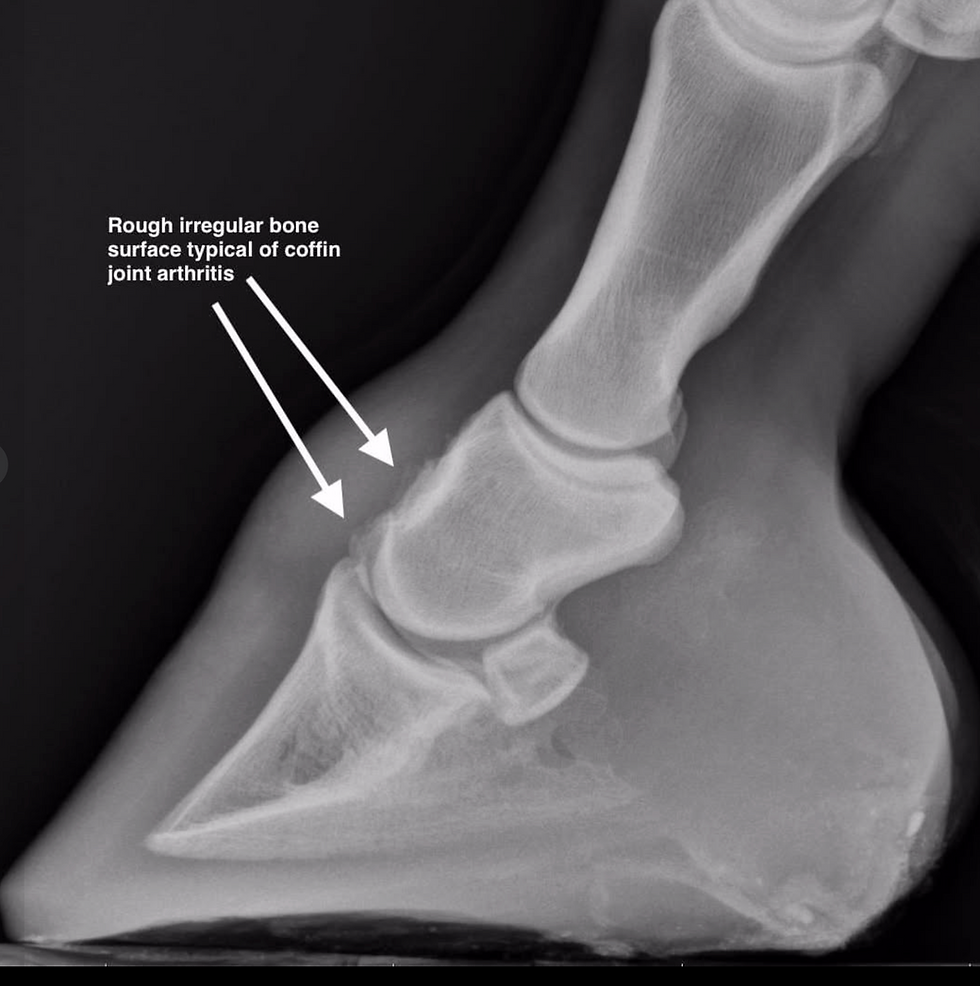
Osteoarthritis (Degenerative Joint Disease)
Osteoarthritis, often abbreviated as OA or DJD, is one of the most common issues affecting the coffin joint.
This is a progressive condition, meaning it develops gradually over time. It involves several key changes:
Cartilage breakdown
Cartilage is the smooth, protective surface covering the ends of bones. It allows joints to move with minimal friction. Once damaged, it has very limited ability to heal.
Inflammation of the joint lining (synovium)
This increases fluid production and contributes to pain.
Subchondral bone sclerosis
The bone beneath the cartilage becomes denser and less able to absorb shock.
Osteophyte formation
These are small bony growths, often called bone spurs.
Signs owners may notice:
Mild or persistent lameness
A shortened or choppy stride
Stiffness, especially when turning
A tendency to land toe-first instead of heel-first
It is important to understand that early osteoarthritis may not show up clearly on radiographs. A horse can be uncomfortable long before obvious changes appear on imaging.
Synovitis (Inflammation of the Joint Lining)
The synovium is the soft tissue lining inside the joint that produces synovial fluid, which lubricates and nourishes cartilage.
Synovitis refers to inflammation of this lining and is often one of the earliest stages of joint trouble.
It can occur:
Before visible arthritis develops
After mechanical strain or overload
In response to poor hoof balance
Common signs include:
Subtle or inconsistent lameness
Sensitivity during flexion tests
Fluctuating soundness from day to day
Recognizing synovitis early can be valuable, as it represents a stage where intervention may help slow progression.
Subchondral Bone Changes
Beneath the cartilage lies the subchondral bone (the bone tissue located beneath the calcified cartilage), which plays a key role in absorbing impact.
Changes in this bone may include:
Sclerosis, or thickening of the bone
Cyst-like lesions, small areas of structural weakness
These changes reduce the bone’s ability to cushion forces and can increase discomfort within the joint.
The Connection to Navicular Disease
The term navicular syndrome is often used broadly, but modern imaging has shown that it is rarely a problem involving just one structure. For that reason, navicular syndrome is now called "Podotrochlear Disease", with the term "Podotrochial" encompassing a wider range of structures inside the hoof. The image below lists all the structures involved in the podotrochlear apparatus. Learn more by reading Navicular: The Current Consensus.

In many cases, horses diagnosed with navicular-related lameness have changes involving:
The coffin joint
The navicular bone
The deep digital flexor tendon
This highlights an important concept: hoof lameness is often multifactorial, meaning several structures are involved at once rather than a single isolated issue.
How Veterinarians Diagnose Coffin Joint Problems
Diagnosing coffin joint pain requires a combination of methods rather than a single test.
1. Lameness Examination
The veterinarian observes the horse moving in different conditions to identify patterns of discomfort.
2. Diagnostic Blocks
Local anesthesia is used to temporarily numb specific areas. If the lameness improves, it helps pinpoint the source of pain.
3. Radiographs (X-rays)
These show bone changes but cannot visualize soft tissues like tendons or cartilage.
4. MRI (Magnetic Resonance Imaging)
MRI provides a much more detailed view, including soft tissues, cartilage, and bone.
However, MRI has limitations:
It is expensive
It is not widely available
It is typically used in more complex or unresolved cases
No single diagnostic tool is perfect. Most diagnoses are made by combining multiple sources of information.

.
Treatment and Management
There is currently no cure for osteoarthritis. Management focuses on improving comfort and slowing progression.
Farriery and Hoof Balance
Proper trimming and shoeing can have a significant impact on how forces are distributed within the hoof.
Good farriery aims to:
Improve breakover
Reduce strain on the deep digital flexor tendon
Maintain correct hoof balance
Enhance overall comfort
Research shows that earlier breakover reduces mechanical stress on internal structures. However, it is important to understand the limits:
Farriery does not regenerate cartilage
It does not reverse advanced arthritis
It is a management tool, not a cure
Medications
Veterinarians may recommend:
NSAIDs to reduce pain and inflammation
Intra-articular corticosteroids to control joint inflammation
Hyaluronic acid to improve joint lubrication
Biologic therapies such as platelet-rich plasma
Some treatments have strong evidence for short-term relief, while others are still being studied for long-term effectiveness.
Exercise Management
Movement is essential for joint health, but it must be balanced.
Controlled exercise can:
Maintain joint mobility
Support cartilage nutrition
Excessive work, especially on hard ground, can increase stress and worsen symptoms. There is no universal plan, and exercise programs should be tailored to the individual horse.
Why the coffin joint is rarely a stand alone problem
One reason coffin joint cases can be frustrating is that the joint does not work in isolation. The forces moving through the foot are shaped by hoof balance, breakover, traction, and the way the whole limb loads and unloads with each stride. That is why it helps to understand related concepts like breakover, traction in horseshoes, and evidence based shoeing in healthy feet when thinking about coffin joint stress.
It also helps to zoom out beyond the hoof itself. A horse with coffin joint pain may present as generally short strided, mildly lame, or simply “not right,” which is why owners should think in terms of the whole locomotor system rather than one structure alone. If you want to connect hoof pain to bigger movement patterns, these guides on equine lameness and the anatomy of the fetlock joint add useful context.
For owners, the practical takeaway is simple: better decisions come from better tracking and better pattern recognition over time. Subtle changes in landing, stride quality, or day to day comfort are easier to spot when you record them consistently, which is where tools like Horse Tracker and the interactive horse anatomy guide can make this topic much more useful in real life.
What Every Horse Owner Should Take Away
Understanding the coffin joint helps you make better decisions for your horse’s long-term soundness. The most important points are:
This joint carries significant weight and experiences high stress
Early signs of lameness are often subtle and should not be ignored
Hoof balance plays a major role in joint health
Osteoarthritis is progressive and cannot be reversed
Many horses can remain comfortable with proper management
Accurate diagnosis requires veterinary guidance
FAQ
What is the coffin joint in a horse?
The coffin joint, also called the distal interphalangeal joint, sits inside the hoof capsule where the short pastern bone, coffin bone, and navicular bone meet. It is hidden from view, which is one reason early problems can be easy to miss.
What does the coffin joint do?
The coffin joint helps the hoof flex under load, extend during push off, absorb concussion when the hoof hits the ground, and facilitate breakover as the heel lifts and the toe rolls forward. It is a key part of normal movement and shock absorption.
Why is the coffin joint so important for soundness?
This joint bears a large amount of weight, handles repeated impact, and comes under heavy stress during breakover. That makes it especially important for long term soundness, particularly in horses doing athletic work, working on hard or uneven ground, or dealing with poor hoof balance.
What are common coffin joint problems in horses?
Common coffin joint problems include osteoarthritis, synovitis, and subchondral bone changes such as sclerosis or cyst like lesions. Coffin joint pain can also overlap with navicular region problems, since structures inside the hoof often affect each other rather than failing in isolation.
What signs can suggest coffin joint pain?
Owners may notice mild or persistent lameness, a shortened or choppy stride, stiffness especially on turns, toe first landing, sensitivity on flexion tests, or soundness that seems to vary from day to day. Early signs can be subtle, and discomfort may be present before clear changes show up on radiographs.
How do veterinarians diagnose coffin joint problems?
Diagnosis usually combines a lameness exam, diagnostic blocks, and imaging. Radiographs can show bone changes, while MRI gives more detail on soft tissues, cartilage, and bone, especially in more complex or unresolved cases.
How are coffin joint problems treated and managed?
Management focuses on improving comfort and slowing progression rather than curing osteoarthritis. Treatment may include careful farriery to improve breakover and hoof balance, medications such as NSAIDs or joint therapies, and controlled exercise tailored to the individual horse.


Comments