
The Percheron Horse

History, Characteristics, Uses, Strengths, and Health Considerations

The Percheron is a French draft horse developed for demanding work in harness. Its muscular build, active movement, and generally willing temperament have made it useful for farming, hauling, carriage driving, and recreation. Although its size attracts attention first, selecting a suitable Percheron requires the same careful assessment of soundness, training, and temperament used with any horse.
For an owner who enjoys driving or wants a substantial riding partner, the breed can offer considerable versatility. It also brings practical responsibilities. Feeding, housing, hauling, and providing hoof care for a horse approaching a ton require planning, suitable equipment, and professionals comfortable working with draft horses.
History and Origins
Development in France
The breed takes its name from Le Perche, a historic region of northwestern France. Its earliest ancestry is uncertain. Stories connecting Percherons to ancient horses, invading armies, and medieval knights appear frequently in breed histories, but these accounts should not be treated as a continuous, documented pedigree.

Arabian influence is part of the breed’s accepted history, including crosses made in the early nineteenth century. However, attributing every modern Percheron’s intelligence, endurance, or refined appearance directly to Arabian ancestry oversimplifies generations of selection for work. Breeders chose horses that could perform the jobs required of them. The breed association’s history and the American Museum of Natural History’s overview provide useful historical background.

From Transport to Heavy Work
Earlier horses from Le Perche were not necessarily as large as today’s heaviest Percherons. As transportation and agricultural demands changed, breeding increasingly favored horses capable of moving substantial loads.
Stagecoach work required forward movement and sustained effort. Farm and freight work emphasized strength, reliability, and cooperation in harness. These changing uses help explain why the modern breed includes different types, from comparatively compact working horses to tall, animated exhibition horses.
Percherons also served military purposes beyond the familiar image of an armored knight. During the First World War, Percherons and their crosses hauled artillery for the British Army. Their history therefore includes transport and logistical work as well as the older traditions associated with mounted warfare. breeds.okstate.edu
Arrival in North America
Oklahoma State University’s breed history records American imports in 1839, followed by extensive importation during the nineteenth century. Percherons became important to farmers and to teamsters moving freight through growing cities.

Mechanization eventually removed much of this everyday demand. Tractors, trucks, and other machinery replaced teams on many farms and roads, and draft-horse numbers declined sharply. Breeders and working-horse communities, including Amish farmers, helped preserve the breed.
Modern Percherons continue to work on farms and in forestry, while others appear in carriage businesses, exhibitions, parades, and recreational driving. Their survival reflects both continued practical use and the willingness of breeders and owners to maintain skills that depend on trained horses. breeds.okstate.edu
Did you know? A horse hauling artillery was doing essential military work even if nobody rode it into battle. Percherons and Percheron crosses served in British artillery teams during the First World War.
Physical Characteristics
Height and Weight
Percherons vary considerably with bloodline, sex, age, and breeding purpose. The Percheron Horse Association of America describes a broad height range of approximately 15 to 19 hands, with most between 16.2 and 17.3 hands. It gives an average weight near 1,900 pounds, with large individuals reaching approximately 2,600 pounds. percheronhorse.org
These figures describe variation rather than a required size. A mature horse’s appropriate weight also depends on its frame and body condition. An overweight Percheron should not be considered correctly conditioned simply because its scale weight falls within a published breed range.
Horse Education Online’s (HEO) Horse Weight and Body-Condition Estimator can help owners track changes. Measurements and formulas remain estimates, especially in unusually large horses. A suitable livestock scale is preferable when an accurate weight is needed.
Conformation and Movement
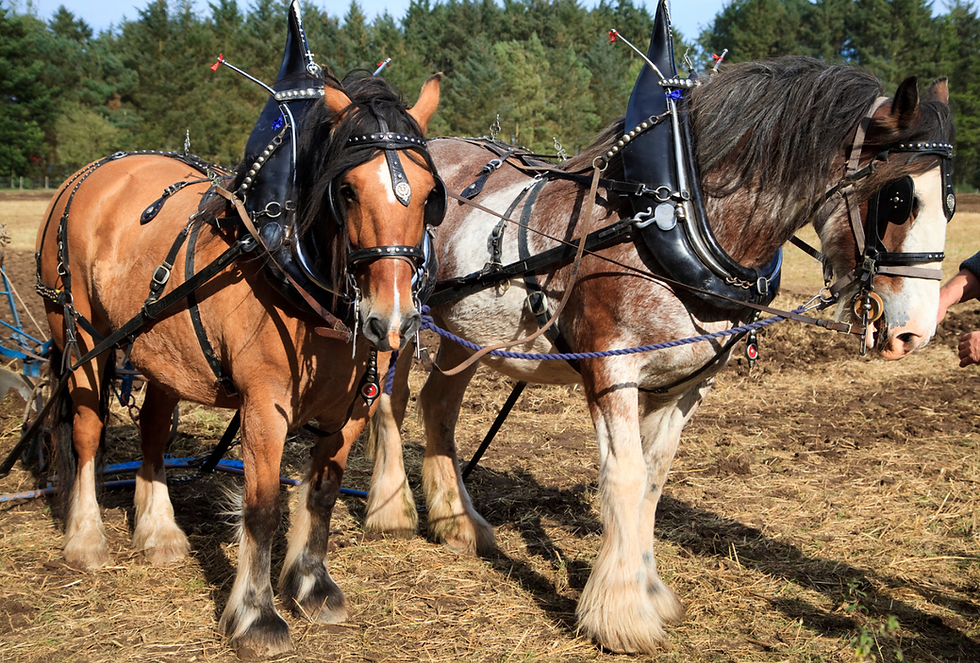
Typical Percheron features include a substantial body, muscular neck, broad chest, powerful hindquarters, and a comparatively refined head. The lower legs generally carry less feathering, meaning long hair around the fetlocks, than heavily feathered breeds such as the Shire or Clydesdale.
Evaluate the individual horse’s proportions and movement rather than rewarding size alone. Watch it walk and trot from the front, behind, and side. Consider limb alignment, hoof shape, freedom of movement, symmetry, and whether the horse appears comfortable.
A large hoof is not automatically a healthy hoof, and impressive muscle does not establish soundness. HEO’s Equine Conformation Study Guide explains a systematic approach to assessment. The Equine Conformation Study Kit provides a more structured way to study these relationships.
Coat Color
Black and gray are the colors most closely associated with Percherons. Other colors occur, but registration requirements should be checked with the relevant registry rather than assumed to be identical internationally.

Gray horses progressively lose pigment from their hair. A dark youngster may become dappled and eventually appear almost white while retaining dark skin. Gray is therefore different from simply being born with a white coat. vgl.ucdavis.edu
HEO’s Horse Coat Colors and Genetics guide explains the difference between base colors and modifying genes. Explore inheritance with HEO’s Horse Coat Color Calculator. Predictions depend on the genetic information available, and appearance alone cannot reveal every allele a horse carries.
Did you know? A height of 17.3 hands means 17 hands and 3 inches, not 17.3 decimal hands. Because one hand equals four inches, that horse measures 71 inches at the withers.
Temperament and Handling
Percherons have a longstanding reputation for willingness and trainability. Many are patient, sociable horses that become dependable partners with consistent handling. They can also be energetic, sensitive, or inexperienced. Breed reputation describes a tendency, not a guarantee.
A useful assessment asks how the horse behaves during ordinary tasks. Does it lead without crowding? Stand when asked? Move away from pressure? Allow its feet to be handled? Load calmly? Remain responsive when separated from companions?
With a draft horse, small handling problems can have large consequences. A horse that leans on its handler, barges through a gate, or snatches away a foot needs appropriate training and, where indicated, investigation for pain.
A suitable, experienced Percheron may work well for a beginner who has instruction and support. An untrained youngster is a very different proposition. Owners should choose a horse whose established skills match their own abilities.
HEO’s Equine Behavior Study Kit helps readers understand communication and learning. It complements practical instruction, especially when an owner is moving from lighter horses into draft-horse handling.
Common Uses and Strengths
Farming and Heavy Pulling
Percherons are well established in horse-powered agriculture. A trained team may plow, cultivate, haul hay, or pull suitable farm implements. Effective work depends on physical conditioning, well-fitting harness, appropriate equipment, and an experienced driver.
The horse must understand stopping, standing, turning, and responding to cues under load. Matching teammates also involves pace, stride, training, and willingness to work together.
There is no single useful answer to how much every Percheron can pull. A wheeled load on level pavement differs greatly from a sled on soft ground. Slope, surface resistance, duration, traction, and equipment all affect the effort required.
Logging and Forestry
Horse logging can suit selective operations where a trained horse moves timber along planned extraction routes. A Percheron’s strength can be useful, but successful forestry work also depends on judgment, footing, and precise communication.

Environmental benefits are site-dependent. Horses may reduce the need for some machinery access, yet dragging timber can still disturb soil and damage vegetation. Horse logging requires skilled handling around unstable loads, obstacles, and moving chains.
Driving and Exhibition
Driving remains one of the breed’s most natural applications. Percherons appear in pleasure driving, commercial carriage work, farm demonstrations, and exhibition hitches. Their size and movement can make a well-schooled team particularly striking.

Work in traffic or crowds requires specific preparation. A horse that drives comfortably at home is not automatically ready for a parade or busy street. Reliable stopping, standing, and responses to unexpected sounds matter as much as an attractive trot.
Some individuals participate in combined driving, but success depends on the horse’s fitness, maneuverability, training, and suitability for the course.
Riding and Recreational Sport
Many Percherons are ridden for pleasure, trail work, and dressage schooling. Some take part in working equitation, mounted patrol, or other activities suited to their training and build. A horse trained to pull still needs an appropriate education under saddle.
Trail suitability should be demonstrated. Evaluate balance on uneven ground, responses to unfamiliar objects, and confidence away from other horses. Height also affects mounting, low-branch clearance, and the practicality of getting back on during a ride.
A Percheron’s gait is not necessarily smoother than a lighter horse’s. Stride, back movement, conditioning, saddle fit, and the rider’s preferences influence comfort.
Crossbreeding and Educational Work
Percherons are crossed with lighter horses, including Thoroughbreds and Quarter Horses, in efforts to combine substance with qualities useful for riding. The outcome varies. Crossing breeds does not guarantee a particular size, disposition, or athletic ability.
Selected Percherons can also participate in educational or equine-assisted programs. Their temperament must be individually assessed, and their height and width must suit participants, mounting arrangements, and staff. A gentle disposition alone does not establish suitability for therapeutic riding.
Limitations and Suitability
Percherons are generally a poor choice when the primary goal is elite sprint racing, highly competitive endurance, or rapid acceleration and repeated tight turns. Individual horses may enjoy a wide range of activities, but enthusiasm does not remove the physical demands of moving a heavy body.
Jumping should be assessed individually. Some Percherons and crosses jump comfortably at suitable levels, but a large purebred draft is seldom the practical first choice for someone targeting upper-level jumping competition.
Pulling ability also does not establish rider-carrying capacity. The University of Minnesota’s carrying-capacity guidance considers conformation, fitness, and the task. Evaluate the horse’s back, soundness, fitness, saddle fit, and the combined demands of rider, tack, terrain, and duration. Simply calculating a percentage of body weight can produce an unjustifiably large load allowance for a heavy draft horse. extension.umn.edu
The breed may also be unsuitable for an owner whose facilities or support network cannot accommodate it. Limited trailer space, restricted farrier availability, or poorly fitting tack can turn routine management into an ongoing problem.
Feeding and Daily Management
Forage and Body Condition
Feed according to the horse’s actual needs. A Percheron doing light recreational work does not need the same ration as one pulling implements for hours.
Good-quality forage should form the foundation of the diet. The University of Minnesota’s mature-horse feeding guidance emphasizes forage, adequate water, balanced nutrients, and feeding each horse individually.
For a simple illustration, 2% of a 2,000-pound horse’s body weight equals 40 pounds of forage dry matter. The actual weight of hay supplied would be higher because hay also contains moisture. That calculation demonstrates how substantial daily forage provision can become; it is not a prescription to feed every Percheron 40 pounds of hay. Pasture intake, hay moisture and analysis, workload, body condition, and health must all be considered.
Use a scale to weigh feed. A scoop or flake is not a dependable unit of weight. A forage analysis helps identify whether protein, minerals, or additional energy are needed. HEO’s Horse Nutrition Basics provides a starting point for these decisions. extension.umn.edu
Avoiding Excess Weight
A broad draft-horse frame can make excess fat less obvious. Check the ribs by touch and assess fat around the neck, shoulders, back, and tailhead. Track changes over time instead of relying on appearance in photographs.
Large quantities of grain are not automatically necessary because the horse is large. Many lightly worked horses can obtain their energy from suitable forage while receiving a balanced source of essential nutrients.
Obesity and insulin dysregulation require attention. In particular, insulin dysregulation is a major risk factor for endocrinopathic laminitis, a form associated with hormonal disturbances. Veterinary assessment helps identify the underlying problem and guide weight management. Avoid abrupt starvation diets or assuming that every overweight horse has the same metabolic condition. ceh.vetmed.ucdavis.edu
See HEO’s explanation of laminitis and the University of Minnesota’s overweight-horse guidance.
Exercise and Hot Weather
Regular turnout and progressive conditioning help prepare a Percheron for work. Increase demands gradually, including changes in terrain, duration, speed, and load. A horse’s strength can make a task look easy before its fitness is adequate for repetition.
During hot or humid weather, reduce strenuous work, schedule activity during cooler hours, and provide shade, ventilation, and clean water. Watch recovery after exercise. Persistent rapid breathing, weakness, distress, or poor coordination requires prompt veterinary attention and active cooling.
University of Minnesota guidance supports continuous cool-water application for an overheated horse. HEO’s Salt and Electrolyte Calculator can support planning, but supplementation should reflect the individual diet and sweat losses. See also HEO’s guide to sweating, anhidrosis, and heat management. extension.umn.edu
Did you know? Muscle and fat can both add considerable weight, but they have different implications for fitness and feeding. Body-condition assessment helps separate excess fat from the substantial frame expected in a draft horse.
Hoof Care and Farrier Access
Arrange dependable farrier care before purchasing a Percheron. Draft-horse services can cost more because of physical demands, appointment time, equipment, and materials. In some areas, finding a farrier who accepts drafts is more difficult than finding someone for a lighter horse.
Discuss the horse’s behavior, soundness, shoeing requirements, and the available working area. The owner should provide a clean, safe surface and a horse trained to stand and offer its feet. A farrier appointment should not be the horse’s first lesson in foot handling.
Large feet need regular assessment for wear, distortion, cracks, infection, and comfort. Neither breed nor size determines whether a horse should be barefoot or shod. Workload, surfaces, hoof quality, wear, and clinical needs guide the decision.
If the horse struggles to balance, trembles, or repeatedly withdraws a limb, investigate the cause. Pain, weakness, and neurologic problems can resemble poor manners.
Read HEO’s Hoof Balance guide and explore its Farriery and Hoofcare Study Resources for further learning.
Health and Genetic Considerations
Polysaccharide Storage Myopathy
Type 1 polysaccharide storage myopathy, or PSSM1, is an inherited muscle disorder documented in Percherons. It involves abnormal muscle glycogen storage and is associated with a variant in the GYS1 gene.
Signs can include muscle stiffness, sweating, cramping, reluctance to move, and episodes of tying-up. Some genetically affected horses show few obvious signs.
A validated PSSM1 genetic test can inform management and breeding decisions. One copy of the variant can cause disease; a horse does not need two copies to be at risk. A negative result does not rule out other muscle disorders. vgl.ucdavis.edu
Management usually combines an individualized diet with consistent, appropriate exercise. Additional fat is not automatically needed in an overweight horse. During an acute episode, stop work and contact the veterinarian rather than trying to exercise the stiffness away.
HEO’s PSSM article explains the condition further. UC Davis guidance also distinguishes PSSM1 testing from commercial tests marketed for other muscle conditions that lack equivalent scientific validation. ceh.vetmed.ucdavis.edu
Developmental Joint Disease
Osteochondrosis affects the normal development of cartilage and underlying bone in growing horses. Osteochondritis dissecans, commonly called OCD, refers to lesions involving separation of cartilage or cartilage and bone.
According to UC Davis, risk factors include growth rate, body size, nutrition, genetics, and trauma. These conditions can affect Percherons but are not unique to the breed.
Young horses need balanced nutrition and appropriate activity. Feeding for rapid size gain is not a sound growth strategy. Joint swelling or lameness warrants examination, and some lesions can exist without obvious lameness. ceh.vetmed.ucdavis.edu
Arthritis and Soundness
Percherons can develop osteoarthritis and other musculoskeletal problems. Large size alone does not prove that a horse will develop early arthritis. Injury history, conformation, body condition, workload, and management all contribute to long-term soundness.
Watch for shortening strides, reluctance on turns, stiffness, or difficulty lifting a foot. These changes deserve assessment rather than being dismissed as normal for a draft.
HEO’s Lameness Prevention article discusses practical management. Its Interactive Horse Skeleton helps readers locate the structures involved.
Chronic Progressive Lymphedema
Chronic progressive lymphedema, or CPL, has been reported in Percherons as well as several other draft breeds. Impaired lymph drainage causes progressive lower-limb swelling and skin changes, which may include thickening, folds, and nodules.
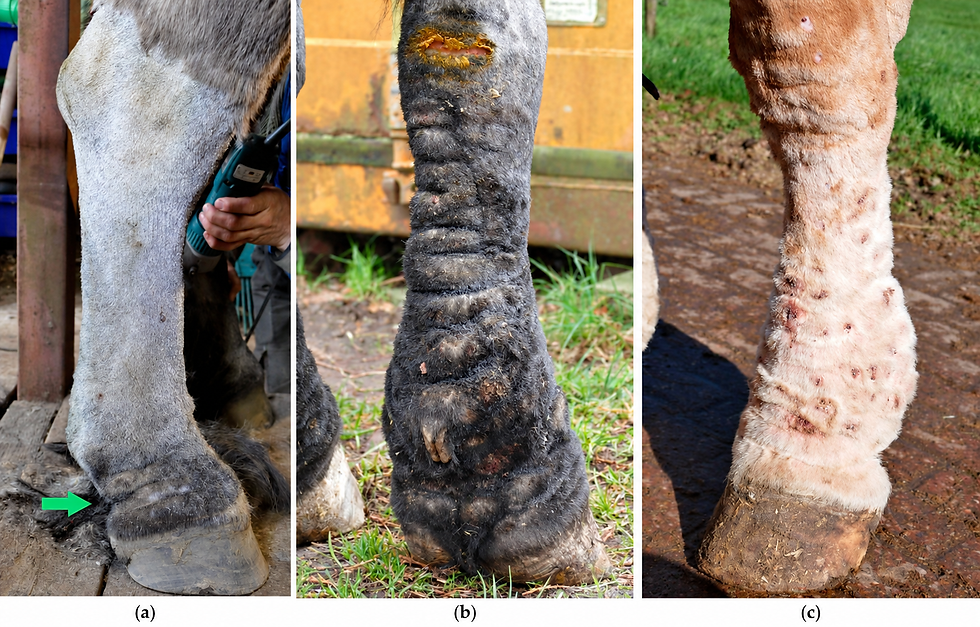
Persistent swelling should not automatically be labeled CPL. Infection, injury, and other disorders can also enlarge a limb. Diagnosis and management require veterinary assessment.
There is no established cure, but appropriate ongoing care can help manage discomfort and secondary complications. Read HEO’s Chronic Progressive Lymphedema article and the UC Davis CPL overview. ceh.vetmed.ucdavis.edu
Shivers and Skin Changes
Shivers is a neurologic movement disorder reported in draft horses and other breeds. Signs may become apparent during backing or hind-foot handling. A horse may lift a hind limb unusually high, move it outward, or tremble. These signs should be investigated rather than assumed to be disobedience. HEO’s Shivers in Horses explores recognition and management.
Gray Percherons also share the melanoma considerations of other gray horses. Report new lumps, especially around the tail, genital region, or throatlatch, to the veterinarian. A mass should not be ignored simply because melanomas are familiar in gray horses. ceh.vetmed.ucdavis.edu
Did you know? Shivers and PSSM1 are different disorders. Difficulty holding up a hind foot does not, by itself, establish either diagnosis.
Routine Preventive Care
Breed-specific concerns should not distract from ordinary preventive care. Maintain a veterinary plan for vaccination, dental examinations, parasite control, and monitoring changes in appetite, manure, behavior, and movement. Keep useful records so gradual changes are easier to recognize.
Learn the individual horse’s normal resting vital signs and discuss when to call for help. HEO’s guides to fever and colic explain important warning signs. Emergency planning should include access to transport capable of safely accommodating the horse.
Housing and Ownership Planning
Measure the individual horse when planning stalls, shelter entrances, gates, and transport. It needs room to turn, lie down, rise, and balance comfortably. Check a trailer’s dimensions and load capacity, along with the towing vehicle’s capabilities.
Tack and harness need individual fitting. A “draft size” label cannot guarantee correct shape or pressure distribution. Reassess fit as weight, muscle, and workload change.
Before purchase, observe the horse performing the intended job and arrange a veterinary prepurchase examination tailored to that use. Discuss muscle-disease testing, past lameness, respiratory concerns, and foot handling where relevant.
Budget for ongoing care and emergency transport. HEO’s Horse Purchase Budget Planner and free Horse Ownership Foundations course support this preparation. The Equine Study Materials and book collection offer further learning.
A well-matched Percheron can be a capable working horse or enjoyable recreational partner.
The best match comes from choosing an individual whose training, health, and physical abilities fit the job, then providing the facilities and professional care needed to sustain that work.
Frequently Asked Questions
1. Where did the Percheron horse originate?
The Percheron originated in Le Perche, a historic region of France. Its early ancestry is uncertain, although Arabian influence is recognized in breed histories. The modern draft horse developed through generations of selection for transportation, agriculture, and other work in harness.
2. How tall is a Percheron and how much does it weigh?
The breed association gives a broad height range of about 15 to 19 hands, with most between 16.2 and 17.3 hands. It describes an average weight near 1,900 pounds, with large individuals reaching around 2,600 pounds. The right weight for a particular horse depends on its frame and condition.
3. Are Percherons good beginner horses?
Some experienced, well-trained Percherons can suit beginners with professional guidance. Others are too green, energetic, or physically challenging for that situation. Choose according to demonstrated behavior, training, and soundness. A reputation for gentleness does not replace evaluating the individual horse.
4. Can you ride a Percheron?
Yes. Many Percherons are ridden for pleasure, trail riding, and other suitable activities. The horse needs riding-specific training, appropriate conditioning, and correctly fitted tack. A history of driving does not mean it already understands a rider’s aids, and its size does not guarantee a smooth ride.
5. What are Percherons best used for?
Their strongest traditional applications include farming, hauling, and driving. Many also make enjoyable recreational riding horses. The best use depends on the individual’s build, health, education, and fitness. Choose a horse proven in the intended job rather than assuming that every member of the breed will suit it.
6. Are Percherons always black or gray?
Black and gray are the predominant colors, but other colors occur. Registry requirements can differ. Gray horses progressively lose hair pigment, so a horse that was dark when young may look almost white later. Color alone cannot establish purebred status or registration eligibility.
7. How much does a Percheron eat?
The amount depends on body weight, condition, workload, forage quality, and pasture intake. For a 2,000-pound horse, forage dry matter equal to 2% of body weight would be 40 pounds. The actual hay weight would be higher because of its moisture content. This calculation is only an illustration. Have the complete ration assessed rather than feeding by breed or flake count alone.
8. What health conditions should Percheron owners know about?
PSSM1 is an inherited muscle disorder documented in the breed. Owners should also recognize signs of joint disease, obesity, lower-limb skin problems, CPL, and movement disorders such as shivers. Gray individuals need monitoring for suspicious skin masses. These concerns do not mean every Percheron will develop them.
9. Do Percherons need horseshoes?
Some remain comfortable barefoot; others need shoes for protection, wear management, traction, or clinical reasons. The decision depends on the feet, work, surfaces, and individual needs. Regular farrier care is necessary either way. Confirm local draft-horse service availability before purchasing.
10. Is a Percheron more expensive to keep than a smaller horse?
It can be. Larger forage requirements, draft-sized tack, suitable transport, and specialized farrier arrangements may increase expenses. Actual costs depend on location and management. Ask local providers for quotes and budget for emergency care before deciding whether ownership is practical.


Comments