
Introduction to the Equine Carpus (Knee): Anatomy, Biomechanics, and Common Problems


Understanding the Horse’s “Knee”
If you look at a horse’s front leg, the joint halfway down the limb is commonly called the “knee.” Anatomically, however, it is not a knee at all. It is the carpus, a structure more comparable to the human wrist.

The equine carpus is one of the most important joints in the horse’s body. Every time a horse gallops, lands from a jump, turns sharply, or even walks across uneven ground, the carpus helps absorb force and stabilize the limb. Because of the tremendous stresses placed on it, the carpus is also one of the most commonly injured joints in athletic horses.
Understanding how this joint works can help horse owners better recognize problems early, understand veterinary recommendations, and appreciate why proper conditioning and management matter so much.
In this article, we will explore:
The anatomy of the equine carpus
How the joint functions during movement
Common injuries and diseases
What veterinary science currently understands about carpal health
Areas where research is still evolving
All information discussed here is based on peer-reviewed veterinary and biomechanical research.
What Is the Carpus?
The carpus is a compound synovial joint. That sounds complicated, but the term can be broken down into simple parts:
Compound joint means it is made up of several smaller joints working together.
Synovial joint means the joint contains lubricating fluid that allows smooth movement.
Unlike the human knee, which bends backward, the horse’s carpus bends forward. This forward bending motion is called flexion.
The carpus acts as:
A shock absorber
A stabilizer
A force-transmission system
A motion-control structure
Without healthy carpal joints, a horse could not safely perform athletic work.
The Bones of the Carpus
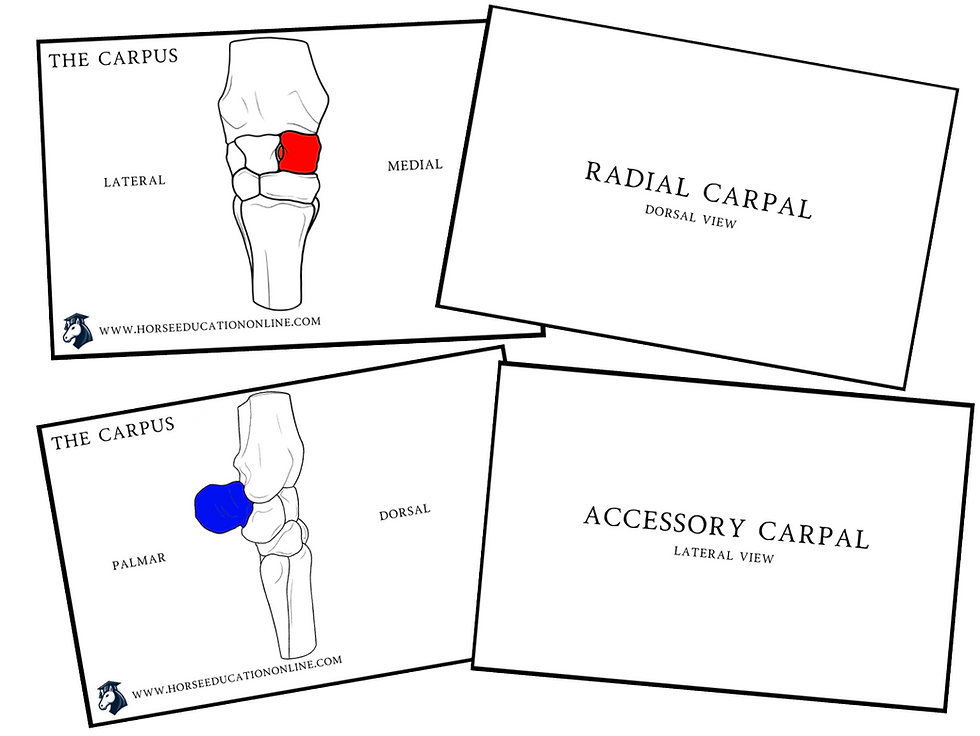
The equine carpus is made up of seven or eight small bones arranged in two rows. We recommend downloading The Carpus Flashcard Set to help you study and memorize them.

Top Row (Proximal Row)
Radial carpal bone
Intermediate carpal bone
Ulnar carpal bone
Accessory carpal bone

Bottom Row (Distal Row)
Second carpal bone
Third carpal bone
Fourth carpal bone
First carpal bone (small and sometimes absent)

These bones sit between:
The radius above, which forms part of the forearm
The metacarpal bones below, including the cannon bone and splint bones
Although these bones are relatively small, they must withstand enormous forces during exercise.

The Three Levels of the Carpus
The carpus is not a single joint space. Instead, it contains three stacked joint levels.
1. Radiocarpal Joint
This joint lies between the radius and the upper row of carpal bones.
It is responsible for much of the carpus’s movement and flexibility.
2. Middle Carpal Joint
This joint sits between the upper and lower rows of carpal bones.
It also contributes significantly to movement.
3. Carpometacarpal Joint
This joint lies between the lower row of carpal bones and the cannon bone.
Very little movement occurs here. Instead, this portion mainly provides stability.
Research shows that most flexion and extension occur in the radiocarpal and middle carpal joints, while the carpometacarpal joint functions more like a supportive base.

Soft Tissue Structures of the Carpus
Bones alone cannot create a functioning joint. The soft tissues surrounding the carpus are equally important.
Articular Cartilage
Articular cartilage is the smooth white tissue covering the ends of bones inside the joint.
Its job is to:
Reduce friction
Distribute force evenly
Protect the underlying bone
One important thing beginners should understand is that cartilage has a very limited ability to heal. Unlike skin or muscle, cartilage has no direct blood supply. Because of this, injuries involving cartilage may heal slowly or incompletely.
This is one reason joint disease can become a long-term problem in horses.
Ligaments
Ligaments are strong bands of connective tissue that stabilize joints by connecting bones together.
Important ligaments in the carpus include:
Collateral ligaments
Intercarpal ligaments
Accessory carpal ligaments
These structures help prevent the joint from collapsing or moving abnormally under heavy loads.
A damaged ligament may create instability that eventually leads to arthritis or chronic lameness.

Joint Capsule and Synovial Fluid
Each movable carpal joint is enclosed in a joint capsule filled with synovial fluid.
Synovial fluid:
Lubricates the joint
Supplies nutrients to cartilage
Helps reduce friction
Inflammation of the synovial membrane is called synovitis, and it is one of the earliest signs of joint stress in many athletic horses.
Learn more about equine joints here.

The Ultimate Carpus Study Aids
The following resources are available through our website to help you study and memorize this information.
How the Carpus Functions During Movement
The equine forelimbs carry tremendous weight. In a standing horse, roughly 60 to 65 percent of body weight is supported by the front limbs.
That means the carpus is constantly exposed to force, even before athletic activity begins.
Movement and Biomechanics
When a horse gallops, jumps, or lands from a fence:
The carpus repeatedly flexes and extends
Large compressive forces travel through the joint
Shear forces act across cartilage and bone surfaces
Modern biomechanical research using force plates and motion-analysis systems has shown that racehorses experience extremely high repetitive loading within the carpus.
Over time, these repeated forces may contribute to microscopic damage inside the joint.
This process is called cyclic loading, meaning the same forces are applied again and again over long periods.
Shock Absorption
The carpus helps transfer force from the upper limb into the cannon bone below.
It works together with:
Tendons
Ligaments
Other lower-limb joints
Unlike the fetlock, which has considerable elastic movement, the carpus is somewhat more rigid. This rigidity improves stability but also means repetitive stress can concentrate within the joint.
This balance between stability and flexibility is one reason the carpus is both highly effective and highly vulnerable.
Common Carpal Problems in Horses
Because the carpus experiences such large forces, injuries are especially common in:
Racehorses
Event horses
Jumpers
Barrel horses
Horses with conformation faults affecting the knees
Below are some of the most common carpal pathologies.
1. Osteoarthritis
Osteoarthritis, also called degenerative joint disease, involves progressive cartilage damage and joint inflammation.
Causes
Repetitive high-speed exercise
Previous injury
Poor joint alignment
Chronic instability
Signs
Joint swelling
Reduced performance
Stiffness
Lameness
Difficulty flexing the joint
Scientific evidence strongly supports repetitive high loading as a major risk factor, especially in racehorses. However, genetics, conformation, and training surfaces may also play important roles. Research is still ongoing in these areas.
2. Synovitis and Capsulitis
Synovitis refers to inflammation of the synovial membrane.
Capsulitis refers to inflammation of the joint capsule.
These conditions often occur before major structural damage develops and may represent some of the earliest warning signs of joint stress.
Early treatment is important because these problems may sometimes be reversible if addressed quickly.
Veterinarians may diagnose these conditions through:
Physical examination
Flexion tests
Ultrasound
Radiographs
Joint fluid evaluation
3. Chip Fractures
Chip fractures, also called osteochondral fragments, involve small pieces of bone and cartilage breaking away from the joint surface.
These injuries are especially common in racehorses.
Causes
Trauma
Repetitive stress
High-speed exercise
Signs
Joint swelling
Sudden lameness
Reduced performance
Many horses undergo arthroscopic surgery, a minimally invasive procedure where a camera and surgical tools are inserted into the joint to remove fragments.
Research suggests early removal often improves outcomes, although long-term prognosis depends heavily on cartilage health.
If you are interested in learning more about joint disease and cartilage damage, Horse Education Online also offers educational resources covering osteoarthritis, synovitis, and equine lameness evaluation.
4. Slab Fractures
A slab fracture is a serious fracture that splits one of the carpal bones, most commonly the third carpal bone.
These injuries are often career-threatening.
Treatment usually requires:
Surgical fixation with screws
Strict rehabilitation
Careful return-to-work planning
Recovery times can be lengthy.
5. Ligament Injuries
Damage to the intercarpal ligaments can destabilize the entire joint.
Because these ligaments are located deep within the carpus, diagnosis may require advanced imaging such as:
MRI
CT scanning
Specialized ultrasound
Some ligament injuries become chronic and may contribute to long-term arthritis.
6. Conformation Faults
Conformation faults involving the knees can significantly influence a horse’s long-term soundness. Horses that are knocked-kneed, bow-legged, back at the knee (calf-kneed), over at the knee (buck-kneed), offset at the knee, or otherwise poorly aligned may place abnormal stress on the bones, cartilage, ligaments, and supporting soft tissues of the carpus during movement.
Over time, these uneven forces can contribute to excessive joint wear, inflammation, ligament strain, and the development of osteoarthritis or chronic lameness. While not every horse with imperfect conformation becomes unsound, research and clinical experience suggest that poor limb alignment may increase the risk of degenerative changes, particularly in horses performing repetitive athletic work such as racing, jumping, or high-speed eventing.
Learn more about conformation fault with:
Why Is the Carpus So Vulnerable?
Researchers believe several factors contribute to the high rate of carpal injuries in performance horses.
These include:
High repetitive loading
Limited cartilage healing ability
Small joint surfaces concentrating force
Repeated microdamage accumulating over time
However, several important questions remain unanswered.
For example:
Why do some horses tolerate intense work while others develop injuries?
What training intensity is truly safe?
Which footing surfaces are best?
These are active areas of ongoing equine sports medicine research.
Prevention and Management
No management program can completely eliminate injury risk. However, research supports several strategies that may reduce the likelihood of carpal disease.
Evidence-Based Management Strategies
Gradual conditioning programs
Monitoring for early swelling
Prompt veterinary evaluation of lameness
Appropriate rest periods
Thoughtful surface management
Balanced trimming and shoeing
Good farriery is particularly important because abnormal hoof balance can alter how forces travel through the limb.
Horse owners interested in limb biomechanics may also benefit from reading related Horse Education Online articles on:
Important Scientific Terms Explained
Term | Meaning |
Synovial joint | A fluid-filled joint that allows movement |
Articular cartilage | Smooth tissue covering bone ends |
Flexion | Bending movement |
Extension | Straightening movement |
Osteoarthritis | Degeneration of joint cartilage |
Cyclic loading | Repeated force over time |
What Science Knows and What Is Still Uncertain
Strong Evidence
Research strongly supports that:
High-speed racing increases carpal injury risk
Cartilage heals poorly
Early removal of osteochondral fragments improves outcomes
Moderate Evidence
Studies also suggest:
Training surfaces influence injury rates
Some conformational traits may predispose horses to injury
Areas Still Being Studied
Researchers are still investigating:
Exact safe training loads
Genetic predisposition
Long-term effects of different footing materials
As equine sports medicine advances, our understanding of injury prevention continues to improve.
Conclusion
The equine carpus is a remarkable and highly specialized joint. It provides the strength, stability, and controlled movement horses need to perform athletic tasks ranging from racing to jumping to everyday riding.
At the same time, the large forces placed on the carpus make it vulnerable to injury and degeneration. Understanding the basic anatomy and biomechanics of this joint helps horse owners recognize problems earlier and make informed decisions about training, veterinary care, and long-term soundness.
Ongoing research continues to improve how veterinarians diagnose, manage, and prevent carpal injuries, helping horses stay healthier and more comfortable throughout their careers.
Q&A
What is the equine carpus?
The equine carpus is the joint complex on the horse’s front limb commonly called the “knee.” Anatomically, it is more similar to the human wrist than the human knee. It helps absorb shock, stabilize the limb, transfer force, and control movement during walking, galloping, jumping, turning, and landing.
Is the horse’s knee the same as the human knee?
No. The horse’s “knee” is not the same as the human knee. The horse’s front limb knee is the carpus, which is more comparable to the human wrist. The horse’s true knee equivalent is the stifle, which is located higher up in the hind limb.
What bones make up the horse’s carpus?
The horse’s carpus contains seven or eight small bones arranged in two rows. The upper row includes the radial carpal, intermediate carpal, ulnar carpal, and accessory carpal bones. The lower row includes the second, third, fourth, and sometimes first carpal bone.
What are the three main joints of the equine carpus?
The three main joint levels of the equine carpus are the radiocarpal joint, middle carpal joint, and carpometacarpal joint. Most movement happens in the radiocarpal and middle carpal joints, while the carpometacarpal joint provides more stability with very limited movement.
Why is the carpus important for horse movement?
The carpus is important because the horse’s front limbs carry a large amount of body weight and absorb major forces during movement. The carpus helps the horse stabilize the limb, transfer load into the cannon bone, control flexion and extension, and handle repeated force during athletic work.
What are common carpal problems in horses?
Common carpal problems in horses include osteoarthritis, synovitis, capsulitis, chip fractures, slab fractures, ligament injuries, and problems related to poor limb conformation. These issues may cause swelling, stiffness, reduced performance, difficulty flexing the joint, sudden lameness, or chronic lameness.
How can owners help protect the horse’s carpus?
Owners can help protect the carpus by using gradual conditioning, avoiding sudden workload increases, monitoring for swelling or stiffness, providing appropriate rest, managing footing, maintaining balanced trimming and shoeing, and calling the veterinarian early when lameness or joint swelling appears.




Comments