
The Friesian Horse

Updated: Sep 8
History, Characteristics, Uses, Health, and Breed Considerations
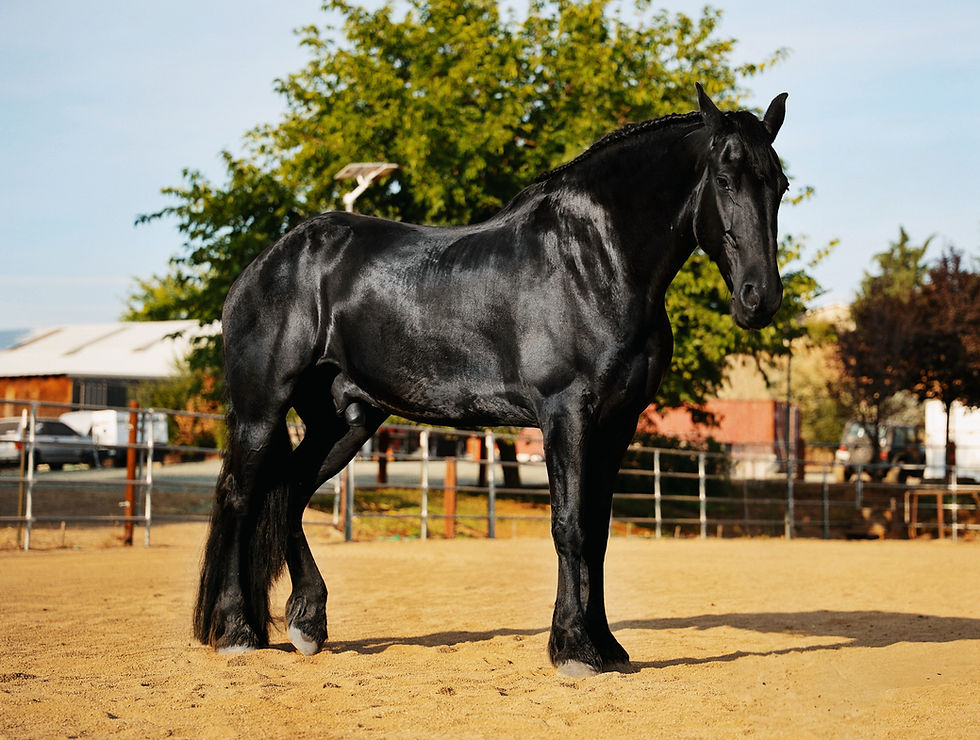
The Friesian horse is one of the easiest breeds to recognize. A glossy black coat, long mane and tail, feathered lower legs, proud carriage, and animated trot give the breed a dramatic appearance that stands out in the show ring, on the road, and on film.
Behind that appearance is a long and complicated history.
The Friesian developed in Friesland, a northern province of the Netherlands, where horses had to be strong enough for work and transport but stylish enough for riding and carriage use. Over time, the breed changed from a compact medieval horse into a Baroque riding and driving horse, then into an agricultural horse, and finally into the modern sport and recreation horse seen today.
Friesians are admired for their trainability, presence, and versatility. They can be excellent dressage horses, driving horses, pleasure mounts, parade horses, and exhibition animals. They are not, however, the best match for every rider or every discipline. Their conformation, movement, grooming needs, genetic background, and breed-associated health risks deserve careful consideration before buying or breeding one.
Friesian Horse Quick Facts
The Friesian originated in Friesland, the Netherlands. Most stand about 15 to 16.3 hands and weigh roughly 1,200 to 1,500 pounds, although individuals vary. Black color, abundant hair, feathered legs, an arched neck, and elevated movement define the breed. Common uses include dressage, driving, pleasure riding, exhibitions, ceremonies, and film.
History and Origins of the Friesian Horse
A horse shaped by Friesland
The Friesian horse takes its name from Friesland, a coastal province in the northern Netherlands. Horses have been bred in this region for centuries. Early written and artistic references describe sturdy, heavily haired horses associated with the people of Friesland, although the horses of the distant past should not be assumed to have looked exactly like modern Friesians.

The medieval war-horse connection
Friesian-type horses are commonly linked with medieval cavalry. Horses used by armored riders needed strength, balance, and the ability to move under a substantial load. The historical Friesian was smaller and more compact than many modern examples, but it was valued as a capable mount.
The connection is sometimes oversimplified. Medieval war horses varied in size and type, and the modern Friesian is not an unchanged relic from that period. Horses from Friesland nevertheless had a reputation for strength and usefulness long before the modern breed
standard existed.
Did You Know? The modern Friesian is not simply an unchanged medieval war horse. The breed has been reshaped several times as warfare, agriculture, transportation, and equestrian sport changed.
Iberian influence and the Baroque Friesian
During the 16th and 17th centuries, Spanish rule and European trade brought Iberian horses into northern Europe. Andalusian and other Spanish-type horses were admired for their agility, elevated movement, arched necks, and aptitude for collected riding.
Iberian influence is widely credited with helping refine the Friesian. The horse became lighter, more elegant, and better suited to carriage work and the formal riding practiced at European courts. The high-set neck, expressive front end, abundant hair, and powerful but stylish movement associated with the breed fit the broader Baroque ideal.
This period also connected the Friesian with classical riding. Learn how court riding developed into modern competition in The History of Dressage.

From carriage horse to trotter and farm horse
As firearms and organized infantry reduced the military importance of heavy cavalry, Friesians found new work. They became carriage horses, road trotters, and lighter agricultural horses. Trotting competitions were popular in Friesland, and speed at the trot was useful both for sport and for practical travel.
By the 19th century, however, the breed faced serious pressure. Specialized trotters could be faster. Heavier draft breeds could perform more demanding agricultural work. Mechanization gradually reduced the need for horses in both transport and farming. Crossbreeding and changing market demands further reduced the number of purebred Friesians.
The establishment of the KFPS
In 1879, breeders and supporters established the Friesch Paarden-Stamboek, now known as the Koninklijke Vereniging Het Friesch Paarden-Stamboek, or KFPS. It was the first horse studbook founded in the Netherlands and became the central organization responsible for recording pedigrees and guiding purebred Friesian breeding.
The studbook did not immediately remove the threat of extinction. According to the KFPS history of the Friesian horse, only three approved purebred breeding stallions remained alive in 1913. The breed survived through focused conservation and the dedication of breeders who continued using Friesians when other horses and machines were often more commercially practical.
Breeding goals shifted again. Friesians were made heavier and more compact to suit agricultural work, while breeders attempted to preserve the breed's black color, feathering, character, and distinctive identity.
A second decline and modern recovery
The tractor created another crisis after the Second World War. As horses disappeared from farms, Friesian numbers and studbook participation declined. Breed advocates responded by promoting the Friesian for sport, recreation, driving, and exhibition. Driving competitions, tourism, film, and artificial insemination helped the population expand internationally.
Modern recovery is a genuine conservation success, but rapid expansion from a narrow foundation also created a challenge. A population can grow in number without gaining much genetic diversity. That distinction helps explain why pedigree analysis and responsible genetic management remain important today.
Did You Know? The KFPS reports that the Friesian population fell to only three living purebred breeding stallions in 1913. Nearly losing the breed helped create the narrow genetic base that modern breeders must manage carefully.
Physical Characteristics and Breed Type
General appearance
The Friesian is commonly described as a Baroque horse. This term refers to a type characterized by a strong body, rounded contours, a relatively upright carriage, an arched neck, and a natural ability to carry more weight behind as training progresses. The breed combines substance with elegance rather than fitting neatly into the modern warmblood or heavy draft categories.
A typical Friesian has:
A refined, expressive head with alert eyes and small ears
A high-set, curved neck
A broad chest and deep barrel
A strong back, loin, and muscular hindquarters
Substantial bone and full feathering around the fetlocks
A long, thick mane and tail

Individual horses vary considerably. Some retain a heavier, more traditional build, while others are taller, longer-lined, and bred with riding sport in mind. Informal labels such as “Baroque type” and “sport type” are useful descriptions, but they do not replace an official registration category or an evaluation of the individual horse.
Height and weight
Many Friesians stand between 15 and 16.3 hands. Smaller and taller individuals exist, and height alone does not determine quality or suitability. A mature Friesian often weighs approximately 1,200 to 1,500 pounds, but a lightly built mare and a tall, mature stallion may differ substantially.
Do not rely on breed averages for medication, feed, or trailer calculations. How Much Does a Horse Weigh? explains estimation methods, and the Horse Weight and Body-Condition Estimator helps track changes.
Coat color
Black is the defining Friesian color. Many Friesians are fading black, meaning the coat can bleach to brown or reddish tones after prolonged sun exposure, especially during summer. A faded coat does not mean the horse is genetically bay or chestnut.
The genetics behind black color are more complex than appearance alone suggests. A black horse must be able to produce black pigment, but it may still carry recessive red. Two black horses that both carry red can produce a chestnut foal. Chestnut Friesians have occurred historically, although the KFPS breeding standard strongly selects for black and restricts white markings.
For a plain-language explanation of Extension, Agouti, and hidden color genes, read Horse Coat Colors and Genetics. Owners with laboratory results can also use the Horse DNA Test Results Interpreter.
Did You Know? A black Friesian can carry a recessive chestnut allele without showing it. Coat color cannot reliably reveal every gene a horse may pass to a foal.
Mane, tail, and feathering
The abundant hair is one of the breed's most popular features, but it carries a management cost. Long manes tangle and break without careful handling. Thick tails collect mud and debris. Feathering can hide small wounds, mites, skin inflammation, and swelling around the pasterns.
Aggressive brushing can pull out healthy hair. Owners often get better results by keeping the hair clean, detangled, and dry and using fingers or a wide-toothed comb on knots.
Movement
Friesians are known for an elevated trot with noticeable flexion of the knee and hock. The forelimbs may appear to lift dramatically, and the horse often travels with an impressive upright outline.
Eye-catching movement is not automatically efficient movement. The horse still needs to step under its body, use its back, maintain rhythm, and develop strength behind. High knee action can hide a short stride or limited engagement. Movement should suit the intended job, not simply look dramatic.
Temperament and Trainability
Friesians are widely valued for an approachable, willing temperament. Many are social, intelligent, and strongly interested in people. They often respond well to calm, consistent handling and can become reliable partners in both ridden and driven work.
Commonly reported qualities include:
Willingness to learn
Strong handler awareness
Sensitivity to pressure and body language
A generally cooperative nature
Energy without the sharp reactivity seen in some lighter breeds
Good memory for both correct training and accidental habits
Breed reputation should never replace an individual assessment. Friesians can be anxious, pushy, inexperienced, or physically uncomfortable like any other horse. Their size, strength, and animated movement may be difficult for a complete beginner. Clear, quiet training tends to suit their sensitivity, while inconsistent or forceful handling may create tension or resistance.
What Are Friesian Horses Good For?
Dressage
Dressage is one of the most visible modern uses of the Friesian. The breed's upright carriage, expressive trot, presence, and willingness make it attractive for classical work, breed competitions, exhibitions, and lower to advanced levels of conventional dressage.

Many Friesians find collected-looking work easier than a truly ground-covering gait, but natural elevation should not be mistaken for correct collection. True collection requires balance, impulsion, engagement, and progressive strength.
Some have competed successfully at high levels, but Friesians are less common in elite international dressage than purpose-bred warmbloods. The average Friesian may have less suspension, elasticity, and length of stride. A suitable individual can still be an excellent dressage partner.
Driving and carriage work
Driving is a traditional strength. Friesians combine pulling power with enough action and visual presence to make an impressive turnout. They are used for:
Pleasure driving
Carriage competitions
Combined and recreational driving
Pairs and four-in-hand teams
Ceremonial and funeral carriages
Weddings and public events
Breed demonstrations

A driving horse must still be selected and trained for the job. Calmness around traffic, noise, crowds, shafts, vehicles, and rein contact is essential.
Pleasure and recreational riding
Many Friesians make dependable pleasure horses for arena work, lessons, hacking, and moderate trails. For trail use, evaluate sure-footedness, confidence away from home, speed control, and fitness rather than relying on the breed label. Heavy feather and a dense coat require extra attention in mud and heat.
Exhibition, ceremonial work, and film
The breed's visual impact makes it a natural choice for parades, demonstrations, ceremonies, and historical or fantasy productions. These jobs require horses that tolerate music, flags, crowds, costumes, equipment, and unfamiliar footing. Temperament and specialized training matter more than color alone.

Crossbreeding and Friesian sporthorses
Friesians are sometimes crossed with warmbloods, Thoroughbreds, Arabians, Saddlebreds, and other breeds to combine Friesian appearance and temperament with a lighter build, greater endurance, or more specialized athletic ability. These horses are often called Friesian Sporthorses.
A Friesian cross is not a purebred Friesian and may belong to a separate registry. Crossbreeding does not guarantee the best qualities of both parents, so conformation, temperament, soundness, and genetic risk still require individual evaluation.
Disciplines Friesians May Be Less Suited For
Upper-level jumping and eventing
Some Friesians enjoy small fences and can participate successfully in lower-level jumping. Purebred Friesians are less commonly suited to upper-level show jumping or eventing, where efficient galloping, scope, agility, rapid recovery, and economical jumping technique are major performance requirements.
Their heavier build, upright way of going, and less economical gallop can increase fatigue. That does not mean a Friesian should never jump. It means the height and workload should match the horse's conformation, fitness, training, and veterinary history.
Endurance riding
Long-distance endurance rewards efficient movement, cardiovascular recovery, and heat dissipation. Friesians can be conditioned for ordinary trail mileage, but their dense coats, substantial body mass, and animated movement usually put them at a disadvantage in elite endurance compared with lighter breeds.
Racing and speed events
The modern Friesian was not selected for maximum galloping speed, rapid acceleration, or sharp turns at speed. Other breeds are more biomechanically suited to racing, high-level barrel racing, polo, and similar disciplines.
A well-built Friesian may enjoy varied recreational work, but buyers seeking elite specialized performance should select a horse bred and proven for that job.
Health and Genetic Considerations
The Friesian population passed through severe bottlenecks and remained relatively closed. Use of a limited number of influential stallions further increased relatedness, so some uncommon inherited diseases occur more often than in the general horse population.
Predisposition does not mean every Friesian will become ill. It means owners and breeders should recognize the risks and use genetic and veterinary screening intelligently.
Dwarfism
Friesian dwarfism is an inherited recessive disorder. Affected foals have disproportionate growth, including markedly shortened limbs and ribs, while the head remains relatively normal in size and the back may appear long. The altered skeletal proportions can lead to serious lifelong orthopedic and functional problems.
A recessive disorder develops when a foal inherits the harmful variant from both parents. Breeding two carriers creates, for each pregnancy, a 25 percent chance of an affected foal, a 50 percent chance of a carrier, and a 25 percent chance of a clear foal.
Hydrocephalus
Hereditary hydrocephalus causes excessive fluid accumulation within the developing brain and skull. The foal's head may become severely enlarged, and affected foals are generally stillborn or nonviable. The abnormal head size can also create a dangerous dystocia for the mare.
Hydrocephalus in Friesians is inherited as a recessive condition. DNA testing allows breeders to identify carriers and avoid carrier-to-carrier matings without automatically removing every carrier from the population.
The UC Davis Veterinary Genetics Laboratory Friesian Health Panel includes tests for Friesian dwarfism and hydrocephalus. Registry requirements and available panels can change, so breeders should confirm current KFPS rules and use a recognized laboratory.
Did You Know? Removing every carrier from a small breed can shrink genetic diversity even further. A more balanced strategy is to identify carriers, breed them only to tested clear horses when registry rules permit, and retain valuable unrelated bloodlines.
Distichiasis
Distichiasis is the growth of eyelashes from abnormal locations along the eyelid margin. These hairs may rub the cornea, causing irritation, tearing, squinting, or corneal ulceration. Severity varies. Some horses have few clinical problems, while others require ophthalmic treatment.
A horse with repeated eye irritation should receive a veterinary examination. Owners should not assume that tearing is caused by dust or flies, particularly when the problem is persistent or affects one eye more than the other.
Megaesophagus
Megaesophagus is an abnormal enlargement and loss of normal motility in the esophagus, the muscular tube that carries food from the mouth to the stomach. Friesians appear predisposed to this disorder.
Possible signs include:
Difficulty swallowing
Repeated choke
Coughing or gagging while eating
Feed or saliva coming from the nostrils
Unexplained weight loss
Recurrent respiratory infection
Aspiration pneumonia
Aspiration occurs when feed, saliva, or fluid enters the airway and can cause life-threatening pneumonia. Repeated choke requires veterinary investigation, which may include endoscopy, imaging, and assessment of esophageal function.
Aortic rupture
Friesians have a recognized predisposition to a characteristic form of aortic rupture. The aorta is the major artery carrying blood away from the heart. A tear may cause internal bleeding or create an abnormal connection between the aorta and pulmonary artery.
Signs may include sudden collapse or death, pain, sweating, rapid heart rate, breathing difficulty, poor performance, or signs resembling colic. Research has found structural and mechanical differences in the Friesian aorta, but the full biological explanation is still being studied.
There is no simple owner screening test that can rule out all risk. Unexplained collapse, severe distress, or sudden cardiovascular signs require immediate veterinary attention.
Retained placenta
Friesian mares are particularly predisposed to retained fetal membranes after foaling. Normally, the placenta should be expelled completely within about three hours. Retention of the whole placenta or even a small piece can lead to metritis, endotoxemia, laminitis, and death.
Owners should never pull forcefully on the placenta. Contact a veterinarian if it has not passed within the mare's planned time frame, commonly three hours, or sooner if she is unwell. Examine the passed placenta to confirm that it is complete.
Anyone breeding a Friesian mare should build this risk into the foaling plan. Review Horse Gestation Period: How Long Are Horses Pregnant? and use the Horse Tracker to keep breeding dates, expected foaling windows, veterinary notes, and health records together.
Chronic progressive lymphedema and lower-limb skin disease
Chronic progressive lymphedema, or CPL, is a serious condition seen in several feathered breeds, including Friesians. Impaired lymphatic drainage causes progressive swelling, skin thickening, folds, nodules, and recurrent infections of the lower legs. Heavy hair can hide early changes.
Pastern dermatitis, commonly called scratches or mud fever, is not the same condition as CPL, but the two can occur together and complicate each other. Moisture, mites, secondary infection, skin trauma, and chronic swelling may all contribute to lower-limb disease.
Regularly part the feathers and check for crusts, soreness, heat, swelling, thickened folds, discharge, or odor. Mud Fever in Horses: Treatment, Biosecurity, and Prevention explains safe first steps and signs that require veterinary attention.
Daily Care and Management
Feeding and body condition
Friesians should be fed as individuals. Their rounded outline and abundant hair can hide excess fat, so use hands as well as eyes. Body Condition Scoring explains the standard system, while The Basics of Equine Nutrition covers forage and balanced nutrition.
Conditioning
Animated movement can create the impression that a horse is fitter than it is. Fitness develops through progressive work that strengthens the cardiovascular system, topline, hindquarters, tendons, ligaments, and supporting structures.
Begin with regular walking and controlled work, then increase duration and intensity gradually. Use transitions, large figures, hills when appropriate, and enough forward movement to develop the back. Avoid drilling collected-looking steps before the horse is strong enough to carry itself.
Heat and coat management
A dark coat absorbs solar heat, and a heavy mane, tail, feathering, and winter coat can slow cooling. Provide shade, ventilation, fresh water, and sensible scheduling during hot weather. After work, monitor breathing, sweating, attitude, and recovery rather than relying only on the clock.
If the horse remains hot, distressed, weak, or unusually slow to recover, stop work and seek veterinary advice. Knowing the horse's normal resting measurements makes abnormal changes easier to recognize. Review The Horse's Vital Signs and record individual baselines.
Hoof and feather care
Abundant feathers should not prevent routine hoof inspection. Pick out the feet, check the heels, and feel around the pasterns frequently. Maintain a regular farrier schedule based on the horse's growth, hoof balance, work, and environment.
Wet feathers should be allowed to dry thoroughly. Repeated washing without complete drying can worsen skin problems. Owners should also inspect beneath boots and wraps, which may trap heat, grit, and moisture.
Record weight estimates, body condition, farrier visits, skin flare-ups, choke episodes, reproductive history, genetic results, exercise, and veterinary findings in the Horse Tracker. Patterns that seem minor in isolation may become clear when dates and photographs are compared.
Did You Know? Long feathering can conceal swelling and skin disease until lesions are advanced. Feeling and visually inspecting the skin beneath the hair is more useful than looking at the outside of the leg.
Buying a Friesian Horse
The dramatic appearance of a Friesian can make buyers overlook practical suitability. Buy the horse that fits the intended job, rider, care environment, and budget.
Before purchasing, consider:
Registration and identity: Verify the passport, microchip, pedigree, ownership records, and issuing registry directly.
Training: Watch the horse perform the exact tasks you expect it to do. A driving horse may not be a safe riding horse, and a show horse may not be confident on trails.
Conformation and movement: Evaluate the whole horse without being distracted by mane, feather, or high knee action.
Soundness: Arrange an independent pre-purchase examination. Additional imaging should be based on age, use, price, findings, and risk tolerance.
Medical history: Ask about choke, respiratory illness, lower-limb swelling, skin disease, eye irritation, lameness, medications, and previous surgery.
Reproductive and genetic records: For breeding stock, review carrier status, inbreeding information, fertility history, and prior foaling complications.
Temperament: Handle the horse in the stall, aisle, turnout, wash rack, trailer, and working environment when possible.
Management costs: Budget for routine care, professional training, specialized grooming, insurance, transportation, and emergencies.
Use the Horse Purchase Budget Planner to estimate first-year expenses, monthly costs, and an emergency fund before committing.
Breeding Friesian Horses Responsibly
Responsible breeding requires more than pairing two registered black horses. The goal should be to produce a healthy, functional horse while protecting genetic diversity.
Breeders should:
Follow current registry breeding and testing requirements
Verify dwarfism and hydrocephalus status through an accepted laboratory
Avoid carrier-to-carrier matings
Review pedigree relatedness and inbreeding information
Consider conformation, soundness, temperament, fertility, and performance
Discuss the mare's retained-placenta risk with the veterinarian
Prepare for dystocia, neonatal emergencies, and the cost of intensive care
Keep accurate records for the foal and the wider breeding program
A carrier is not the same as an affected horse. When registry policies allow, carefully mating a valuable carrier to a tested clear horse can preserve useful genetic diversity without producing an affected foal. The pairing must still be assessed for overall relatedness and quality.
Genetic tests only address the variants included in that test. A “clear” panel does not guarantee that a horse is free from every inherited disease, and it cannot replace a breeding soundness examination, pedigree analysis, or veterinary judgment.
Is a Friesian the Right Horse for You?
A Friesian may be a good match for an owner who wants an expressive, people-oriented horse for dressage, driving, pleasure riding, exhibitions, or ceremonial work. The best owner appreciates the breed's appearance but is equally prepared to manage its body condition, fitness, feathers, skin, feet, and health records.
The breed may be a poor match for someone seeking an elite endurance horse, upper-level jumper, low-maintenance pasture horse, or inexpensive first horse chosen mainly for looks.
A novice may succeed with a mature, well-trained Friesian under professional guidance, but breed reputation alone does not make every individual beginner-safe.
The most sensible approach is to evaluate three things separately: the breed's general tendencies, the individual horse's actual qualities, and the demands of the intended job. When all three match, the Friesian can be a capable and memorable partner.
Frequently Asked Questions About Friesian Horses
1. Where do Friesian horses come from?
Friesian horses originate from Friesland, a province in the northern Netherlands. Horses from the region were historically used for riding, cavalry, transport, trotting, carriage work, and lighter agricultural work. The modern breed is managed internationally by the KFPS, which was established in 1879.
2. Are all Friesian horses black?
Black is the defining and accepted breed color, but not every black coat looks equally dark year-round. Sun bleaching can give a Friesian a brown or reddish cast. Recessive chestnut genetics also remain possible in the breed, so a black horse may carry red even though it does not show it.
3. How tall is a Friesian horse?
Many mature Friesians stand approximately 15 to 16.3 hands, although some are shorter or taller. Height varies with sex, age, bloodline, and breeding type. Suitability should be based on the horse's conformation, strength, training, and intended use rather than height alone.
4. Are Friesian horses good for beginners?
Some mature, well-trained Friesians can suit novice riders, especially with professional instruction. Others are too powerful, green, sensitive, or animated for a beginner. A calm breed reputation does not replace an individual temperament assessment and a safe rider-
horse match.
5. Are Friesian horses good for dressage?
Yes. Many Friesians are successful in dressage because they are trainable, expressive, and naturally upright. They are especially popular in lower- and mid-level competition, classical exhibitions, and breed sport. They are less common at the highest international levels, where extreme elasticity, suspension, and ground-covering movement are heavily rewarded.
6. Can Friesian horses jump?
Many can jump small or moderate fences when properly trained and conditioned. Purebred Friesians are generally not bred for upper-level show jumping or eventing, and their heavier build and less efficient gallop may limit performance. Fence height and workload should match the individual horse.
7. What genetic diseases affect Friesian horses?
Important inherited or breed-associated concerns include Friesian dwarfism, hydrocephalus, distichiasis, megaesophagus, aortic rupture, retained placenta in mares, and chronic progressive lymphedema. Not all have a simple DNA test, and predisposition does not mean every Friesian will develop the condition.
8. What genetic tests should a Friesian have before breeding?
At minimum, breeders should follow current KFPS or relevant registry requirements and verify status for Friesian dwarfism and hydrocephalus through an accepted laboratory. Additional testing may be recommended as research and registry policies change. Pedigree relatedness, health, conformation, fertility, and temperament must also be considered.
9. Are Friesian horses expensive to maintain?
Their basic needs are the same as those of other horses, but costs may increase because of their large size, grooming requirements, professional training, reproductive management, skin care, or medical needs. Purchase price varies widely. Prospective owners should budget for boarding, forage, farrier care, veterinary care, insurance, tack, training, transportation, and emergencies.
10. How long do Friesian horses live?
Individual lifespan varies widely and depends on genetics, health, use, and care. Friesians can live well into their late teens or twenties, but breed-associated disorders may shorten life in some horses. There is no guaranteed breed lifespan, so buyers should focus on the individual horse's examination, history, and long-term management.
Conclusion
The Friesian horse survived changes in warfare, transportation, agriculture, and sport because breeders repeatedly found a new role for it. That adaptability produced the modern horse: black, expressive, substantial, trainable, and equally recognizable under saddle or in harness.
Its beauty should be considered alongside its practical needs. Friesians require thoughtful conditioning, regular inspection beneath the feathers, careful weight management, and informed veterinary care. Breeders must take genetic testing, pedigree diversity, reproductive risk, and the health of the wider population seriously.
For the right rider or driver, a well-selected Friesian can be an excellent partner for dressage, carriage work, exhibitions, and recreational riding. The soundest choice is based on the complete horse, not the silhouette. Training, temperament, conformation, medical history, and suitability for the intended job matter far more than a long mane or an impressive trot.


Comments