
The Ultimate Equine Conformation Study Guide

An Introduction to Equine Conformation, and the Study Tools You Need to Master It

Equine conformation describes the way a horse is built, including its overall proportions, skeletal alignment, joint angles and the relationship between one part of the body and another. Learning to evaluate conformation helps horse owners and equine professionals understand how structure may influence movement, comfort, athletic ability and the physical demands of a particular job.
A useful conformation assessment is systematic. It looks beyond color, breed, muscle and first impressions. The evaluator studies the whole horse, examines individual regions, watches the horse move and then considers the findings in the context of age, breed, conditioning and intended use.
This equine conformation study guide will walk you through that process. It can be used by horse owners, veterinary and vet tech students, farriers and apprentices, trainers, breeders, riding instructors and anyone preparing for an equine studies examination.
For a complete self-paced course, the Equine Conformation Study Kit combines structured learning material, study aids and a comprehensive knowledge assessment. Students who already understand the fundamentals and want a focused visual review can purchase the Conformation Flashcards separately. The flashcards are included with the complete Study Kit, so there is no need to purchase both.

What Is Equine Conformation?
Equine conformation is the shape, proportion and structural alignment of a horse's body. It includes the relationship between the skeleton, joints, hooves and supporting soft tissues. Although people often discuss conformation in terms of appearance, its practical value lies in understanding form and function.

A conformation assessment commonly considers:
Overall balance and body proportion
The relationship between the front end, barrel and hindquarters
Head and neck proportions
Shoulder, hip and pastern angles
Length and strength of the back and loin
Alignment of the front and hind limbs
Hoof shape and the hoof-pastern relationship
Symmetry and muscular development
The way the horse travels at the walk and trot
Conformation should never be treated as a verdict on a horse. Very few horses are built perfectly, and many horses with visible deviations remain sound and successful. A conformational trait may increase stress in a particular area without guaranteeing that the horse will become lame. Workload, footing, conditioning, hoof care, previous injury, age and management also affect how well a horse performs.
Recent research reinforces the need for a balanced interpretation. A 2026 study comparing Quarter Horses from different disciplines found measurable differences in body shape, but static morphology alone did not uniquely predict movement patterns at the walk and trot. Conformation provides useful information, but the horse's actual movement and individual history must remain part of the assessment.
Did You Know? A conformation fault is usually a description of structure, not a diagnosis. It tells you where forces may be directed, but it does not prove that pain, injury or lameness is present.
Why Learning Horse Conformation Matters
Conformation knowledge gives you a practical framework for understanding the horse in front of you. It can help you:
Select a horse whose build is reasonably suited to the intended work
Recognize structural strengths and limitations
Understand why a horse may move in a particular way
Notice areas that may require closer monitoring
Communicate more clearly with veterinarians, farriers and trainers
Make better decisions about conditioning, workload and hoof care
Separate a long-standing structural trait from a new physical change
If this is your first introduction to the subject, begin with The Beginner's Guide to Equine Conformation. It introduces balance, proportion and a simple box method that teaches you to look at every horse in the same order.
The Best Order for Studying Equine Conformation
Trying to memorize every fault at once usually creates confusion. Learn the subject in layers so each new term has an anatomical and functional meaning.
1. Learn the Parts of the Horse
You cannot describe conformation accurately if you are unsure where the carpus, cannon, fetlock, pastern, point of shoulder, stifle, gaskin or point of buttock is located. Start with external landmarks, then connect those landmarks to the underlying skeleton.
Use the Interactive Horse Anatomy Learning Tool and Interactive Horse Skeleton Map to review structures visually. The Parts of the Horse Flashcards and Parts of the Horse Infographic Poster can help reinforce the terminology.

2. Learn Overall Balance Before Individual Faults
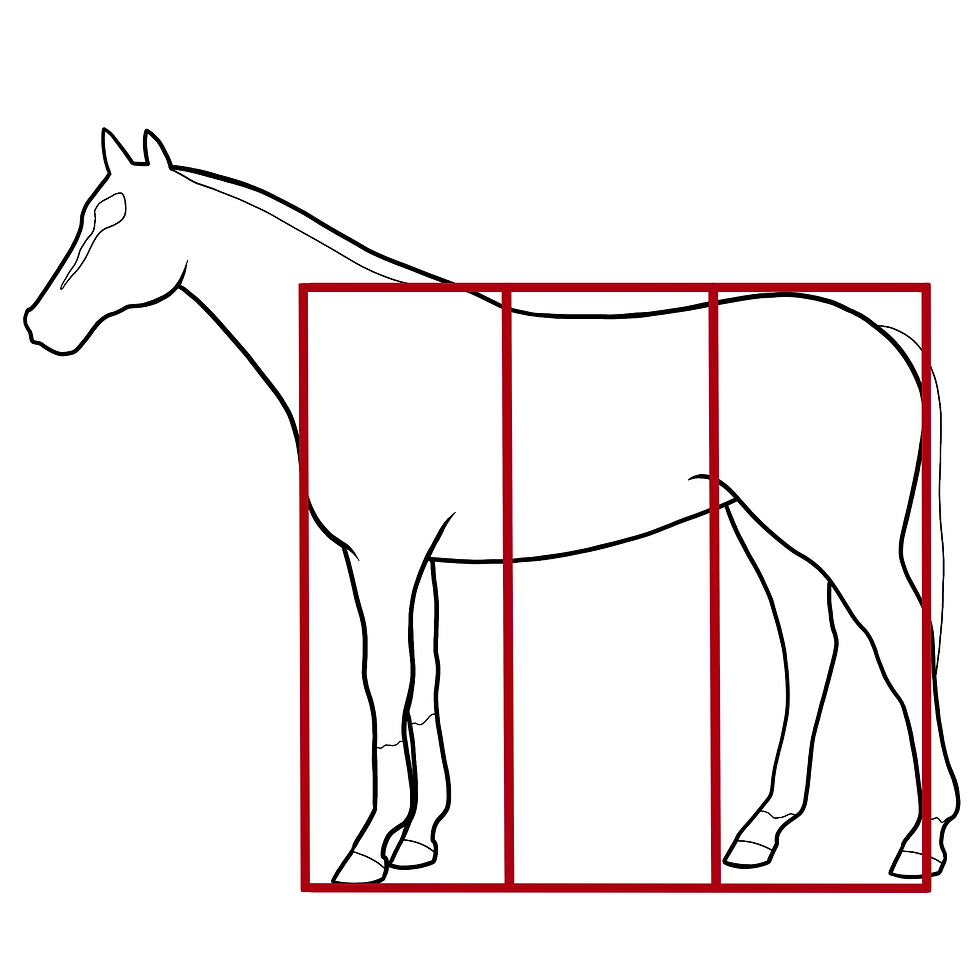
First decide whether the horse appears proportional. Divide the horse mentally into three sections:
The front end, including the head, neck, shoulder and forelimbs
The middle, including the chest, barrel, back and loin
The hind end, including the pelvis, croup and hind limbs
Ask whether these sections appear to belong to the same horse. Then compare body length with height, the level of the withers and croup, the length of the back, and the relationship between the topline and underline.
Do not worry about exact measurements at first. The goal is to develop a repeatable system and train your eye to recognize
proportion.
3. Study One Region at a Time
After you understand overall balance, study the front limbs, hind limbs, topline, neck and shoulders separately. Learn the correct viewing angle, normal alignment, name of each deviation and the possible functional effect.
4. Connect Static Conformation to Movement
A horse standing still provides only part of the picture. Once you identify a structural trait, watch the horse walk and trot. Look for its effect on limb flight, foot placement, stride length, breakover and tracking.
5. Practice Active Recall
Looking at the same diagram repeatedly can create familiarity without true recall. Cover the labels, name the fault from memory and explain why it matters. This is where equine conformation flashcards become especially useful. They require you to retrieve the term and its meaning instead of simply recognizing it on a page.

How to Set Up a Horse for Conformation Evaluation
Good positioning matters. A horse standing on a slope, resting a hind limb or reaching toward the handler can look very different from the same horse standing square on level ground.
Whenever possible:
Place the horse on firm, level footing
Remove bulky tack, blankets and leg wraps
Allow the horse to hold its head and neck in a natural position
Stand the horse reasonably square without forcing an artificial pose
View the horse directly from each side, the front and the rear
Stand far enough away to see the entire horse without lens distortion
Take photographs at approximately mid-body height
Watch the horse walk and trot on a straight line in both directions
Use several views and observe the horse more than once. A single photograph can be misleading because of camera angle, posture, uneven ground or the exact moment at which the image was taken.
Did You Know? Hoof length can change the apparent angle of the pastern and lower limb. Record the date of the horse's last trim or shoeing when comparing conformation photographs taken at different times.
Step 1: Evaluate Overall Balance and Proportion
Begin with the whole horse. Avoid getting distracted by one unusual foot, a dramatic marking or a heavily muscled hindquarter.
From the side, consider:
Does the horse appear generally square or unusually long or tall for its body?
Are the withers level with, higher than or lower than the croup?
Do the front end, middle and hindquarters appear proportional?
Is the back excessively long or short in relation to the rest of the body?
Does the neck appear proportional to the head and body?
Is the horse's depth of heartgirth appropriate for its frame?
Does the topline flow smoothly from the withers through the back, loin and croup?
Balance is relative to breed, age and purpose. A mature stock horse, Arabian, Thoroughbred, draft horse and Warmblood should not be expected to have identical proportions. The first question is whether the horse is balanced within its own type and physically suited to the work being considered.
An uphill build places the withers higher than the croup and may help some horses shift weight toward the hindquarters. A downhill build places the croup higher than the withers and may encourage more weight on the front end. Young horses often appear temporarily downhill during growth, so age must be considered.
Step 2: Study the Topline, Back and Loin
The topline includes the withers, back, loin and croup. This region helps transmit force from the hindquarters and supports the rider's weight.
A very long back may provide flexibility but can be harder to stabilize under load. A very short back may be strong but can reduce space for saddle placement or limit flexibility. The loin, sometimes called the coupling, should appear strong enough to connect the back and pelvis without an obvious weak or excessively long section.
Also look for:
Prominent or poorly defined withers
A dipped or swayed back
A raised or roached back
Weak coupling through the loin
A very flat or steep croup
Left-to-right muscular asymmetry
Do not confuse skeletal conformation with muscle loss, body condition or posture. A horse with poor topline development may look structurally weak even when the primary problem is inadequate conditioning, pain, nutrition, saddle fit or age-related muscle loss.

Step 3: Evaluate the Head, Neck and Shoulder
The head and neck help the horse balance while moving. Study the length and set of the neck, the throatlatch, the point at which the neck enters the chest and the relationship between the neck and shoulder.
A low-set or short neck may make elevation and balance more difficult for some horses. A long neck can provide a large balancing lever, but its usefulness depends on muscular development and how the horse carries it. Avoid judging the neck solely by its upper outline because posture and training can greatly change its appearance.
The shoulder should be evaluated by locating the scapula rather than following the surface of the muscle. A more sloping shoulder is commonly associated with greater reach and a smoother stride. A more upright shoulder is often associated with a shorter stride and increased concussion. Shoulder angle should still be interpreted alongside pastern angle, limb alignment and actual movement.

Step 4: Evaluate Front Limb Conformation
The front limbs carry a larger share of the horse's weight and are exposed to substantial concussion. Evaluate them from both the front and the side.
From the front, imagine a vertical line descending through the center of each limb. Study the relationship between the forearm, carpus, cannon bone, fetlock, pastern and hoof.
Common front-view terms include:
Base-wide: The feet stand farther apart than the limbs at their origin from the chest.
Base-narrow: The feet stand closer together than the limbs at their origin.
Toed-in or pigeon-toed: The toes point toward one another.
Toed-out or splay-footed: The toes point away from one another.
Offset or bench knee: The cannon bone does not sit centrally beneath the carpus.
From the side, look at the alignment of the carpus and the position of the entire limb beneath the body.
Over at the knee: The carpus sits forward of the expected vertical line.
Back at the knee: The carpus appears behind the expected line, creating a backward curve through the limb.
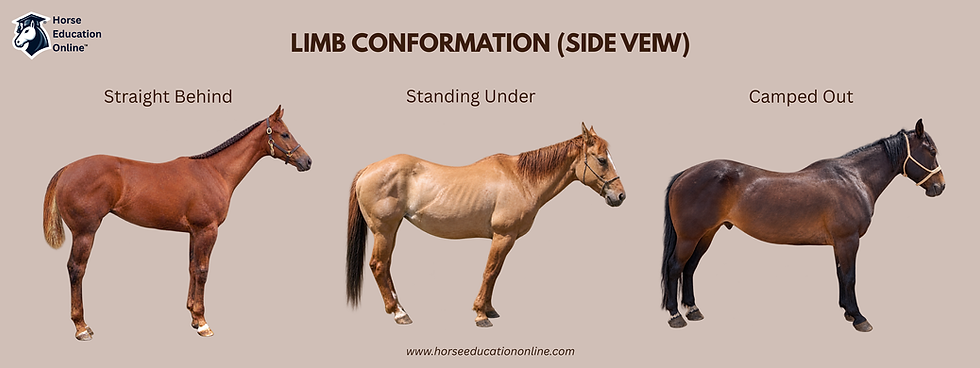
Camped-out in front: The forelimbs stand too far forward from the body.
Standing-under in front: The forelimbs stand too far beneath the body.
Straight Behind: There is little angulation between the bones of the hind limbs.
The terms describe structure, but severity matters. Mild deviations are common. A pronounced deviation, multiple deviations in the same limb or marked asymmetry deserves closer professional evaluation.
For a deeper look at the knee, read Introduction to the Equine Carpus: Anatomy, Biomechanics, and Common Problems.
Step 5: Evaluate Hind Limb Conformation
The hindquarters generate propulsion and play a major role in acceleration, jumping, collection, stopping and turning. Begin at the pelvis and follow the alignment through the stifle, hock, cannon, fetlock, pastern and hoof.
From the side, common terms include:
Sickle-hocked: The hock angle is excessive, and the lower limb appears placed too far under the horse.
Post-legged or straight behind: The stifle and hock have less angulation than expected.
Camped-out behind: The hind limbs stand excessively behind the body.
Camped-under behind: The hind limbs stand farther beneath the body than expected.
From the rear, look for a reasonably straight relationship from the point of the buttock through the hock and lower limb.
Cow-hocked: The hocks sit closer together while the lower limbs angle outward.
Bow-legged behind: The hocks sit farther apart while the lower limbs angle inward.
Base-narrow or base-wide behind: The feet stand unusually close together or far apart relative to the upper limbs.
Because the hock is central to hind-limb power and loading, a sound understanding of the joint makes these terms easier to remember. Review Introduction to the Equine Hock: Anatomy, Biomechanics, and Why It Matters before trying to memorize every hind-limb fault.
Step 6: Evaluate the Pasterns and Hooves
The lower limb should be studied as a connected unit. Look at pastern length and slope, the alignment of the hoof and pastern, heel support, toe length, medial-lateral balance and differences between paired feet.
An upright pastern generally provides less visible flexion during loading and may transmit more concussion. A long, sloping pastern may provide more elasticity but can increase strain on supporting soft tissues. These are broad mechanical tendencies, not predictions of injury.
The hoof-pastern axis describes the alignment between the front surface of the hoof wall and the pastern. A broken-back or broken-forward appearance may result from hoof distortion, trimming, posture, pain or the horse's underlying conformation. It should be assessed by a qualified hoof-care professional in the context of the whole limb.
Continue this section with The Pastern Joint: Structure, Function, and Why It Matters, What Is Hoof Balance? A Scientific, Peer-Reviewed Guide and Club Foot in the Adult Horse.

Did You Know? Trimming and shoeing can support a mature horse and reduce the effect of some imbalances, but they cannot safely straighten bones that developed in a different alignment. The goal is functional support, not forcing every hoof and limb to look identical.
Step 7: Watch the Horse Move
Static conformation creates expectations. Movement shows how the individual horse actually uses its body.
Watch the horse walk and trot on level footing. Observe from the front, rear and side while maintaining a safe distance. Look for:
Rhythm and regularity
Stride length and joint flexion
Straightness of limb travel
Hoof flight and placement
Tracking of the hind feet in relation to the front feet
Heel-first, flat or toe-first landing
Paddling, winging, plaiting or interference
Differences between the left and right sides
Changes with speed, circles or fatigue
Conformation can influence the direction in which the limbs travel, but hoof balance, training, rider influence, fatigue, pain and footing can also alter movement. Read Understanding Gait Faults in Horses: A Practical, In-Depth Guide to connect structural observations with hoof flight and footfall.
Sudden or marked asymmetry should not be dismissed as a conformation fault. A horse that develops a shortened stride, head nod, hip hike, toe drag, reluctance to turn, heat or swelling needs an appropriate veterinary evaluation.
Common Horse Conformation Faults to Know
The following terms appear frequently in equine conformation exams, judging programs and professional discussions:
Downhill or uphill build
Long back or short back
Weak loin or long coupling
Upright or sloping shoulder
Upright or long, sloping pasterns
Base-wide or base-narrow stance
Toed-in or toed-out feet
Offset or bench knees
Over at the knee or back at the knee
Sickle hocks or post-legged hind limbs
Cow hocks or bow-legged hind limbs
Club foot
Do not memorize these as isolated labels. For each term, learn four things:
The view from which it is identified
The anatomical structures involved
The way it may redirect force or movement
The other factors that could change its appearance
That approach is slower at first, but it produces knowledge you can use in a barn instead of facts you can only repeat on a test.
Did You Know? Left-to-right asymmetry may be more important than a mild, symmetrical deviation. A difference between paired limbs can reflect posture, hoof imbalance, uneven muscle development, previous injury or pain and should be investigated in context.
Conformation Must Be Judged in Context
There is no single perfect conformation for every horse and every job. A horse bred for sprinting, sliding stops, collected dressage work, endurance or pulling heavy loads may have different useful proportions.
Use these questions to keep an assessment practical:
Is the horse mature, or is it still changing through growth?
What work is the horse expected to perform?
How demanding is that work?
Does the horse move comfortably and efficiently?
Is the trait mild, moderate or severe?
Is it symmetrical?
Are several deviations loading the same region?
What does the horse's veterinary, performance and hoof-care history show?
Breed standards and judging ideals can help describe type, but appearance should not replace evidence from movement, soundness and real-world performance. A recent study of Quarter Horses found that horses from different disciplines showed broadly similar locomotor patterns despite measurable morphological differences. The lesson for students is simple: assess the horse standing still, then watch the horse work.
Conformation, Posture and Hoof Distortion Are Different
Students commonly mistake temporary posture or acquired distortion for fixed skeletal conformation.
Conformation refers primarily to the horse's underlying build and structural relationships.
Posture is the way the horse is standing at a particular moment. Pain, tension, uneven footing, handling and habit can change it.
Hoof distortion develops as the hoof capsule grows and responds to loading, wear, disease and trimming or shoeing. It can exaggerate or disguise features of limb conformation.
Muscle and body condition add another layer. A horse with muscle atrophy, a weak topline or substantial fat deposits may be difficult to evaluate accurately from photographs. Repeat the assessment after proper positioning, and compare your findings with movement and palpation rather than relying on an outline alone.
A Four-Week Equine Conformation Study Plan
Week 1: Anatomy and Landmarks
Learn the external parts of the horse.
Review the major bones and joints.
Practice identifying landmarks on photographs and live horses.
Use anatomy tools and parts-of-the-horse study aids.
Week 2: Balance and Body Proportions
Divide horses into front, middle and hind sections.
Practice the box method from the beginner's guide.
Compare horses of different breeds and ages.
Describe what you see before assigning a fault name.
Week 3: Limb Conformation
Study front limbs from the front and side.
Study hind limbs from the rear and side.
Learn one group of terms at a time.
Use flashcards for short daily recall sessions.
Week 4: Form and Function
Watch horses walk and trot from several directions.
Connect static observations to hoof flight and foot placement.
Review gait faults, hoof balance, the hock, carpus and pastern.
Complete practice assessments without notes, then check your work.
Ten to fifteen minutes of focused recall each day is usually more productive than one long session followed by a week without review. Mix diagrams, photographs, live observation and verbal explanation. If you can identify a trait and explain its possible functional significance in plain language, you understand it.
Choosing the Right Equine Conformation Study Resource
Horse Education Online offers three ways to continue studying, depending on how much structure you need.
Equine Conformation Study Kit
Choose the Equine Conformation Study Kit if you want a complete, self-paced learning path. It covers whole-horse assessment, front and hind limb conformation, the relationship between conformation and performance, and the ways certain traits may influence movement, loading and lameness risk. The kit includes structured educational material, supporting study aids and a 100-question online knowledge assessment. Eligible learners receive a Certificate of Completion after meeting the program requirements.
The Study Kit is designed for horse owners and students as well as farriers, trainers, riding instructors and other equine professionals who want to strengthen their academic understanding of conformation.
Conformation Flashcards
Choose the standalone Conformation Flashcards if you already have a reliable reference and want a focused way to memorize conformation types, definitions, effects on movement and anatomical areas that may experience added stress.
The flashcards are especially useful for:
Veterinary and vet tech students
Farriers, apprentices and horseshoeing school students
Trainers and riding instructors
Horse judging and equine studies students
Owners preparing to assess or purchase a horse
Remember that the conformation flashcards are included in the complete Study Kit. Purchase the separate set only if you do not plan to enroll in the kit.
Free Articles and Interactive Resources
Use the Equine Anatomy and Conformation Study Resources page to find related educational materials in one place. You can also explore the complete collection of equine conformation articles for further reading on anatomy, growth, joints and structural assessment.
Final Study Advice
The best conformation students develop a consistent order of observation. Start with the whole horse, move through each anatomical region, inspect the limbs from the correct views and finish by watching the horse travel. Describe what you see before deciding what it means.
Keep the assessment proportional and practical. One mild fault rarely tells the whole story, and a visually impressive horse is not automatically well suited to every job. Combine structure with movement, soundness, history and intended use. That is how conformation knowledge becomes useful in daily horse care, professional education and better decision-making.
Equine Conformation Frequently Asked Questions
1. What is equine conformation?
Equine conformation is the shape, proportion and structural alignment of a horse's body. It includes overall balance, joint angles, limb alignment, the topline, hooves and the relationship between individual body regions.
2. How do you evaluate a horse's conformation?
Stand the horse naturally on level ground and view it from both sides, the front and the rear. Assess overall balance first, then study the topline, shoulders, front limbs, hind limbs, pasterns and hooves. Finish by watching the horse walk and trot in a straight line.
3. What is considered good horse conformation?
Good conformation is balanced, proportional and appropriate for the horse's breed, age and intended use. The limbs should show functional alignment, paired structures should be reasonably symmetrical and the horse should move comfortably. There is no single ideal build for every discipline.
4. What are the most common horse conformation faults?
Common terms include downhill build, long back, upright shoulder, upright or long pasterns, base-wide or base-narrow stance, toed-in or toed-out feet, offset knees, back at the knee, cow hocks, sickle hocks and post-legged hind limbs.
5. Can conformation faults cause lameness?
Some conformational traits may change the way force travels through bones, joints, tendons, ligaments and hooves. This can increase stress in certain areas, especially under demanding work. A fault does not guarantee lameness, and conformation alone cannot diagnose the source of pain.
6. Can a farrier correct poor conformation?
A farrier can support hoof balance, improve breakover and help manage the way a mature horse loads its feet. Farriery cannot safely realign mature bones or erase the horse's underlying conformation. Young horses with developing limbs require timely evaluation by a veterinarian and an experienced farrier.
7. Can a horse with poor conformation still be ridden?
Many horses with less-than-ideal conformation remain comfortable and useful. Suitability depends on the type and severity of the deviation, the work expected, the horse's movement, soundness, conditioning and management. A pre-purchase examination is advisable when selecting a horse for a specific job.
8. What is the difference between conformation and posture?
Conformation describes the horse's underlying build. Posture describes how the horse is standing at a particular moment. Uneven footing, pain, tension, handling or resting a limb can temporarily change posture and create a misleading impression of conformation.
9. What is the best way to study equine conformation?
Learn anatomical landmarks first, then study balance, individual body regions, limb alignment and movement in that order. Use active recall, labeled and unlabeled diagrams, photographs, live horses and repeated short review sessions. Flashcards work best when you answer before turning the card over.
10. Should I choose the Equine Conformation Study Kit or the flashcards?
Choose the Equine Conformation Study Kit for a complete course with structured material, study aids and an assessment. Choose the Conformation Flashcards separately if you only need a targeted review tool. The flashcards are already included in the Study Kit.
References and Further Reading
Conformation of the Horse, University of Minnesota Extension
Conformation of the Horse: Relationship of Form to Function, AAEP Proceedings
Similar Locomotor Patterns Across Quarter Horse Disciplines Inform Lameness Assessment
Investigating Associations Between Horse Hoof Conformation and Presence of Lameness



Comments