
What Is Hoof Balance? How to Assess a Horse’s Feet

Updated: 1 day ago
Hoof balance is one of the most familiar terms in farriery, yet it is easily oversimplified. It is often described as making the bottom of the hoof level, the medial and lateral walls equal, or the foot visually symmetrical. Those observations may be useful, but none provides a complete definition.
A hoof is part of a moving limb. Its outer shape, internal anatomy, ground-bearing surface, landing pattern, loading pattern, and breakover all influence one another. The same foot can also behave differently on concrete, packed dirt, arena footing, or deep sand. A scientifically useful definition must therefore account for both what the hoof looks like while the horse is standing and what it does during movement.
Hoof balance is the relationship between the shape and alignment of the hoof, the structures within the foot and distal limb, and the way forces are accepted, distributed, and released through the hoof during weight bearing and locomotion.

This definition includes two closely related components:
Static hoof balance: the shape and alignment of the hoof and lower limb while the horse is standing.
Dynamic hoof balance: how the hoof lands, loads, moves through stance, breaks over, and leaves the ground.
Peer-reviewed research supports both components. It also shows why one measurement, external landmark, or geometric formula cannot identify balance in every horse. Conformation, gait, speed, footing, hoof morphology, soundness, farriery, and loading history all matter.
Readers who want to review the structures discussed throughout this article can use the Interactive Horse Anatomy Learning Tool, the Hoof Anatomy study resource, and the Basic Farrier Anatomy Study Sheets.
Why Hoof Balance Cannot Be Defined by Symmetry Alone
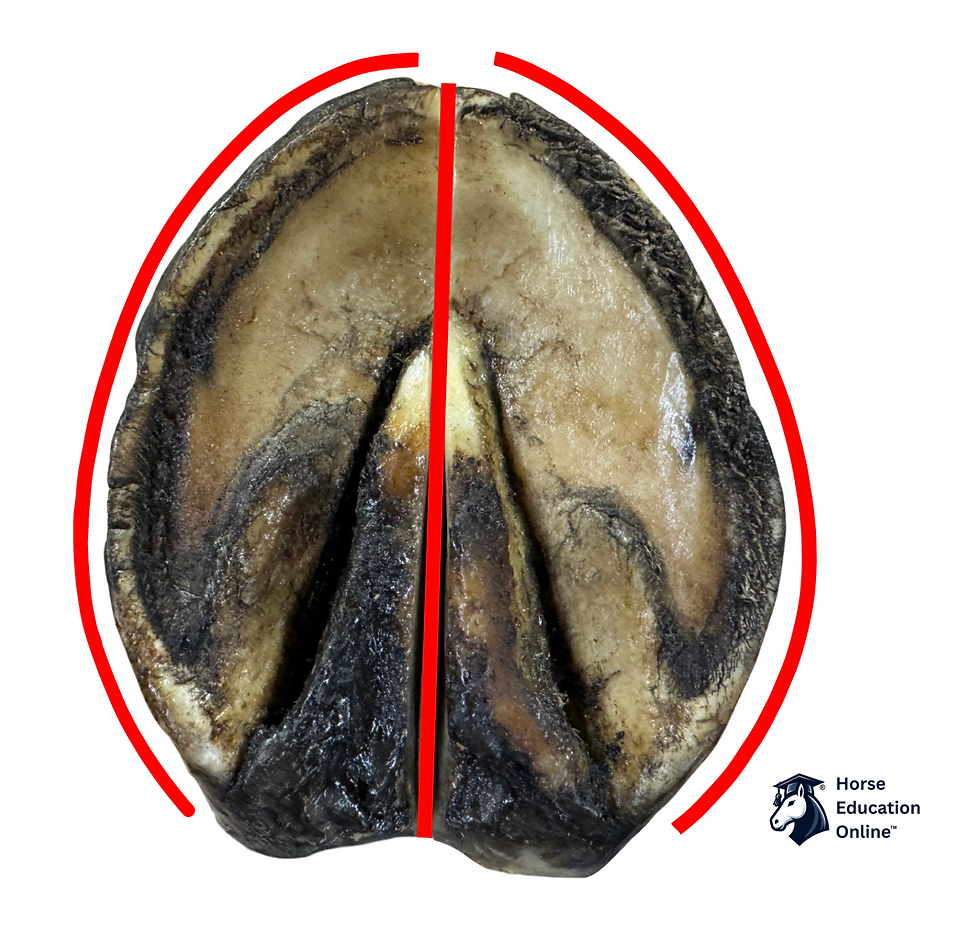
The traditional picture of a balanced hoof is usually neat and symmetrical. The medial and lateral walls are similar in length, the heels appear even, the frog points toward the center of the toe, and the foot seems to land flat. These features may be desirable in some horses, but the scientific literature does not support perfect symmetry as a universal definition of correct hoof balance.

Caldwell and colleagues directly tested commonly taught geometric proportions of hoof balance in cadaver limbs, shod horses, and unshod horses. The researchers assessed relationships involving dorsal hoof wall length, heel position, the center of pressure, the center of rotation, and the bearing border. The proposed geometric equivalence was not consistently present, even after standardized trimming. Widely published measurements and ratios rarely occurred in the sample population.
Measurements still give the farrier and veterinarian objective information, document change, and expose distortion. Symmetry remains one observation among many. Problems arise when a measurement is treated as a universal target without considering the anatomy above the hoof or the way the foot functions during movement.
A visually symmetrical hoof can load abnormally. A hoof that appears mildly asymmetrical may have a repeatable loading pattern that is appropriate for that horse's limb conformation.
Correct assessment requires context.
The picture below shows the front limb conformation of the horse with the visually "symmetrical" hoof shown in Figure 1. The hoof appears symmetrical from the solear perspective despite the base-narrow, toed-out conformation of the animal.

The Beginner's Guide to Equine Conformation explains how the alignment of the entire limb influences movement and hoof wear. For horses with marked differences between the front feet, see Understanding High-Low Syndrome in Horses and Club Foot in the Adult Horse.
Did You Know? A small amount of hoof asymmetry does not automatically indicate poor farriery. Hoof form reflects the horse's conformation, loading, movement, environment, and history. The important question is whether the asymmetry is stable and functional or progressive and associated with abnormal loading, distortion, or pain.
The Anatomy Behind Hoof Balance
The hoof capsule surrounds structures that must accept large forces while supporting the limb and managing impact. These include:
the distal phalanx, commonly called the coffin bone or P3
the middle phalanx, or short pastern bone
the navicular bone
the distal interphalangeal joint, commonly called the coffin joint
the deep digital flexor tendon
collateral ligaments
laminae
the digital cushion
ungual cartilages
the sole, frog, bars, heels, and hoof wall

The hoof capsule cannot be evaluated as though it were separate from these structures. Parks emphasized that hoof form and function must be considered in relation to the entire equine digit. The wall and solar surface are the visible parts of a larger mechanical system.
Trimming the wall changes the ground-bearing surface beneath the bones, joints, tendons, and ligaments of the lower limb.
The hoof capsule grows around the distal phalanx. The orientation of P3, sole depth beneath it, and its relationship to the hoof wall and ground help determine how the foot can be trimmed safely. External landmarks provide clues but cannot show every internal detail. Distortion, unusual conformation, chronic lameness, or previous laminitis may make radiographs valuable.
The coffin joint moves as the foot loads and unloads, and its alignment affects the mechanical relationship among the hoof, pastern, and limb. Learn more in The Coffin Joint: The Hidden Engine Inside the Horse's Hoof and The Pastern Joint: Structure, Function, and Why It Matters.
The deep digital flexor tendon travels down the back of the limb, passes over the navicular region, and inserts on the solar surface of P3. Changes in hoof angle, heel elevation, toe length, and breakover can alter the mechanical demands placed on this tendon and the structures around the navicular bone. For a deeper discussion of this region, see Navicular: The Current Consensus.
Static Hoof Balance
Static balance describes the hoof and distal limb while the horse is standing. It is usually the first part of the assessment because the farrier can examine the foot from the front, side, behind, and solear surface before watching the horse move.
Important components of static balance include:
Dorsopalmar or dorsoplantar alignment: the front-to-back relationship of the foot. Dorsopalmar applies to a forefoot, while dorsoplantar applies to a hind foot.

Mediolateral alignment: the relationship between the medial, or inside, and lateral, or outside, portions of the foot and limb.

Hoof-pastern alignment: the relationship between the dorsal hoof wall and the pastern.

Hoof wall angles: there is no standard hoof wall angle.
Hoof wall lengths: there is no standard length. Appropriate length is dependent on the size and weight of the horse.
Heel height and position: including whether the heel tubules are reasonably straight, folded forward, crushed, migrated, or markedly different from one side to the other.

Solar proportions: including the position of the frog, bars, sole, white line, widest part of the foot, and bearing border.
Internal alignment: including the orientation of P3 and the joints of the distal limb when radiographs are available.

The horse's stance: because the position of the limb changes the apparent alignment seen from outside and on a radiograph.
Static examination may identify flares, dishing, mismatched heel heights, sheared heels, a stretched white line, cracks, uneven growth, a long toe, or heels that have migrated forward.
Each finding needs interpretation. A flare may reflect leverage, uneven loading, laminar stretching, old injury, or conformation. A high heel may be excess horn, part of an upright foot, or a contracture pattern. Removing material merely to make the sides look alike can create a new imbalance if the internal structures do not support the change.
Stance Can Change What a Radiograph Appears to Show
Radiographs can provide valuable information about the position of P3, sole depth, joint alignment, hoof wall relationships, and the distribution of hoof capsule around the bone.
They are most useful when taken with careful positioning and consistent technique.
Pauwels and colleagues demonstrated that radiographic measurements of hoof-pastern and distal limb alignment were significantly influenced by how the horse stood during imaging. The apparent hoof-pastern angle had a strong relationship with limb position. A foot placed farther forward or back can therefore make an alignment appear different without any change to the hoof itself.
This is why standardized positioning matters when radiographs are used to compare feet or monitor change over time. The beam angle, limb placement, foot blocks, calibration marker, and weight-bearing posture should be as consistent as possible. A single image still needs to be interpreted alongside the clinical examination, hoof morphology, and movement.
Did You Know? The hoof does not have to change for its radiographic angles to look different. Moving the limb forward or backward during imaging can alter apparent hoof-pastern and joint relationships. Consistent positioning is essential when comparing radiographs taken at different times.
Dynamic Hoof Balance
Dynamic balance describes what happens when the horse moves. This is the functional side of hoof balance and the reason a foot cannot be judged from a photograph alone.
During a stride, the hoof passes through several phases:
Approach and impact: the hoof travels toward the ground and makes initial contact.
Loading: more of the foot contacts the surface as force rises.
Midstance: the limb accepts substantial vertical load while the horse's body moves over it.
Unloading: force decreases and the heels begin to leave the ground.
Breakover: the foot rotates over its forward bearing area.
Toe-off: the hoof leaves the surface and enters the swing phase.


Force distribution changes throughout this sequence. The toe, heels, medial and lateral sides, frog, wall, and sole do not carry the same percentage of load at every instant.
Dynamic assessment considers:
which part of the hoof contacts the ground first
whether the landing pattern is repeatable
how quickly the rest of the foot loads
how force is distributed between toe and heel
how force is distributed between medial and lateral regions
the path of the center of pressure during stance
when the heels unload
where and how the hoof breaks over
whether the movement changes with speed, direction, or footing
whether the horse appears comfortable and symmetrical in its overall gait
Pressure plates, force plates, instrumented shoes, high-speed video, and hoof-mounted sensors measure parts of this process. In practice, farriers and owners rely on observation, slow-motion video, wear, growth, palpation, and comfort. These tools cannot reproduce a laboratory, but they can expose repeatable patterns and changes.
The Evidence-Based Shoeing in Healthy Feet article provides a broader explanation of impact, ground reaction forces, center of pressure, and shoeing mechanics. The Understanding Gait Faults in Horses guide helps separate a hoof-loading observation from a gait fault or interference pattern.
Understanding the Center of Pressure
The center of pressure, commonly abbreviated CoP or COP, is one of the most useful scientific concepts in hoof balance. It represents the effective location of the combined ground reaction force beneath the hoof at a particular instant.
The center of pressure is not a fixed anatomical point. It moves as different areas of the hoof accept and release load. The path it follows during stance is sometimes called the center-of-pressure trajectory.
Van Heel and colleagues studied 18 horses with a high-resolution pressure-measurement system before and after trimming. The horses commonly landed laterally. Their center of pressure moved toward a maximum lateral deviation and then returned toward the dorsopalmar or dorsoplantar axis as the hoof progressed through stance. Individual horses also showed characteristic unloading patterns.

A balanced hoof does not necessarily maintain equal pressure on the medial and lateral sides at every instant. Normal locomotion moves force across the foot. The goal is not to hold the center of pressure in the geometric center.
At the same time, large or persistent displacement can be important. A long wall, wedge, distorted heel, unusual conformation, painful structure, or compensatory gait may change where force is applied. The significance depends on the size, timing, duration, repeatability, and clinical context of that change.
Did You Know? The center of pressure travels across the hoof during every stance phase. A pressure map is therefore a moving record, not a single dot that should remain in the middle of the foot.
Mediolateral Hoof Balance
Mediolateral balance concerns the relationship between the inside and outside of the foot. Traditionally, this has often been reduced to two expectations: both heels should contact the ground simultaneously, and both sides should carry equal load. Research in sound horses shows that the real pattern is more complicated.
In the van Heel study, lateral-first landings were common in both front and hind feet. Trimming changed some measures of asymmetry, but it did not erase each horse's characteristic pattern. Oosterlinck and colleagues also found that sound sport horses did not distribute vertical force equally between the medial and lateral halves throughout the entire stance. At the walk, the seven horses studied showed greater lateral loading through much of stance. At the trot, patterns differed between limbs and changed during different parts of stance.
These findings do not prove that every lateral landing is normal. They show that a slightly lateral landing cannot be labeled abnormal without further evidence. Consider:
the horse's limb conformation
the severity of the landing difference
how rapidly the hoof becomes fully loaded
whether the pattern is consistent from stride to stride
whether the pattern is similar in both directions
wall growth and wear between farrier visits
distortion such as flares, sheared heels, or cracks
signs of pain or lameness
the effect of circles, speed, and footing
A mild, repeatable lateral-first landing in a sound horse may be compatible with normal function. A forceful one-sided landing with progressive distortion, shortened stride, pain, or an abrupt change deserves closer attention.
A toed-in, toed-out, base-wide, or base-narrow limb does not approach the ground like a theoretically straight limb. Forcing every foot into a predetermined plane can move the ground surface away from an alignment the joints and bones can comfortably accommodate.
The trim must be based on the live foot rather than one isolated rule. The farrier assesses wall height, sole plane, frog position, heel structure, limb alignment, landing, and the horse's response. Pathology or significant lameness may require veterinary examination and imaging before substantial changes are made.
Progressive cracks and distortion can provide evidence of abnormal mechanical stress. See Quarter Cracks in Horses: Causes, Treatment, and Prevention and White Line Disease in Horses for related conditions that require more than a simple visual assessment of balance.
Dorsopalmar and Dorsoplantar Hoof Balance
Dorsopalmar balance describes the front-to-back relationship in a forefoot. Dorsoplantar balance is the corresponding term for a hind foot.
This part of balance is often discussed as toe length compared with heel length, but the complete assessment includes much more:
dorsal hoof wall angle and length
heel height, position, and integrity
hoof-pastern alignment
orientation of P3
sole depth beneath P3
the position of the ground-bearing surface beneath the distal limb
toe-to-heel pressure distribution
timing of heel unloading
center-of-pressure progression
the location and duration of breakover
A long toe and underrun heel can increase the forward lever in front of the distal interphalangeal joint. An upright foot has a different mechanical relationship and may require a different approach. Neither can be managed responsibly by chasing one external angle while ignoring sole depth, heel structure, internal alignment, and the individual horse.
Heel height and heel support are related but not identical. A heel may appear low because it is worn, crushed, or migrated forward. Leaving more horn does not necessarily move the functional support backward. Lowering an upright heel merely to match the opposite foot may remove needed structure.
Dorsopalmar or dorsoplantar balance is therefore a relationship, not a toe-to-heel ratio. The farrier is trying to place the ground-bearing surface in a mechanically appropriate relationship with the internal foot and limb while preserving healthy tissue.
What Happens When Hoof Balance Is Deliberately Changed?
Experimental studies provide strong evidence that changing the geometry beneath the hoof changes loading.
Wilson and colleagues attached wedges to modified shoes to elevate one portion of the front feet in eight Thoroughbred-type horses. Altering mediolateral balance displaced the point of force application approximately 10 millimeters toward the elevated side. The horses did not fully compensate by moving the load elsewhere. Heel elevation delayed heel unloading, while toe elevation caused earlier heel unloading.
The study involved an acute, deliberately created imbalance and should not be treated as a direct model of every naturally occurring hoof asymmetry. Its central mechanical lesson is still important: changing the surface beneath the hoof changes where and when force is applied.
This is why trimming and shoeing are not cosmetic procedures. Removing horn, changing wall height, adding a wedge, moving a shoe, applying an extension, or modifying breakover can alter the mechanical environment of the foot. Those changes may be useful when applied for a clear reason, but every intervention also changes load somewhere.
Shoes add other variables, including weight, stiffness, traction, surface area, and the location of support. For related information, see Why We Shoe Horses, Horseshoes: Understanding Traction, and Bar Shoes: Common Designs and Uses.
Did You Know? In an experimental wedge study, elevating one side of the hoof shifted the point of force application about 10 millimeters toward the elevated side. The horses did not simply cancel the change by redistributing the load across the rest of the foot.
How Trimming Changes Hoof Mechanics
Trimming changes wall length, the bearing border, heel geometry, solar contact, and the relationship between the ground and the internal foot. Even a conservative trim can alter pressure distribution.
In the van Heel study, trimming reduced some left-to-right differences in center-of-pressure movement. More recently, Seery and colleagues evaluated 94 forefeet from 50 sound horses and found measurable changes in solar pressure distribution after one trimming event. Changes in bearing-border length, heel measurements, and center-of-pressure relationships were associated with increased pressure in the frog region.
The visual result matters, but the foot's interaction with the ground is equally important.
A practical assessment therefore includes observations before and after trimming:
limb conformation and stance
the hoof from multiple views
the solar surface
wall growth, wear, and distortion
movement in a straight line
movement on a circle when appropriate
landing and loading on a consistent surface
comfort during turns and transitions
the horse's response in the days and weeks after the trim
Large changes may be poorly tolerated when a hoof has been distorted for a long time or internal structures have adapted to chronic loading. The safe rate of change depends on available horn, sole depth, pathology, and comfort. Some problems require staged correction over several cycles.
The Pacific Coast Horseshoeing School Trimming and Shoeing Guide provides additional practical instruction. Owners can document farrier dates, hoof photographs, shoeing changes, lameness notes, and veterinary findings in the Horse Tracker.
Hoof Balance and Breakover
Breakover is the terminal portion of stance during which the heels have unloaded and the foot rotates toward toe-off. It is influenced by the hoof, the horse, and the ground. Toe length, hoof angle, shoe position, shoe design, gait, speed, conformation, and surface can all affect its timing and duration.
Hagen and colleagues studied sound horses with hoof-mounted inertial sensors. Heel elevation shortened breakover duration in their experimental conditions. A plain steel shoe increased breakover duration at the walk, while rolling the toe or positioning the shoe farther palmarly reduced that effect.
Farriery can modify breakover, but breakover alone cannot define the entire foot. A hoof can have a short breakover lever and still have poor heel structure, inadequate sole depth, abnormal mediolateral loading, or pain. The intervention must fit the horse's anatomy and clinical needs.
Breakover should also be distinguished from the center of pressure. The center of pressure moves throughout the stance phase. Breakover describes the late-stance rotation and departure of the foot. The two are mechanically related, but they are not interchangeable terms.
For a full explanation, read What Is Breakover? A Deep Dive. The article When to Apply a Rocker-Toe Horseshoe discusses one shoe modification used to alter the breakover environment.
Did You Know? Breakover is a phase of the stride, not a single permanent point painted on the hoof. The part of the foot that provides the final pivot may vary with direction, gait, wear, shoe design, and the surface beneath the horse.
The Surface Changes How the Same Hoof Loads
Hoof balance is partly a hoof-ground interaction. The same hoof can produce different pressure patterns on hard and deformable surfaces.
Oosterlinck and colleagues compared five sound, unshod ponies on a hard pressure-plate setup and on the same plate covered with arena material. On the softer surface, peak vertical force, vertical impulse, peak pressure, and stance duration decreased, while hoof contact area increased. Toe-to-heel and mediolateral loading at impact also changed.
This preliminary study had a small sample, so its findings should not be generalized to every horse or arena. It still demonstrates that pressure distribution measured on one surface does not describe everything the hoof will do on another.
Hard surfaces make the landing easier to see and film because the foot does not sink into the footing. Deformable surfaces may allow the hoof to settle, rotate, and gain contact differently. Deep, loose, inconsistent, slippery, or excessively firm footing can each change loading and traction.
Movement comparisons are most useful on the same surface, at the same gait, from the same angle, and under similar conditions. A change seen only on different footing may reflect the surface rather than a sudden change in hoof shape.
What Does a Scientifically Balanced Hoof Look Like?
Science does not provide one exact shape that applies to every horse. A scientifically defensible assessment looks for a functional relationship among hoof form, internal anatomy, limb alignment, movement, and comfort.
Area assessed | Practical scientific interpretation |
Hoof capsule | Appropriate for the horse's individual limb conformation, without uncontrolled or progressive distortion |
Medial-lateral relationship | Avoids excessive or clinically important asymmetric loading; does not require identical loading at every instant |
Toe-heel relationship | Provides mechanically appropriate dorsopalmar or dorsoplantar support and loading |
Distal limb alignment | Compatible with the underlying skeletal conformation and assessed with standardized positioning when radiographs are used |
Landing | Repeatable and appropriate for the individual; not required to be perfectly flat in every sound horse |
Center of pressure | Progresses through the hoof during stance without evidence that severe displacement is creating harmful overload |
Breakover | Allows the foot to leave the ground without an unnecessarily adverse lever or poorly timed restriction |
Hoof structures | Retain enough healthy wall, sole, frog, heel, and supporting tissue to accept expected forces |
Horse | Remains comfortable, sound, and able to perform the intended work |
This approach does not abandon measurements or standards. It uses them in context. A hoof angle, heel-to-toe proportion, sole depth, or landing pattern becomes meaningful when it is connected to the rest of the horse.
What Hoof Balance Does Not Automatically Mean
Current evidence does not support automatically equating correct hoof balance with:
perfectly identical medial and lateral hoof walls
a perfectly flat landing in every horse
simultaneous contact of every part of the ground surface
exactly 50:50 medial-to-lateral loading
exactly 50:50 toe-to-heel loading
making both front feet identical
one prescribed toe-to-heel ratio
one external landmark applied as the trimming target for every horse
forcing every hoof into the same geometric model
Normal horses show individual variation. That variation should not be used to dismiss obvious distortion or lameness, but it does prevent one ideal drawing from serving as the definition of balance for the entire species.
A Practical Hoof-Balance Assessment
Owners should not remove hoof material to diagnose or correct balance, but they can provide useful observations to the farrier and veterinarian.
Start with the whole horse. Observe posture, limb conformation, muscle symmetry, stance, and weight shifting. A horse that habitually places one foot forward may make that hoof look different and may be protecting a painful structure.
Compare each foot with its history. Compare opposite feet, but do not assume they should be identical. Monthly photographs from consistent angles show whether a flare, heel difference, or hoof angle is stable or changing.
Use several views. Examine the foot from the front, side, behind the heel bulbs, and across the solar surface. Look at wear, growth rings, wall direction, heel position, frog, white line, cracks, and nail holes.
Watch several strides. On a safe, firm, nonslip surface, watch the horse walk and trot toward you, away, and from the side. Slow-motion video can help, but the complete loading sequence matters more than one frame.
Keep conditions consistent. Circles change limb loading, and soft footing can hide first contact. Comparisons are clearer at the same gait, on the same surface, and from the same camera position.
Review the whole farrier cycle. A finished foot is one point in time. Rapid flare, heel migration, cracking, or lost comfort before the next visit may indicate that the interval or plan needs adjustment.
Put comfort first. Movement, stride length, willingness to turn, stumbling, and post-farriery comfort matter. A visually improved hoof is not a successful result if the horse becomes sore.
The Hoof Triage Toolkit can help owners organize observations when a hoof problem appears. It does not replace a veterinarian or farrier, especially when the horse is acutely lame.
When Hoof Imbalance May Require Veterinary Investigation
Call the veterinarian when hoof asymmetry or a change in landing is accompanied by:
sudden or significant lameness
reluctance to bear weight
increased digital pulse or hoof heat
swelling above the hoof
pain during turns
repeated stumbling or a sudden shortening of stride
a new, forceful, or inconsistent landing pattern
a deep or unstable hoof crack
drainage, separation, or suspected infection
persistent soreness after trimming or shoeing
rapid hoof distortion or suspected laminitis
The Comprehensive Guide to Equine Lameness explains the veterinary assessment process. For common foot-related and other causes, see The 10 Most Common Causes of Lameness in Pleasure Horses.
Hoof balance may contribute to the mechanical environment surrounding an injury, but it should not be blamed for every lameness. Pain elsewhere in the limb or body can change the way a horse loads the hoof. In those cases, the altered landing or hoof wear may be a result of compensation rather than the original cause.
What the Evidence Can and Cannot Tell Us
There is good experimental evidence that altering hoof geometry changes the location and timing of force beneath the foot. Pressure-measurement studies also show that trimming can change center-of-pressure patterns and solear pressure distribution. Research in sound horses demonstrates that lateral-first landings and unequal mediolateral loading can occur without obvious lameness. Surface studies confirm that footing changes hoof contact and pressure patterns.
The evidence is weaker for claims that one external landmark, hoof proportion, or trimming formula identifies ideal balance in every horse. Caldwell and colleagues directly challenged the universal application of commonly proposed geometric relationships.
Important limitations include:
many biomechanical studies include small numbers of horses
studies may involve only sound horses or one type of horse
an acute experimental wedge is not identical to chronic natural distortion
pressure plates measure selected aspects of force and contact, not the health of every internal structure
laboratory surfaces do not represent every arena, trail, or working environment
group averages can hide meaningful individual variation
an association between a hoof measurement and pressure change does not prove that the measurement caused injury
These limits show how carefully the research should be applied. The strongest approach combines published evidence with anatomy, clinical examination, history, work, footing, and response over time.
Did You Know? “Normal” in a research paper often describes the average or range found in a particular study group. It does not mean that every sound horse will reproduce the same landing, pressure pattern, or hoof proportion.
The Most Defensible Scientific Definition of Hoof Balance
Equine hoof balance is the condition in which the hoof's external shape, internal anatomical alignment, ground-contact surface, and dynamic loading pattern work with the horse's individual limb conformation so that ground reaction forces are accepted, distributed, and released without unnecessary mechanical stress.
This definition deliberately does not require perfect symmetry. It recognizes that the foot must be judged as part of the limb and as part of a moving horse. A balanced trim or shoeing plan respects healthy tissue, internal anatomy, conformation, movement, intended work, and the horse's response.
The final standard is functional. The hoof should support a comfortable horse, maintain appropriate relationships through the distal limb, and manage the forces of weight bearing and locomotion without creating avoidable overload.
Further Horse Education Online Resources
Readers who want to continue studying hoof balance, anatomy, conformation, and lameness may find these resources useful:
Frequently Asked Questions About Hoof Balance
1. What does hoof balance mean in a horse?
Hoof balance describes the relationship among the hoof's shape, internal structures, lower-limb alignment, ground surface, and loading during movement. It includes static balance while standing and dynamic balance while the hoof lands, bears weight, breaks over, and leaves the ground.
2. Does a balanced hoof have to be perfectly symmetrical?
No. Symmetry is useful to assess, but research does not support perfect geometric symmetry as a universal requirement. A mildly asymmetrical hoof may function normally for an individual horse, while a symmetrical-looking hoof may load abnormally. Progressive asymmetry, distortion, pain, or lameness still requires investigation.
3. Should a horse always land perfectly flat?
No. Studies of sound horses have documented lateral-first landings. The importance of a landing pattern depends on its severity, repeatability, the speed at which the hoof loads, the horse's conformation, the surface, and whether pain or distortion is present. A forceful or newly altered landing is more concerning than a mild, stable pattern.
4. What is mediolateral hoof balance?
Mediolateral balance concerns the inside-to-outside relationship of the hoof and distal limb. It includes wall height, heel position, limb alignment, landing, and force distribution. Correct mediolateral balance does not require an exact 50:50 load split at every moment of stance.
5. What is dorsopalmar hoof balance?
Dorsopalmar balance describes the front-to-back relationship of a forefoot. The corresponding term for a hind foot is dorsoplantar balance. It includes toe length, heel position, hoof angle, hoof-pastern alignment, P3 orientation, sole depth, breakover, and toe-to-heel loading.
6. What is the center of pressure in the hoof?
The center of pressure is the effective point beneath the hoof where the combined ground reaction force acts at a particular instant. It moves throughout the stance phase as the hoof lands, loads, and unloads. It should not be confused with one permanent anatomical landmark.
7. Can trimming change the way a hoof loads?
Yes. Research has shown measurable changes in center-of-pressure movement and solar pressure distribution after trimming. The effect depends on what material is removed, the resulting bearing border and heel geometry, the horse's anatomy, and the surface beneath the hoof.
8. Is faster breakover always better?
No. Breakover can be modified through trimming, shoe placement, shoe design, and hoof angle, but shortening it excessively is not automatically beneficial. The appropriate breakover environment depends on internal anatomy, heel support, conformation, soundness, gait, and the horse's clinical needs.
9. Can hoof imbalance cause lameness?
Abnormal loading can alter forces through the hoof and distal limb and may contribute to tissue overload or aggravate an existing condition. Hoof imbalance should not be assumed to be the cause of every lameness. Pain elsewhere can also change landing and wear, making hoof asymmetry a result of compensation.
10. How can an owner tell whether a hoof is balanced?
An owner can monitor photographs, growth, wear, cracks, landing, stride, comfort, and changes through the farrier cycle. A complete evaluation requires the farrier to assess the live foot, limb alignment, solar surface, and movement. Veterinary examination and radiographs may be needed when there is lameness, significant distortion, unusual conformation, or suspected internal pathology.
11. When should I call a veterinarian about hoof balance?
Contact your veterinarian if changes in hoof shape or landing occur with lameness, persistent soreness after farriery, repeated stumbling, or rapid distortion. Sudden severe lameness, reluctance to bear weight, or suspected laminitis needs prompt veterinary attention. Avoid assuming that trimming alone will resolve the problem; pain elsewhere in the limb can also change how a horse loads its feet.
Peer-Reviewed References
Parks AH. Form and function of the equine digit. Veterinary Clinics of North America: Equine Practice. 2003;19(2):285-307. https://doi.org/10.1016/S0749-0739(03)00018-X
Wilson AM, Seelig TJ, Shield RA, Silverman BW. The effect of foot imbalance on point of force application in the horse. Equine Veterinary Journal. 1998;30(6):540-545. https://doi.org/10.1111/j.2042-3306.1998.tb04531.x
van Heel MCV, Barneveld A, van Weeren PR, Back W. Dynamic pressure measurements for the detailed study of hoof balance: the effect of trimming. Equine Veterinary Journal. 2004;36(8):778-782. https://doi.org/10.2746/0425164044847993
Oosterlinck M, Hardeman LC, van der Meij BR, et al. Pressure plate analysis of toe-heel and medio-lateral hoof balance at the walk and trot in sound sport horses. The Veterinary Journal. 2013;198(Suppl 1). https://doi.org/10.1016/j.tvjl.2013.09.026
Oosterlinck M, Royaux E, Back W, Pille F. A preliminary study on pressure-plate evaluation of forelimb toe-heel and mediolateral hoof balance on a hard versus soft surface in sound ponies at the walk and trot. Equine Veterinary Journal. 2014;46(6):751-755. https://doi.org/10.1111/evj.12210
Caldwell MN, Allan LA, Pinchbeck GL, Clegg PD, Kissick KE, Milner PI. A test of the universal applicability of a commonly used principle of hoof balance. The Veterinary Journal. 2016;207:169-176. https://doi.org/10.1016/j.tvjl.2015.10.003
Pauwels FE, Rogers CW, Wharton H, Flemming H, Wightman PF, Green RW. Radiographic measurements of hoof balance are significantly influenced by a horse's stance. Veterinary Radiology & Ultrasound. 2017;58(1):10-17. https://doi.org/10.1111/vru.12443
Bras R, Morrison S. Mechanical principles of the equine foot. Veterinary Clinics of North America: Equine Practice. 2021;37(3):581-618. https://doi.org/10.1016/j.cveq.2021.09.001
Hagen J, Bos R, Brouwer J, Lux S, Jung FT. Influence of trimming, hoof angle and shoeing on breakover duration in sound horses examined with hoof-mounted inertial sensors. Veterinary Record. 2021;189(4). https://doi.org/10.1002/vetr.450
Seery S, Gardiner J, Bates KT, et al. Changes in pressure distribution of the solar surface after a single trimming event are associated with external hoof measurements in the equine fore foot. Equine Veterinary Journal. 2025;57(5):1255-1264. https://doi.org/10.1111/evj.14463
This article is intended for education and does not replace examination or treatment by a veterinarian or qualified farrier.


Comments